
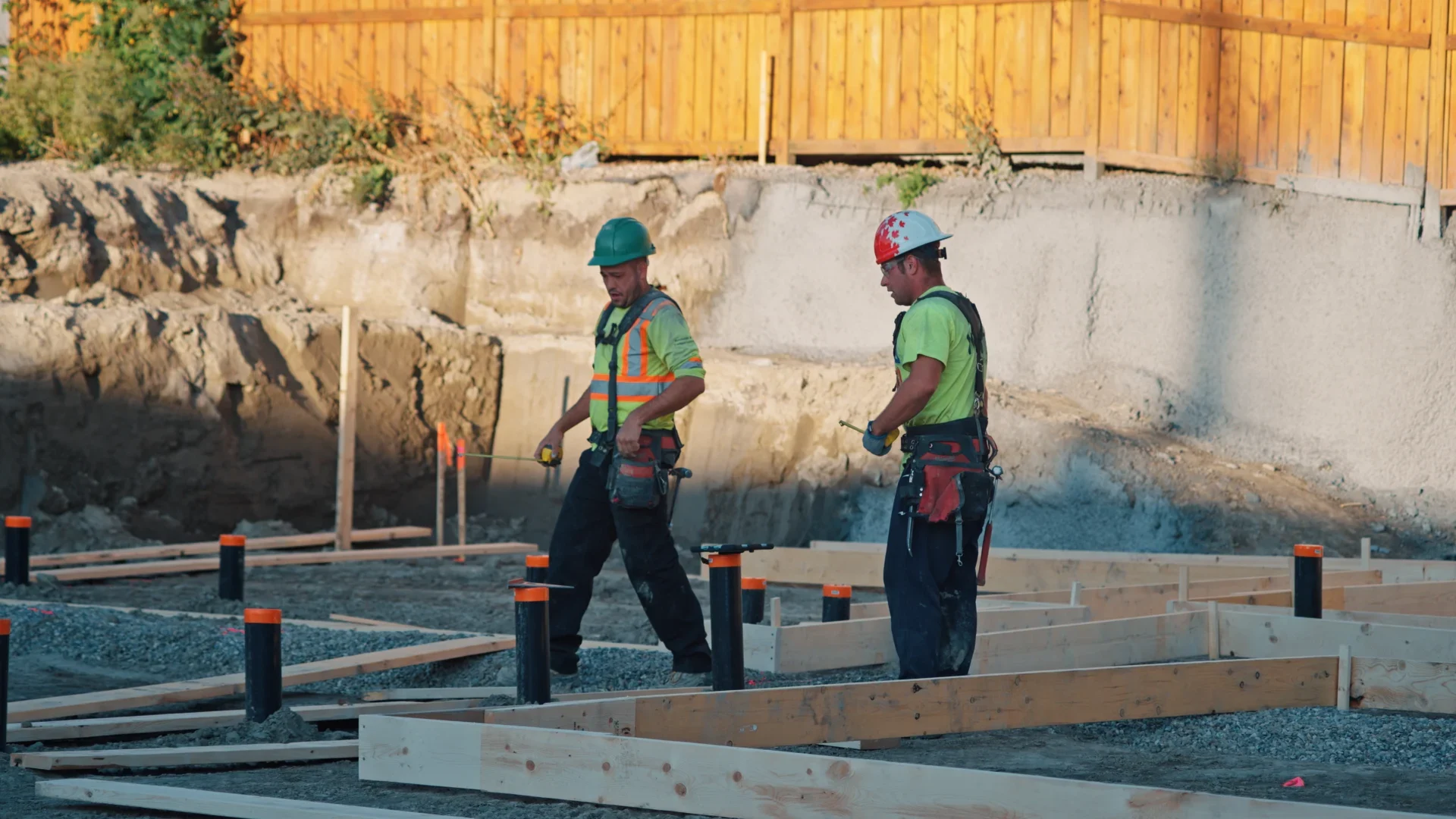
Yes — most foundation cracks in a Calgary home are normal. The majority are thin, vertical shrinkage cracks from concrete curing, made near-universal here by expansive clay soil and roughly 128 freeze-thaw cycles a year. The cracks that warrant a professional are horizontal cracks, any crack wider than about 6 mm (1/4″), and any crack that is actively growing or letting water in. Alberta’s New Home Warranty is explicit that a foundation crack on its own is not a structural defect.
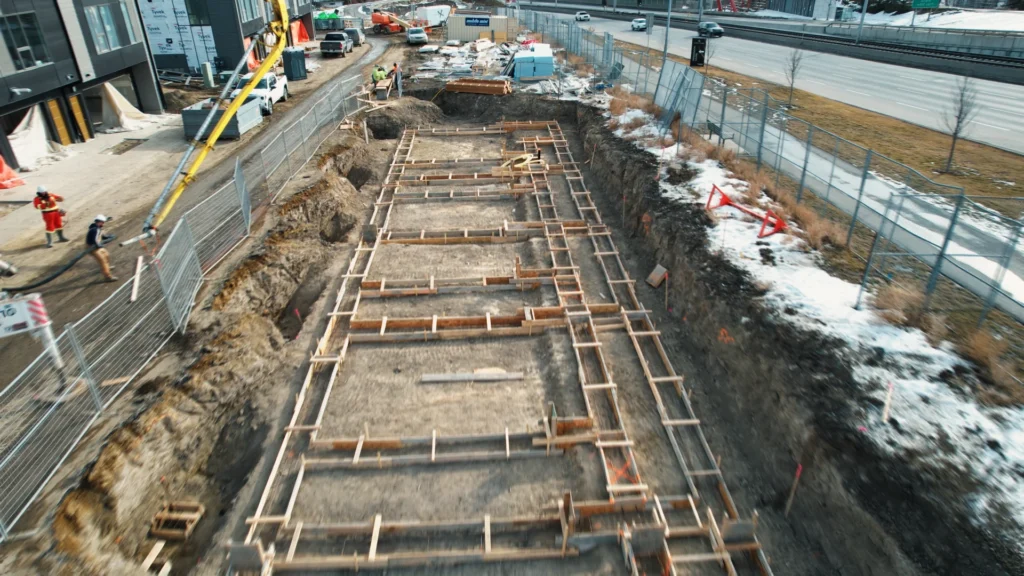
Why are foundation cracks so common in Calgary?
If you’ve owned a Calgary home for more than two or three winters, you’ve almost certainly seen a foundation crack. That’s not bad luck — it’s the ground. Three local realities make cracking close to universal here:
- Expansive clay soil. Calgary sits on clay derived from the Bearpaw Formation that swells when wet and shrinks when dry. That seasonal volume change presses against — and pulls away from — your foundation walls every year.
- Roughly 128 freeze-thaw cycles a year. Water trapped in concrete pores freezes, expands about 9% in volume, and works micro-cracks open from the surface inward. Calgary’s chinooks make this worse: a 20–30 °C temperature swing in a single day drives more freeze-thaw transitions than the steady deep cold of Edmonton or Winnipeg. (Source: City of Calgary Climate Hazards 2022 Year in Review.)
- Concrete shrinks as it cures. Every wall loses a little volume in its first months. That shrinkage finds the path of least resistance and shows up as a thin vertical line.
So the useful question is never “do I have a crack?” It’s “which kind of crack do I have?” — because the pattern, not the panic, tells you whether you’re looking at cosmetic movement or something a structural engineer should see.
We’ve poured the foundation under roughly 1 in 10 Calgary low-rise homes since 1988, which means we’ve watched what Calgary clay and chinooks do to residential concrete for decades. Here’s the honest triage.
What size foundation crack is serious?
Width is the single most informative thing about a crack. These thresholds come from inspector field practice (not a building code — don’t let anyone quote them to you as one), and we’ve paired every figure with millimetres so you can actually measure it:
| Crack width | What it usually means | What to do |
|---|---|---|
| Under ~1.5 mm (1/16″) | Hairline shrinkage or cure cracking | Monitor. Usually cosmetic. |
| ~1.5–3 mm (1/16–1/8″) | Minor settlement | Watch for growth or water; have it assessed if either appears. |
| Over ~3 mm (1/8″) | Worth a professional look | Get it assessed. |
| Over ~6 mm (1/4″), OR any horizontal crack, OR a crack that’s growing or admitting water | Possible structural issue | Call a professional now. |
A simple field rule the home inspectors use: if a crack is wider than a pinky finger or you can slide a credit card into it, stop monitoring and start measuring properly. (Thresholds corroborated by ThisOldHouse and Basement Repair Specialists, and by Calgary inspectors NexLevel and TrueYe.)
The four crack types every Calgary homeowner should recognize
Type 1: Hairline vertical cracks — usually shrinkage, least concerning
Look like: thin vertical lines, typically under 1.5 mm, running top-to-bottom. Often appear in the first 6–24 months after the pour.
Mean: the concrete shrank as it cured and the wall relieved that stress. Even a properly air-entrained, sulphate-resistant Calgary wall develops some hairline shrinkage cracking — it is not a sign of bad workmanship or sub-spec material.
When to worry: generally don’t. Hairline cracks under ~1.5 mm rarely admit water or affect structure. Mark them, and only escalate if they widen over the years or start leaking.
Type 2: Wider vertical cracks — sometimes settlement, moderate concern
Look like: vertical cracks ~1.5–3 mm wide, sometimes tapering top-to-bottom, occasionally with a matching drywall crack above on the interior.
Mean: part of the home has settled slightly. Some settlement is expected in a home’s first 2–5 years; ongoing movement after that warrants a look. Calgary’s expansive clay makes settlement cracking more common than in markets with stable bedrock or sand, and poor drainage amplifies it.
When to worry: if it’s growing year over year, admitting water, or paired with sticking doors/windows or sloping floors, get a structural assessment. A wide vertical crack that hasn’t moved in 5+ years and stays dry is usually a repair candidate, not a replacement one.
Type 3: Horizontal cracks — often structural, high concern
Look like: a horizontal line, often about mid-height on the wall or at the footing-to-wall joint, sometimes running most of the wall’s length.
Mean: lateral pressure on the wall has exceeded its tensile strength — most often hydrostatic pressure from saturated soil, or Calgary’s clay swelling against the wall as moisture changes seasonally. (Source: Basement Repair Specialists on structural vs. hairline cracks.)
When to worry: yes — get a structural engineer’s assessment. Not every horizontal crack is an emergency, but this is not a pattern to monitor casually. An engineer can tell you whether the wall has lost capacity, whether the cracking is active or stable, and what repair fits — anything from carbon-fibre straps to exterior excavation and waterproofing.
Type 4: Diagonal or stair-step cracks — soil-movement, moderate-to-high concern
Look like: cracks at a 30–60° angle, or following block mortar joints in a stair-step, often at corners or near window/door openings.
Mean: part of the foundation has rotated or shifted — uneven settlement, soil washout under a footing, or pressure at one corner. Older foundations (pre-1980s) with shallower footings or non-air-entrained concrete are more prone to this.
When to worry: get a structural assessment. Diagonal movement is often progressive until the underlying cause (drainage, soil support, frost protection) is corrected.
How do I tell a shrinkage crack from a settlement crack? (the 5-step diagnostic)
Before you call anyone, run this quick check.
Step 1 — Measure the width. Use a feeler gauge, a crack-monitoring card, or a precise ruler. Under 1.5 mm = hairline; 1.5–3 mm = moderate; 3 mm+ = wide.
Step 2 — Identify the direction. Vertical, horizontal, diagonal, or stair-step. Direction maps to the mechanism (shrinkage, settlement, lateral pressure, soil movement) more reliably than anything else.
Step 3 — Check for water. Watch the crack during heavy rain or spring melt. Does water track through? Is there efflorescence (a whitish mineral crust) signalling past flow? Water-admitting cracks are higher priority regardless of width.
Step 4 — Check for growth. Pencil-mark and date each end of the crack. Re-check at 3, 6, and 12 months. Cracks that grow are active; cracks that hold are stable.
Step 5 — Look above. Drywall cracks, sticking doors and windows, sloping floors, or gaps at baseboards mean movement is reaching the structure above — which raises the priority on the diagnosis below.
Does the Alberta New Home Warranty cover foundation cracks?
This is the single most reassuring fact most homeowners never hear: a foundation crack, by itself, is not a structural defect. Alberta’s New Home Warranty framework states plainly that cracks in the foundation alone are not considered a structural defect. What’s covered is a defect in the load-bearing portions of the home that affects structural integrity — not a hairline shrinkage line. (Source: Alberta New Home Warranty Program (ANHWP); Government of Alberta New Home Warranty overview.)
For new homes inside the warranty period, structural cracking that compromises load-bearing capacity is covered; ordinary shrinkage and minor settlement cracks generally are not. If you’re inside your warranty window and worried, that distinction is exactly what an assessment will clarify.
Why does my Calgary basement keep getting new cracks?
Four local drivers explain most residential cracking. Knowing which apply to your lot helps you prioritize.
- Expansive clay soil. Swells wet, shrinks dry, pushes laterally on the walls. Good drainage buffers the cycle; poor drainage transmits the full swing to the concrete.
- Chinook freeze-thaw. ~128 cycles/year drive surface-in micro-cracking; chinook swings make Calgary’s exposure unusually aggressive.
- Drainage failures (the most preventable). Clogged eavestroughs, flat or back-pitched grading, damaged waterproofing, blocked weeping tile — each lets water pool against the wall and amplify the clay cycle. Most Calgary cracks have a drainage component somewhere in their history.
- Original spec. A Calgary foundation should be poured with Type HS sulphate-resistant cement, 5–7% entrained air, and 32 MPa at 56 days as the CSA A23.1:24 minimum for S-2 soil (35 MPa is the common residential spec). Walls poured with the wrong cement (Type GU) or too little air crack and degrade faster — and pre-1970s foundations predate standard air entrainment entirely. (See our companion piece on Type HS cement.)
When to repair vs. when to replace
Once a crack is diagnosed, the decision is usually straightforward.
Repair candidates (the large majority of Calgary cracks):
- Hairline vertical under 1.5 mm: usually no repair unless leaking.
- Hairline/moderate vertical that leaks: interior polyurethane injection — effective, durable, modest cost, and it seals even under active water pressure.
- Wider vertical (1.5–3 mm), not actively growing: polyurethane or epoxy injection.
- Isolated horizontal or single-corner stair-step crack assessed as stable by an engineer: exterior excavation, waterproofing membrane, possible carbon-fibre strap reinforcement.
Escalate to an engineer before deciding:
- Any horizontal crack longer than ~1 m or wider than ~2 mm.
- Any diagonal crack longer than ~1 m or paired with movement above.
- Any crack measurably growing year over year.
- Any crack with drywall cracking, door/window misalignment, or floor sloping above.
- Any crack on a foundation older than 50 years or with non-air-entrained concrete.
Replacement (rare for Calgary residential): reserved for severe cracking propagated across multiple walls, settlement that has compromised load-bearing capacity, or decades of drainage failure and freeze-thaw decay. Full replacement is uncommon — and the call belongs to the structural engineer, not the homeowner alone and not the repair contractor selling the work.
Can I just seal a foundation crack myself, or do I need an engineer?
It depends entirely on the diagnosis above. A stable, dry-to-slightly-weeping vertical hairline crack is a reasonable candidate for a polyurethane injection kit or a single visit from a repair specialist — no engineer required. But any horizontal crack, any crack with movement above it, and anything growing or wider than ~6 mm should be looked at by a structural engineer before a dollar is spent on repair. The engineer protects you from two failure modes at once: paying to seal a symptom while the cause keeps working, and being talked into a far bigger job than the crack actually needs.
That second risk is real. Foundation repair is a famously trust-poor category. The honest move — and the one we’d want for our own families — is to get the diagnosis from someone who isn’t selling you the repair.
Who does Omega refer for repair?
Straight answer: Omega 2000 Cribbing pours new residential foundations — we don’t do crack repair as a primary service. Calgary has an established repair-specialist ecosystem (Concrack, Wizard Crack Repair, Abalon, Basement Technologies Calgary, Deluxe Concrete, Elite Concrete Restoration, and others) that focuses on diagnosing and fixing existing foundations. For repair, they’re the right call, and we’re happy to point you to the right one for your crack pattern.
Where we add value is upstream: the cracks that never happen are the ones designed out at the spec stage. We’ve poured to Calgary’s full spec — Type HS cement, 5–7% air, 32 MPa-min/35 MPa-typical at 56 days, CSA A23.1:24 — since 1988.
FAQ
Are foundation cracks normal in a Calgary home? Yes. Most are thin vertical shrinkage cracks from curing, made near-universal by Calgary’s expansive clay and ~128 freeze-thaw cycles a year. The minority that matter are horizontal cracks, anything over ~6 mm (1/4″), and anything growing or leaking.
What size foundation crack is serious / when should I worry? Under ~1.5 mm (1/16″) is usually cosmetic. Over ~3 mm (1/8″) deserves a look. Over ~6 mm (1/4″), any horizontal crack, or any crack that’s growing or admitting water means call a professional. Width and direction tell you more than anything else.
Are horizontal foundation cracks always structural? Not always, but they’re the one pattern you should never monitor casually. A horizontal crack signals lateral soil or hydrostatic pressure on the wall and should be assessed by a structural engineer to determine whether it’s active or stable.
Why does my Calgary basement keep getting new cracks? Expansive clay that swells and shrinks seasonally, ~128 freeze-thaw cycles a year, and — most preventably — drainage problems that let water pool against the wall. Poor original spec (wrong cement, too little air) accelerates all of it.
Does the Alberta New Home Warranty cover foundation cracks? A crack on its own is not a structural defect under Alberta’s New Home Warranty. Structural cracking that compromises load-bearing capacity inside the warranty period is covered; ordinary shrinkage and minor settlement cracks generally are not.
How do I tell a shrinkage crack from a settlement crack? Shrinkage cracks are thin, vertical, and appear in the first 6–24 months. Settlement cracks are wider, may taper, and often come with a matching drywall crack above. Mark and date the ends; a crack that grows over months is active and needs a closer look.
Can I inject or seal a foundation crack myself, or do I need an engineer? A stable, mostly-dry vertical hairline crack can be sealed with polyurethane injection without an engineer. Any horizontal crack, any crack with movement above it, and anything growing or over ~6 mm should be assessed by a structural engineer first.
Do hairline cracks in a new build mean the foundation was poured wrong? No. Even properly spec’d, air-entrained, sulphate-resistant Calgary walls develop some hairline shrinkage cracking as they cure. It’s the concrete relieving stress, not evidence of bad work or wrong materials.
Most foundation cracks are normal. The expensive mistakes happen when homeowners misdiagnose them.
If you’re unsure what kind of crack you’re dealing with, reach out. We’ll point you in the right direction — even if the right answer is simply to monitor it.
Talk to the Omega 2000 Cribbing team. We’ll help you understand what you’re looking at, what Calgary soil and freeze-thaw cycles actually do to foundations, and when it’s time to bring in a structural engineer.