

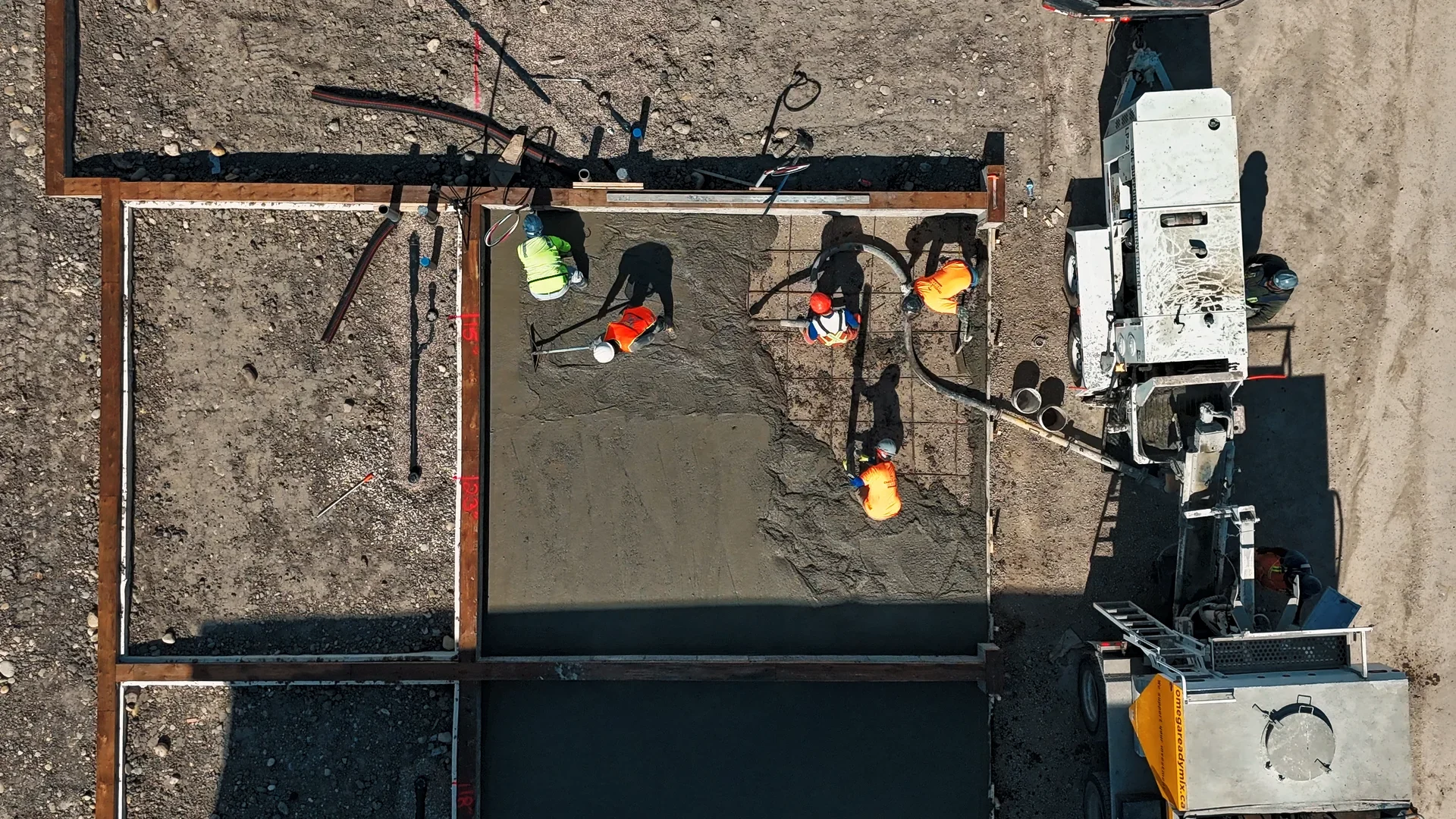
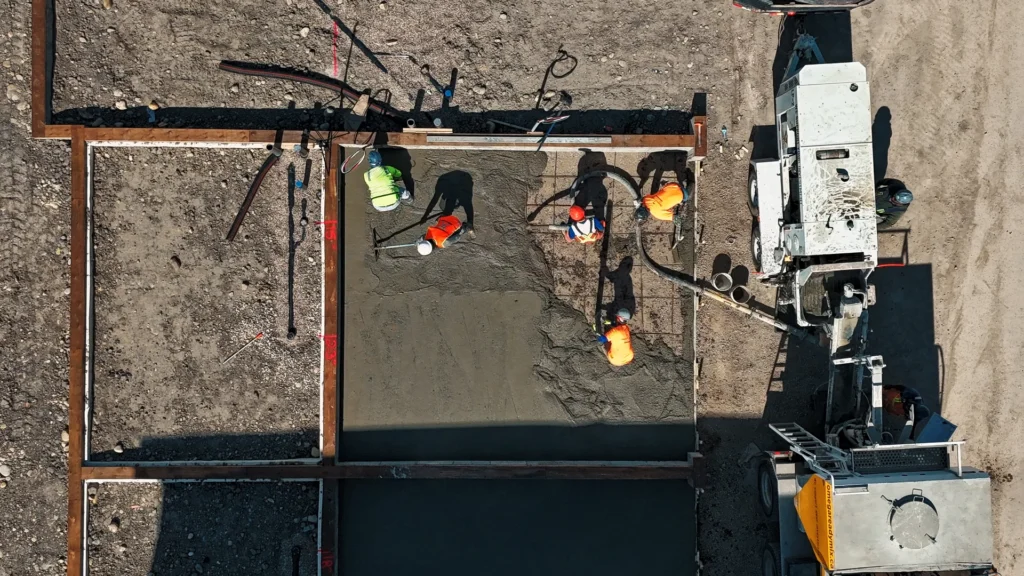
Calgary spec builders have until August 4, 2026, when the R-CG repeal changes setbacks, density caps, and rowhouse rules. Miss any of these 7 foundation decisions — footing geometry, party-wall placement, setback depth, suite load, radon rough-in, geotech, or DP/BP timing — and the cost lands after the excavator leaves.
Foundation errors on narrow infill lots rarely show up as line items on the original quote. They show up as change orders, permit delays, re-digs, and warranty exposure — after the formwork is set and the concrete is placed. The following seven mistakes are the ones Omega 2000 Cribbing, in business since 1988, sees most consistently on Calgary’s inner-city lots in 2026.
1. Why the R-CG Repeal Reshapes Narrow-Lot Foundation Geometry (The New Numbers)
On April 8, 2026, Calgary City Council voted 12-3 to repeal the October 2023 citywide R-CG rezoning. The repeal takes legal effect on August 4, 2026. Between now and that date, three cutoff windows govern permit submissions: May 4, June 6, and July 6, 2026. Projects that miss these windows revert to pre-October 2023 zoning limits.
What does that mean in concrete terms? The R-CG rezoning had expanded rowhouse permissions to mid-block lots and pushed densities toward four units in many configurations. The repeal walks that back. Mid-block rowhouse permissions are proposed to be removed. Density reverts to the previous zoning maximums for those lots. For a spec builder who designed a four-unit rowhouse and sized the continuous footing accordingly, the reversion is not merely a planning inconvenience — it is a structural mismatch between the foundation already permitted or designed and the structure now allowed.
The implication for foundation design is direct: load assumptions, footing widths, and wall-line configurations all trace back to a unit-count and a floor-area target. If the unit count drops after August 4 because the lot is no longer R-CG eligible, a footing designed for four units is oversized at best and re-permittable at worst. Conversely, a builder who assumed the repeal was irrelevant and continued under pre-repeal assumptions without a confirmed grandfathered permit will face a different problem: a foundation that does not match the approved drawings.
The City of Calgary’s planning team has published guidance on the repeal timeline at Calgary’s Housing Strategy. Before any foundation work begins on a narrow infill lot, confirm which zoning rules govern the specific permit — the pre-October 2023 zoning, the R-CG overlay, or a grandfathered application — and design the footing accordingly.
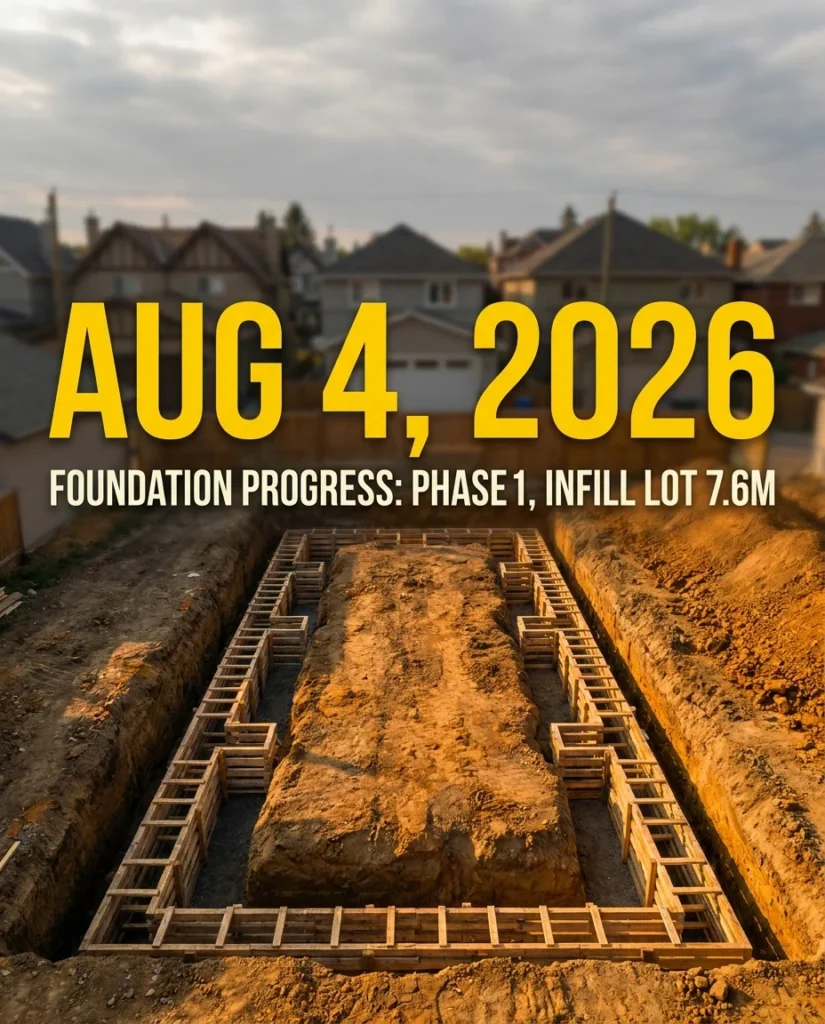
2. Mistake 1 — Sizing the Footing for 4 Units When the Repeal Caps You at 3
This is the most expensive version of the geometry problem. A builder secures a preliminary engineering sketch for a four-unit rowhouse under R-CG rules, goes to tender on the foundation, and starts excavation before the development permit is stamped. The footing design assumes four structural wall lines, four load paths, and four sets of column bearing points in the parkade or crawl space.
After August 4, the lot reverts to a maximum of three units. The structural engineer must now revise the foundation drawings. The revision is not always a simple subtraction — wall lines shift, footing widths adjust, rebar placement changes, and the overall footing plan requires a new APEGA stamp. If cribbing is already set or concrete is already placed, portions of the foundation may need to be modified or removed.
The cost of a footing re-do on a 7.6-metre or 9-metre wide infill lot — after excavation, form setting, and crib mobilisation — ranges from a partial re-form to a full re-dig of the affected bay. Neither scenario is cheap, and neither is covered under a standard new home warranty if the error traces to a design assumption that was not confirmed against the approved permit.
The fix is straightforward: do not issue the foundation tender until the development permit is in hand and the unit count is confirmed in writing. On lots where the grandfathering window is in play, get written confirmation from the City on which cutoff date governs your application before the crib is set.
3. Mistake 2 — Treating Party-Wall Lines as Flexible After August 4
On a narrow rowhouse lot, the party wall sits at a shared property line and the foundation below it carries load from both adjacent units. This is not a negotiable dimension. The footing must be centred on the property line, or the encroachment — however minor — creates a title issue that survives the sale.
The R-CG repeal adds a layer of complexity because some builders designed party walls assuming a mid-block rowhouse configuration that the repeal may no longer permit. If the end unit of what was designed as a four-unit row is now a detached or semi-detached unit under the reverted zoning, the party wall’s legal status changes. A shared foundation wall that carried a contractual and structural relationship between two titled lots does not automatically resolve itself when the planning framework shifts.
APEGA-stamped drawings must reflect the correct property-line position. Any deviation — even 50 mm — from the stamped party-wall position requires a revised drawing before the foundation is accepted by the building inspection. On a 7.6-metre lot with 1.2-metre side setbacks, a 50 mm deviation consumes a meaningful fraction of the available tolerance.
The practical discipline is this: set the crib forms to the stamped drawing dimensions, not to the excavated edge. The excavated edge is a rough cut. The form is the legal dimension. Verify the party-wall form position with a string line and a tape before the concrete truck backs in.
4. Mistake 3 — Skipping the Geotech on a Tight Infill Fill Sequence
Calgary’s inner-city infill lots carry decades of fill history. Previous structures, old services, backfilled basement excavations from the 1950s through the 1980s, and the standard practice of burying demolition debris rather than hauling it all mean that many inner-city lots have inconsistent bearing capacity below the topsoil.
A geotechnical investigation is not a regulatory luxury on a narrow infill lot — it is the document that tells the structural engineer what the footing bears on. Without it, the footing width and depth are guesses. An APEGA engineer of record cannot stamp a foundation drawing without reasonable confidence in the bearing stratum, and on a lot with unknown fill history, that confidence requires soil borings or test pits.
The cost of a two-borehole geotech on a standard 50-foot Calgary infill lot is a fraction of the cost of a foundation that settles differentially after the warranty period begins. Alberta’s New Home Buyer Protection Act (NHBPA) mandates warranty coverage, and a foundation failure that traces to a known geotechnical risk that was not investigated is exactly the kind of claim that leads to warranty disputes between the builder, the warranty provider, and the new homeowner.
On lots with suspected fill — particularly those that previously held older single-family homes with coal chutes, oil tanks, or carriage houses — geotech is not optional. Confirm with the structural engineer whether the site history warrants test pits as well as borings, since borings alone can miss discrete buried obstructions.
5. Mistake 4 — Designing for R-CG Setbacks That Revert on August 4
The R-CG zoning established setback rules that differ from the pre-October 2023 baseline for some lot configurations. A narrow infill lot designed under R-CG setbacks may have a foundation that sits closer to the property line than the reverted rules permit.
After August 4, 2026, if a building permit was not obtained before the applicable grandfathering cutoff, the structure must comply with the reverted setback minimums. A foundation already poured to R-CG setback dimensions on a lot where the grandfathering window closed will require a variance application or, in the worst case, a partial demolition of the affected footing run.
This mistake is particularly common on projects where the architectural drawings were finalised under R-CG rules and the builder assumed the building permit would follow the development permit without a gap. When the DP is approved under R-CG and the BP application crosses the August 4 boundary without a confirmed grandfathering status, the building inspector applies the reverted rules to the BP drawings. If those drawings show a setback that is now non-compliant, the inspector will not issue the permit — and the excavation is already open.
The discipline: confirm the setback rules that govern the BP application, not just the DP application. They are separate processes. The City’s lot grading bylaw also interacts with setback depths on sloped lots, adding another dimension to confirm before the form is set (calgary.ca/water/stormwater/lot-grading-bylaw.html).
6. Mistake 5 — Under-Speccing the Foundation for a Secondary Suite Above Grade
Calgary’s Backyard Suite Incentive provides component-based support — up to $15,000 for construction, up to 40% or $20,000 for underground infrastructure, up to $7,500 for accessibility features, and up to $2,500 for compliance costs. Many spec builders and infill developers are incorporating secondary suites into their narrow-lot designs specifically to capture this incentive and improve project economics.
The foundation error is this: the suite adds occupancy load, structural load, and in some configurations a separate mechanical system. If the foundation was designed for a two-storey single-family occupancy and the permit is subsequently amended to include a secondary suite — whether above grade, in a laneway configuration, or as a garden suite — the load path changes. Concentrated loads from the suite’s bearing walls or columns may land on a footing section that was sized for a lighter load case.
An APEGA structural engineer must review the amended load case before the foundation is approved for the suite occupancy. This is not a checkbox exercise — it requires recalculating the bearing pressure under the new load and confirming the footing width and reinforcement are adequate. On a narrow lot where the footing is already at minimum width to fit within the setback envelope, there may be no room to widen the footing without encroaching on the setback. In that scenario, a grade beam or deepened section may be required.
Note: the federal $80,000 secondary-suite loan referenced in some earlier government communications was cancelled in Budget 2025 and is no longer available. Do not design project financing around that program.
7. Mistake 6 — Omitting the NBC(AE) 2023 Radon Rough-In on a Narrow-Lot Configuration
NBC(AE) 2023 — Alberta’s building code, in force since May 1, 2024 — requires radon rough-in provisions in new residential construction. This requirement has been part of Alberta’s regulatory framework since November 1, 2015, and the 2023 edition maintains and updates it.
On a narrow infill lot, the rough-in is sometimes omitted when the builder treats the foundation as a minimal slab-on-grade or when the crawl space configuration is treated as “not a basement.” The code does not provide that exemption. The sub-slab depressurisation pathway — the perforated pipe, the aggregate layer, and the capped stub-up for future fan installation — must be incorporated into the foundation design regardless of lot width.
On a 7.6-metre lot, the geometry of the sub-slab system is tighter than on a standard suburban footprint. The perforated pipe run must terminate at a location where a future fan and exhaust stack can be installed without penetrating party walls or violating setbacks. This means the rough-in routing must be coordinated with the architectural drawings before the slab is poured — not added afterward.
Omitting the rough-in is a deficiency that the building inspector will flag on final inspection. Retrofitting a sub-slab depressurisation system after the slab is placed on a narrow-lot rowhouse is expensive and in some configurations requires core drilling through a slab that carries bearing loads. The rough-in costs almost nothing when installed during foundation work. It costs significantly more afterward.
8. Mistake 7 — Filing the DP/BP Without Confirming Which Zoning Rules Apply (Grandfather vs New)
The R-CG repeal created three permit-submission cutoff windows before the August 4, 2026 effective date: May 4, June 6, and July 6, 2026. A project that submits a development permit application before a cutoff date and receives a complete application acknowledgment from the City is generally able to proceed under the R-CG rules in effect at the time of submission, subject to the City’s specific grandfathering language.
The error builders make is conflating DP acknowledgment with BP issuance. A development permit approved under R-CG rules does not automatically protect a building permit application filed after August 4. The two permits are separate processes, and the City applies the zoning rules in effect at the time of the BP application. If there is any gap between DP approval and BP filing that crosses the August 4 boundary — particularly common on projects where financing takes longer than expected — the builder may face a BP drawing review under reverted rules even though the DP was approved under R-CG.
The practical consequence for foundation work: a builder who starts excavation and crib mobilisation before the BP is issued, relying on DP approval as sufficient authority, is taking on the risk that the BP drawings will require revision to meet reverted setbacks or density limits. Foundation work done before BP issuance is at the builder’s risk in any scenario, but the R-CG repeal timeline makes this risk acute in 2026.
Confirm with the City planning department — in writing — which zoning rules govern the BP application for each specific lot and permit number before the excavator arrives. This is not administrative caution; it is the difference between a foundation that passes final inspection and one that does not.
FAQ
Q1: Does the R-CG repeal affect permits already approved before August 4, 2026? The City of Calgary has established grandfathering provisions for complete development permit applications submitted before the applicable cutoff dates (May 4, June 6, or July 6, 2026). However, the building permit is a separate application. Confirm in writing with the City which rules govern your specific BP application — do not assume DP grandfathering automatically extends to the BP. For authoritative guidance, see calgary.ca/planning/projects/rezoning.html.
Q2: How wide does a footing need to be on a 7.6-metre Calgary infill lot? Footing width is determined by the bearing capacity of the soil (established by geotech), the structural load from the building above (established by the APEGA engineer of record), and the applicable requirements of CSA A23.1:24 and the NBC(AE) 2023. There is no single universal answer for a 7.6-metre lot. An APEGA-stamped foundation drawing is required; the engineer will size the footing based on the specific load case and soil report for that lot.
Q3: Is a geotechnical investigation required by code for infill lots in Calgary? The NBC(AE) 2023 requires that foundations be designed to bear on soil with adequate capacity. While the code does not universally mandate a formal geotech report for every single-family build, the APEGA engineer of record cannot certify bearing assumptions without evidence. On infill lots with unknown fill history, a geotech investigation is the standard of practice that supports the engineer’s stamp and protects the builder under the New Home Buyer Protection Act warranty framework.
Q4: What is the radon rough-in requirement under NBC(AE) 2023? NBC(AE) 2023 requires sub-slab depressurisation rough-in in new residential construction. This includes a layer of gas-permeable material (typically 100 mm of clean aggregate) below the slab, a perforated collection pipe, and a capped stub-up to allow future installation of a radon fan. The requirement applies regardless of lot width or foundation type. It has been part of Alberta’s building code framework since November 1, 2015.
Q5: Who stamps the foundation drawings for a Calgary infill foundation? Foundation drawings for new residential construction in Alberta must be prepared or reviewed and stamped by a licensed APEGA professional engineer. This applies to single-family homes, rowhouses, and multi-unit infill projects. The APEGA stamp confirms that the design meets the applicable codes and standards, including CSA A23.1:24 and NBC(AE) 2023. For more information on engineer-of-record requirements, see apega.ca.
Q6: How does the secondary suite incentive affect foundation design on an infill lot? Calgary’s Backyard Suite Incentive is component-based, offering up to $15,000 for construction costs, up to 40% or $20,000 for underground infrastructure, up to $7,500 for accessibility, and up to $2,500 for compliance. Adding a suite changes the structural load case for the foundation. The APEGA engineer must review the amended load path before the suite is approved. The federal $80,000 secondary-suite loan was cancelled in Budget 2025 and is no longer a financing option.
Sources
- City of Calgary — Repeal of Citywide Rezoning — https://www.calgary.ca/planning/projects/rezoning.html
- Alberta NHBPA — New Home Warranty — https://www.alberta.ca/new-home-buyer-protection
- NBC(AE) 2023 — Alberta Building Code — https://www.alberta.ca/building-codes
- CSA A23.1:24 — Concrete Materials and Methods of Concrete Construction — https://www.csagroup.org/store/product/2701210/
- APEGA — Association of Professional Engineers and Geoscientists of Alberta — https://www.apega.ca
- City of Calgary — Lot Grading Bylaw — https://www.calgary.ca/water/stormwater/lot-grading-bylaw.html
About Omega 2000 Cribbing
Omega 2000 Cribbing has provided foundation forming and cribbing services in Calgary and the surrounding region since 1988. The company works alongside spec builders, infill developers, and their structural engineers on narrow-lot and inner-city residential projects across the Calgary market.
Don’t Discover Foundation Problems After the Concrete Is Poured
Since 1988, Omega 2000 Cribbing has worked alongside Calgary builders, developers, and engineers on inner-city foundations, infill projects, and narrow-lot construction.
If you’re planning a project affected by the August 4, 2026 R-CG repeal, contact Omega 2000 Cribbing before excavation starts.