

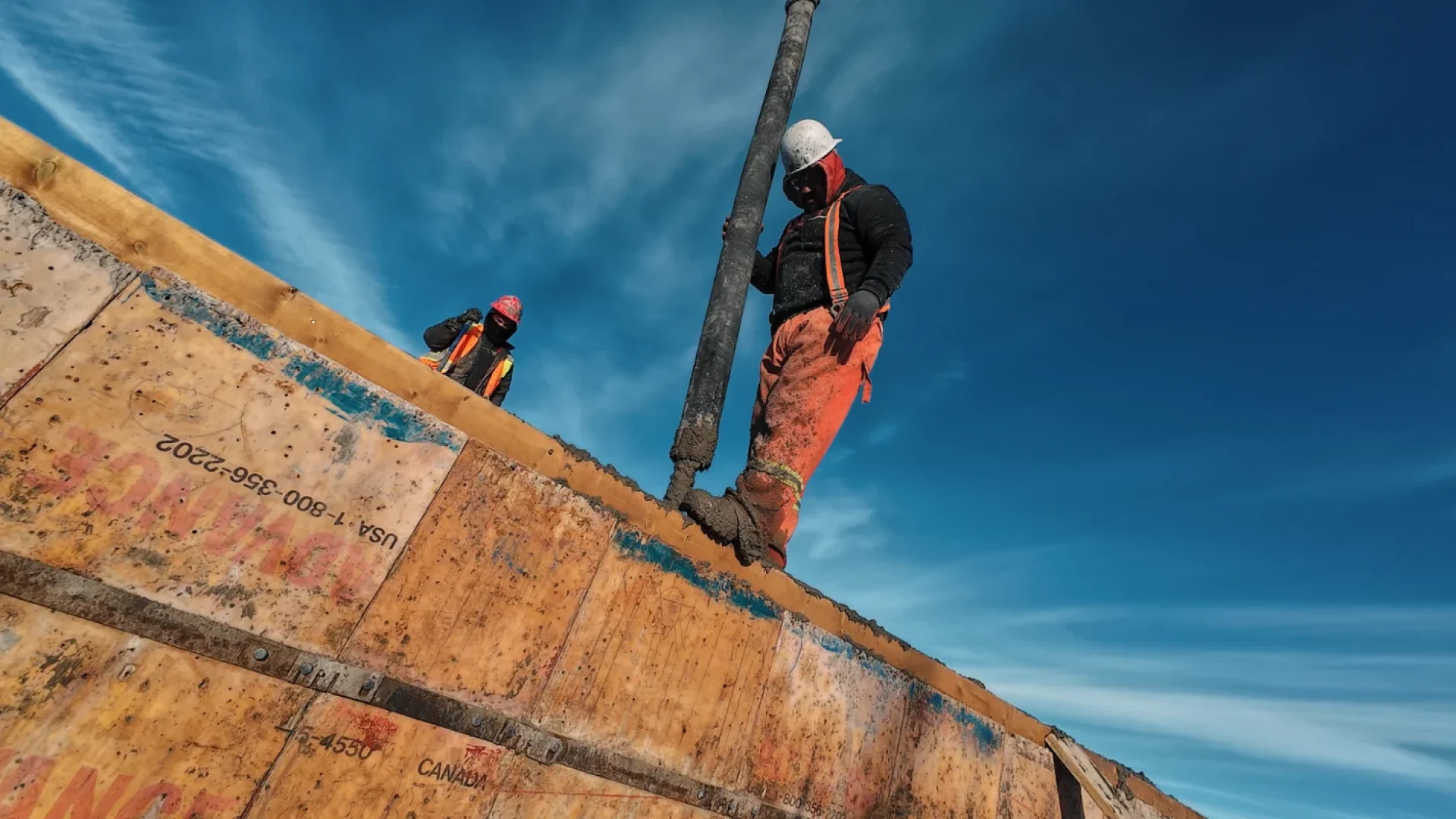
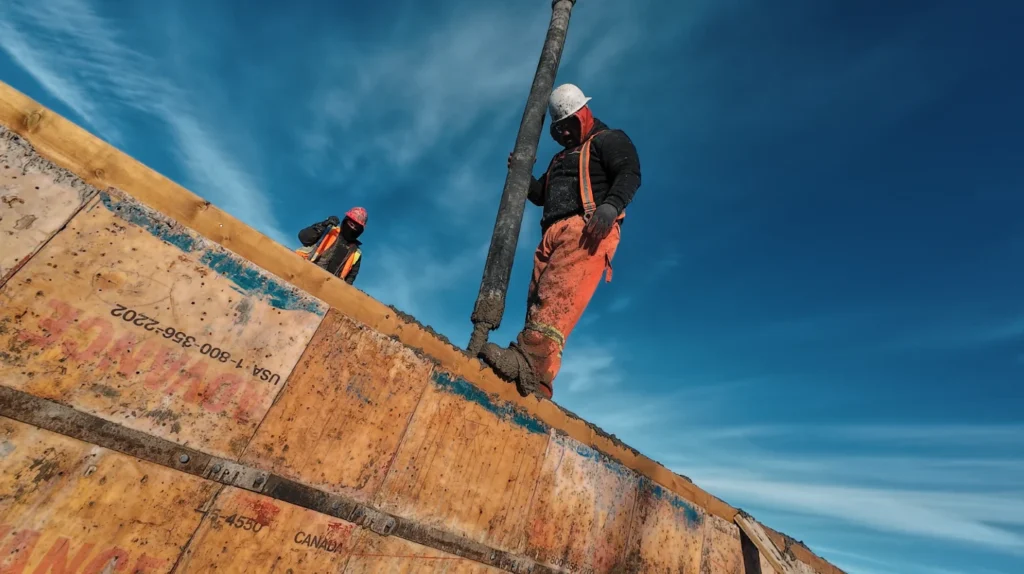
The short answer: pick a boom pump when you need reach and volume, like walls, big footings, or a commercial pour where the truck has to place concrete over a fence, a foundation, or across an open site. Pick a line pump when access is tight and the volume is lower, like a backyard slab or a basement, where a hose can snake through a gate or a doorway.
We have been placing and pumping concrete around Calgary since 1988. The question we hear most from builders, subcontractors, and homeowners is not “how much” first. It is “how do we get the concrete where it has to go?” That is the real decision. Here is how we make it.
1. Start with access, not the pump
Before anyone talks equipment, we look at how a truck and a hose can reach the pour. A boom pump is a truck with a folding arm that swings concrete up and over. It needs room to set up, room to unfold, and clear space overhead. No overhead power lines, no low tree canopy, no tight lane it cannot open the outriggers in.
A line pump is smaller. It parks where it can, and the concrete travels through a hose laid along the ground. That hose can run around corners, through a side gate, down a stairwell, into a basement. If the pour sits behind an obstacle a boom cannot lift over, the line pump usually wins.
So the first question is not “boom or line.” It is: can a big truck get in, set up, and reach? If yes, keep reading about volume. If no, you are likely looking at a line pump.
2. Then weigh the volume
Reach solves the “where.” Volume solves the “how fast.” A boom pump moves a lot of concrete quickly, which matters when you have a wall or a footing that has to go in as a continuous placement so it cures as one piece. In a recent ten-day stretch our walls ran 40 to 60 cubic metres in coordinated multi-truck rounds, and our footings ran 14 to 90 cubic metres. That is boom-pump territory. You want the concrete placed before the first load starts to set.
A line pump moves concrete at a steadier, smaller pace. For a garage slab, a set of steps, a small patio, or a residential footing, that pace is right. You are not racing a large volume, so you trade throughput for the ability to get into a tight spot.
3. Reach: over, around, or through
This is where the two tools really separate.
A boom pump reaches over and up. Over a finished foundation, over a fence, up to an elevated deck or a second pour. On an open commercial or municipal site it lets the truck sit in one safe spot and feed several placement points without repositioning.
A line pump reaches around and through. Around the side of a house, through a standard gate, down into a basement or a window well, into a courtyard a truck will never enter. The hose does the walking the truck cannot.
If your obstacle is height, think boom. If your obstacle is a narrow, enclosed, or below-grade path, think line.
4. The residential picture
Most homeowners we talk to are trying to diagnose their own site, not pour it themselves, so here is the plain version. A backyard slab in an established community like Mahogany, Legacy, or Shawnee, boxed in by fences and a house, is usually a line-pump job. The hose feeds through the gate and around to the back. A larger, more open lot, or a job that has to lift over a retaining wall or a foundation, can call for a boom.
A garage slab is the classic in-between. In that same recent stretch we placed a roughly 1,500 square foot garage slab on a Saturday. Whether that is boom or line comes back to the same two questions: can a boom truck set up and reach the pad, and how tight is the approach? Send a site photo and we will tell you straight.
5. Commercial, municipal, and institutional pours
On commercial and industrial sites, and on municipal and utility work, volume and reach usually both point to a boom. High-strength placements, thrust blocks, ramp and split pours, big flowable-fill backfills: these move fast and often have to clear obstacles. In the same ten days we placed fill-crete, a low-strength self-levelling backfill, up to 70 cubic metres on commercial work, and single pours up to 90 cubic metres for a major Calgary developer’s footing. Those are jobs where a boom earns its keep.
That said, a line pump still shows up on big sites for finish-and-detail work, the spots a boom arm cannot tuck into. Often the smart plan uses both across a project.
6. We run both, and we pump for others too
Because we place, finish, and pump ourselves, we are not trying to talk you into whichever machine happens to be free. We run boom- and line-pump operators, and we also pump for other contractors and suppliers when they need reach or throughput they do not have in-house. So the recommendation you get is about your pour, not our schedule.
We also batch and deliver our own mix through the Omega Group, so the concrete arriving on site is matched to the pour: a 32 MPa, Type 50 sulphate-resistant mix at 5 to 8 percent air for Alberta’s sulphate soils and freeze-thaw, a C-2 exposure mix for salted flatwork like driveways and sidewalks, or the right fill-crete for a void. Right mix, right pump, one call.
Concrete pumping has evolved well beyond simply moving concrete from the truck to the forms. Today’s projects rely on integrated scheduling, modern pumping technology, coordinated logistics, and real-time communication between the plant, dispatch, pump operators, and placing crews. Our guide on The Future of Concrete explores how these innovations are making Calgary projects faster, safer, and more efficient.
Proof from a recent ten-day stretch
In a recent ten-day working stretch, our pump and placing crews, fed by Omega Ready Mix’s five-truck fleet (RM 1 through 5) and its batch plant with two cement silos and near-daily 28 to 42 tonne bulker deliveries:
- batched, delivered, and placed 1,100-plus cubic metres of concrete
- ran about 80 separate pours, including Saturday work
- placed single pours up to 90 cubic metres (a footing for a major Calgary developer)
- placed fill-crete up to 70 cubic metres on commercial work, and roughly 25 cubic metres of builder void-fill
- poured footings from 14 to 90 cubic metres and walls from 40 to 60 cubic metres in coordinated multi-truck rounds
- worked from 5:00 am starts to evening pours near 5 pm, across residential, commercial, municipal, institutional, and industrial jobs
- accommodated builders’ concrete testers on site for quality control
Range like that, from a 1 cubic metre trench to a 90 cubic metre pour, is exactly why the boom-or-line call has to be made job by job.
Selecting the correct pump is about more than convenience—it affects placement quality, productivity, and safety. For readers interested in industry best practices, the American Concrete Pumping Association (ACPA) publishes guidance on pump selection, safe setup, hose handling, and jobsite operations, while the American Concrete Institute (ACI) provides technical recommendations for concrete placement, consolidation, and pumping procedures. These resources explain why access planning, continuous placement, and proper equipment selection are critical to a successful concrete pour.
FAQ
What is the difference between a boom pump and a line pump? A boom pump is a truck with a hydraulic arm that lifts and places concrete up and over obstacles, ideal for high volume, walls, and footings. A line pump is a smaller unit that pushes concrete through a ground-level hose, ideal for tight-access, lower-volume jobs like backyard slabs and basements.
Which pump do I need for a backyard concrete slab in Calgary? Usually a line pump. Most backyards are enclosed by fences and the house, so a hose that snakes through a side gate reaches the pad, where a boom truck cannot set up or lift over. If the lot is open or the pour must clear a wall or foundation, a boom may fit instead.
Do I need a concrete pump for a small pour? Not always. If a truck can discharge directly into the forms, you may not need a pump at all. A pump earns its cost when the concrete has to travel over, around, or through an obstacle the truck chute cannot reach. Send a site photo and we will tell you honestly.
How much concrete can a boom pump place? A boom pump moves high volumes quickly, which is why we use it for placements like walls of 40 to 60 cubic metres and footings up to 90 cubic metres in continuous, coordinated rounds. High throughput lets a large pour go in as one piece before it starts to set.
Can a line pump reach a basement or a pour below grade? Yes. A line pump’s hose can run down a stairwell, through a doorway, or into a window well to place concrete below grade or in enclosed spaces a boom arm cannot get into. That access is the main reason to choose a line pump.
Do you pump concrete for other contractors? Yes. We run both boom- and line-pump operators and we pump for other contractors and suppliers, not only our own placements. Because we also batch, deliver, place, and finish, we can match the pump and the mix to the job on one call.
We’ll Recommend the Right Pump—Not the Most Expensive One
Every concrete project is different. Sometimes a boom pump is the fastest and safest option. Sometimes a line pump is the only practical choice. And sometimes you don’t need a pump at all.
Our team will review your project and recommend the most efficient solution based on:
- Site access and overhead clearance
- Concrete volume and placement speed
- Distance from the truck to the forms
- Residential, commercial, municipal, or industrial requirements
- Pumping, placing, and finishing logistics
- The right concrete mix supplied through Omega Ready Mix
Whether you’re pouring a backyard patio, basement slab, foundation wall, commercial footing, or a 90 m³ structural placement, we’ll coordinate the pump, the concrete, and the crew so everything arrives on schedule and works as one operation.
Contact Omega 2000 Cribbing today to book your boom pump or line pump, request a site assessment, or send us photos of your project. We’ll tell you honestly which option is the best fit for your site—and if you don’t need a pump, we’ll tell you that too.