

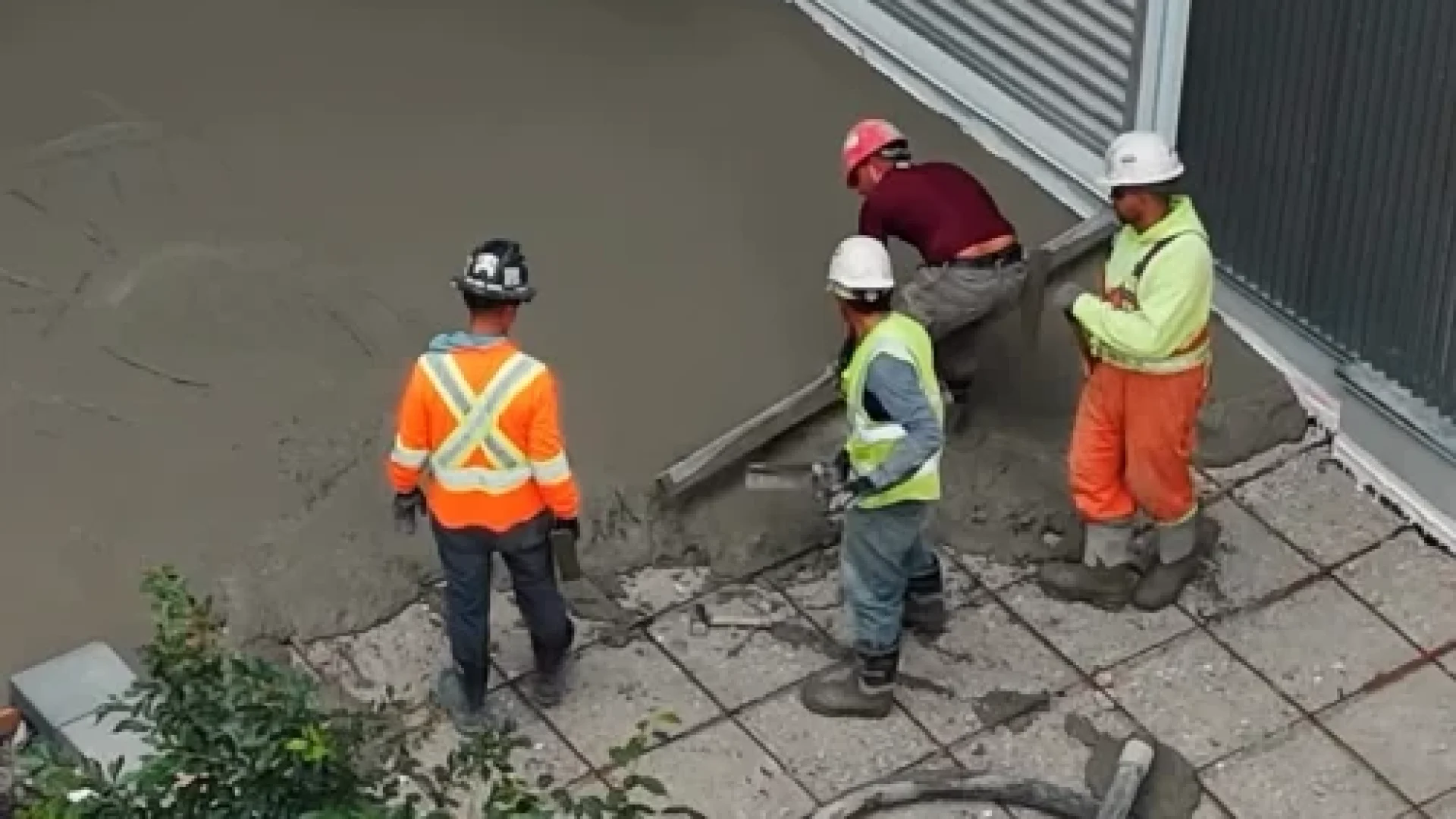
When the same group batches the concrete, trucks it, pumps it, places it, and finishes it, nobody gets to point fingers if a load runs late or a mix comes back off. One team owns the whole pour, start to strip. That is the real difference between hiring one integrated crew and standing between a supplier and a contractor who each blame the other.
I have been placing concrete around Calgary since 1988. In that time I have watched more pours go sideways over a phone call than over a technical mistake. Here is what usually happens, and why the setup you choose matters more than most people think.
1. The finger-pointing problem is a setup problem, not a people problem
Picture the standard arrangement. You hire a concrete supplier to make and deliver the mix. You hire a separate placing contractor to form, pump, place, and finish it. On a good day the two never speak, because they never have to. On a bad day they only speak to each other about who is at fault.
The truck shows up 90 minutes late. The finishing window closes early because the weather turned. A cylinder break comes back low. Now you have two companies who each did their part and each have a reason it was the other one’s part. You are the person standing in the middle holding a bill and a slab you are not sure about.
That is not a character flaw in either company. It is what the setup produces. Two contracts, two crews, two dispatch desks, and one seam running right down the middle of your pour. The seam is where things fall through.
2. Vertical integration closes the seam
Here is the honest scope, because that matters to me. Omega 2000 Cribbing is the placing side. We form, we pump, we place, and we finish. Omega Ready Mix supplies the concrete from its own batch plant and its own fleet. Both are Omega Group companies. When you bring in the group, the supply and the placing sit under one roof and answer to one schedule.
That closes the seam. If a load is running behind, the placing crew already knows, because dispatch is not calling a stranger. If a mix needs adjusting for the pour in front of us, the conversation happens between people who work for the same outfit and see each other every morning. Nobody is protecting a separate contract. The only thing being protected is your pour.
3. One schedule instead of two calendars
The quiet killer on a concrete job is timing. Concrete does not wait for a meeting. Once it is in the truck, the clock is running, and the finishing window after it is placed is shorter than most buyers expect.
When supply and placing run on two separate calendars, you become the coordinator whether you wanted the job or not. You are the one confirming the truck for the morning the crew is booked, then re-confirming when the crew slips a day. When it is one team, that coordination is internal. We schedule the concrete against the crew and the pump as one plan, and we adjust it as one plan when a site moves.
In a recent ten-day stretch our crews ran pours from 5:00 am starts through 5 pm evening placements, including Saturday work. Footings ran from 14 to 90 cubic metres. Walls ran 40 to 60 cubic metres in multi-truck coordinated rounds. You cannot run that many walls in that many rounds if the concrete and the crew are talking through a middleman. It only works when it is one desk making one plan.
4. Real batching capacity behind the placing crew
A placing crew is only as good as what shows up in the truck. This is where the group actually matters, not as a slogan.
Omega Ready Mix runs its own fleet of mixer trucks and its own cement supply, with a batch plant that holds two cement silos and takes near-daily bulker deliveries in the 28 to 42 tonne range. That is real batching capacity behind the crew, not a broker’s phone number. When the crew I send to your site needs concrete, the concrete is being made by the same group, on the same schedule, to the mix your job actually calls for.
For most Calgary foundation work that mix is a 32 MPa, Type 50 concrete with 5 to 8 percent air. Type 50 is the sulphate-resistant cement, what current CSA nomenclature calls Type HS, and around here you want it, because our soils carry sulphates and our winters run the freeze-thaw cycle hard. Salted exterior flatwork like driveways, sidewalks, and steps lands in CSA exposure class C-2: 32 MPa at 28 days, 5 to 8 percent air, water-to-cement ratio at or below 0.45. Getting that right is not a placing decision or a supply decision on its own. It is both at once, which is exactly the point.
Integrated concrete delivery is becoming the standard because construction schedules are getting tighter, quality expectations are higher, and builders expect a single team to coordinate every stage of a project. Learn how modern batching technology, integrated operations, and smarter logistics are shaping The Future of Concrete and why more Calgary builders are moving away from disconnected suppliers and subcontractors.
5. When the mix or the load is off, one team fixes it
Things go wrong on concrete jobs. I would not trust anyone who told you otherwise. What separates a good outcome from a bad one is how fast the fix happens and who owns it.
When supply and placing are one group, a problem gets solved in the yard, not litigated between two front offices. A load needs a tweak, the plant is the same company. A truck order needs to move up, dispatch already has the crew’s schedule in front of them. There is no window where each side waits for the other to admit something before anyone acts. The buyer is not refereeing. That is the whole value.
We also accommodate builders’ concrete testers on site, because we would rather the numbers get checked in real time than have a break come back weeks later with no one around to answer for it. When the same group owns supply and placing, there is always someone to answer for it.
6. Honest scope, so you know what one call actually gets you
I will not oversell this. Omega 2000 Cribbing places, finishes, and pumps. That is our lane and we have been in it since 1988. Omega Ready Mix supplies the concrete. Omega Precast, a separate Omega Group company, also produces precast at the yard; product details coming soon. The “one call, one company” idea is the Omega Group umbrella, and what it buys you is a supplier and a placing contractor who do not treat each other as strangers.
You can absolutely hire a supplier and a placing crew separately and get a fine result. Plenty of good jobs run that way. But if you have ever stood between two companies pointing at each other, you already understand why one team owning the pour is worth asking about.
Proof from a recent ten-day stretch
In a recent ten-day stretch, the group batched, delivered, and placed 1,100-plus cubic metres of concrete across roughly 80 separate pours, Saturday work included. Single pours ran up to 90 cubic metres, a footing for a major Calgary developer. Fill-crete, our 5 MPa self-levelling backfill, went in at placements up to 70 cubic metres on commercial work and around 25 cubic metres for builder void-fill. The work spanned residential, commercial, municipal, institutional, and industrial sites in the same week, served by a five-truck ready-mix fleet and the group’s own batch plant. That range, from a 1 cubic metre trench to a 90 cubic metre pour, does not happen when supply and placing are strangers.
Concrete quality depends on more than the placing crew. It also relies on recognized industry standards governing concrete production, exposure classes, testing, and construction practices. For homeowners, builders, engineers, and project managers who want to better understand the technical requirements behind structural concrete, sulphate-resistant cement, exposure classes, and quality assurance, the publications from the Canadian Standards Association (CSA Group), the Alberta Ready Mixed Concrete Association (ARMCA), and the Concrete Alberta provide valuable guidance on current Canadian concrete standards, testing procedures, and best practices for durable concrete construction.
FAQ
What does vertical integration mean for a concrete job? It means one group handles the whole chain: batching the concrete, trucking it, pumping it, placing it, and finishing it. Instead of a separate supplier and placing contractor with two contracts and two schedules, one team owns the pour from the plant to the finished surface.
Who does what inside the Omega Group? Omega 2000 Cribbing places, finishes, and pumps concrete, and has since 1988. Omega Ready Mix supplies the concrete from its own plant and fleet. Omega Precast (a separate Omega Group company) also produces precast at the yard; product details coming soon.
What happens if a concrete load is late or the mix is off? With one integrated team, the fix happens inside the group rather than between two front offices blaming each other. Dispatch already knows the crew’s schedule, and the plant is the same company, so a load can be adjusted or moved up without the buyer refereeing.
What concrete mix do you use for Calgary foundations? The common workhorse is 32 MPa, Type 50 (sulphate-resistant, called Type HS in current CSA nomenclature) with 5 to 8 percent air, chosen for Alberta’s sulphate soils and freeze-thaw winters. Salted exterior flatwork uses CSA exposure class C-2. The right mix depends on the specific job.
Can you handle both small and large pours? Yes. In a recent ten-day stretch, work ranged from a 1 cubic metre trench to a 90 cubic metre footing, across roughly 80 pours. Footings ran 14 to 90 cubic metres and walls ran 40 to 60 cubic metres in coordinated multi-truck rounds.
Do you pump concrete for other contractors? Yes. Alongside our own placing work, we also pump for other contractors and suppliers. Boom- and line-pump work is part of what Omega 2000 Cribbing does.
One Call. One Schedule. One Team Responsible for the Entire Pour.
Whether you’re planning a residential foundation, commercial slab, structural walls, municipal work, or a large multi-truck placement, coordinating concrete shouldn’t be your second full-time job.
The Omega Group keeps the entire operation under one roof:
- Omega Ready Mix batches and delivers concrete from our own plant.
- Omega 2000 Cribbing provides placing, pumping, and finishing crews.
- Coordinated scheduling from dispatch to completed placement.
- Mix designs built for Calgary’s sulphate soils and freeze-thaw climate.
- Support for projects ranging from small residential pours to large commercial and municipal placements.
Instead of managing separate suppliers, pump operators, and placing contractors, work with one integrated team that shares the same schedule, the same communication, and the same responsibility for the finished result.
Contact the Omega 2000 Cribbing today to discuss your upcoming project, confirm the right concrete mix, and schedule a coordinated pour throughout Calgary and the surrounding region.ing, a wall, a slab, or a backfill coming up, get us the site details and the timing and we will get you scheduled, often next-day or same-week depending on the calendar. One call reaches the crew that places it and the group that supplies it.