

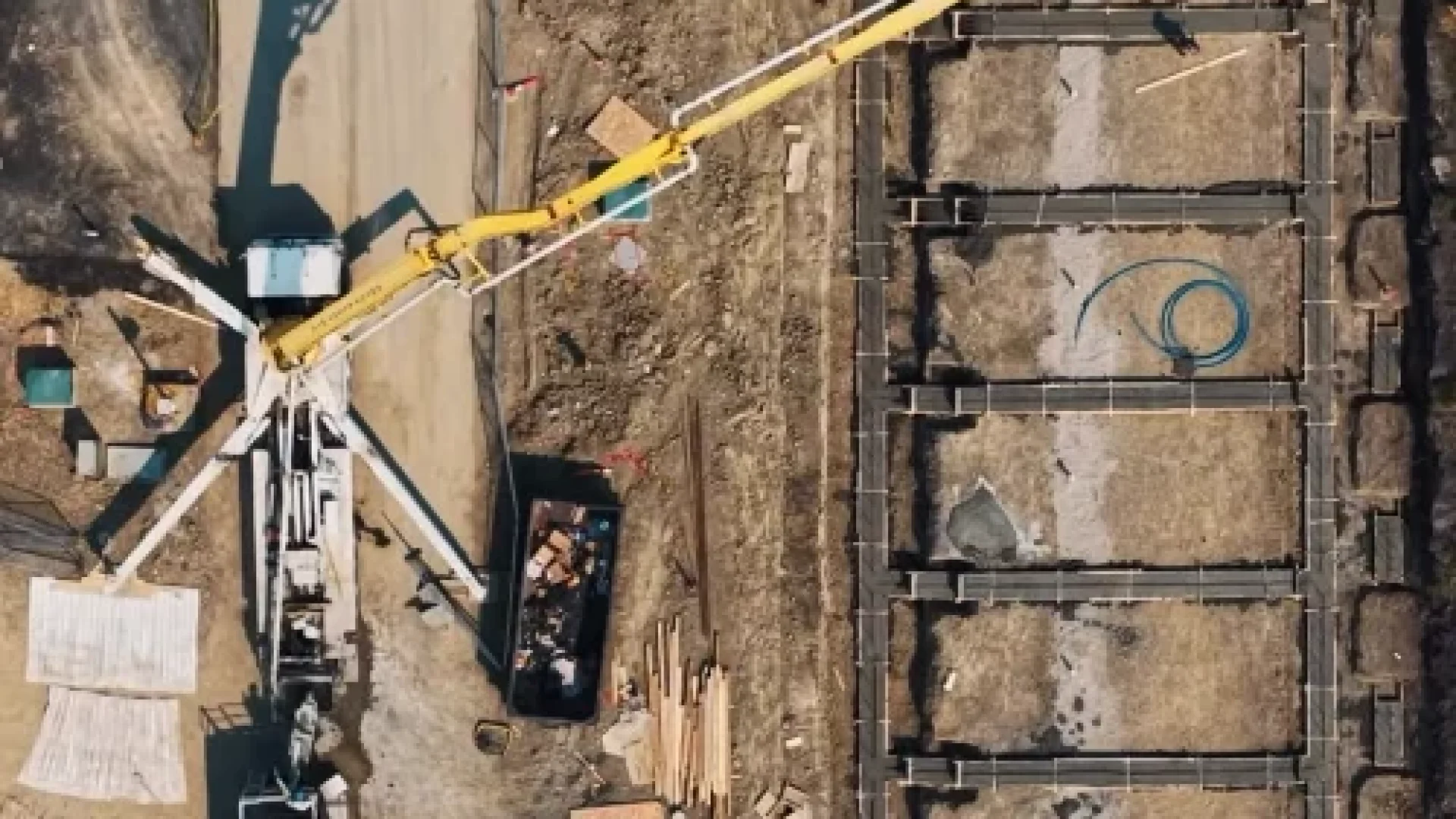
Your geotechnical report is the instruction manual for everything your foundation crew does below grade, and most of it comes down to four findings. The soluble-sulphate result sets your cement type (in Calgary, almost always Type HS). The bearing-capacity number decides whether prescriptive footings are legal or you need an engineered design or piles. The fill and slope findings can trigger a bearing certificate or move your building envelope. And the groundwater reading drives drainage and waterproofing. The report is stamped by an APEGA P.Eng., which is what makes those findings binding on the people pouring your concrete.
What is a geotechnical report, and do you need one in Calgary?
A geotechnical report is a P.Eng.-stamped study of what the ground on your specific lot can do. An engineer drills test holes (borings), classifies the soil at depth, runs lab strength and consolidation testing, logs groundwater, and then writes site-specific recommendations for bearing capacity and foundation design. Alberta’s own Geotechnical Investigation Guidelines describe exactly this scope: borings, soil classification, groundwater assessment, laboratory testing, and foundation/bearing recommendations.
(Source: Government of Alberta, Geotechnical Investigation Guidelines, https://www.alberta.ca/system/files/custom_downloaded_images/tr-geo-tech-guide.pdf.)
Do you need one? On a standard inner-city infill lot with known soils, often not; the builder pours to the prescriptive path of the building code. But on acreage, hillside lots, deep-fill sites, anything near a watercourse, or any build the City flags, a geotechnical report is the gating document. If you’re an Estate Builder on a Bearspaw or Springbank acreage, you will almost certainly have one, and you should read it, because it tells you more about your foundation budget than any other piece of paper in the project.
Here’s the part nobody explains: a geotech report isn’t written for you, and it isn’t really written for your builder either. It’s written for the engineer who designs your footings and the crew who pours them. This guide translates the findings that change what we actually do in the trench.
What does the sulphate (S-2) finding mean for my foundation?
This is the single most foundation-direct line in the entire report, and it’s the one homeowners never notice.
Your report tests the soil for water-soluble sulphate and assigns a sulphate exposure class. Calgary soils derived from the Bearpaw Formation routinely test S-2, a soluble-sulphate content of roughly 0.10–2.0%, with 0.20% or more being the threshold that puts you in the severe-sulphate category. (Source: Concrete Alberta, https://concretealberta.ca/.) Sulphate in soil chemically attacks ordinary concrete: it reacts with the cement paste, expands, and over years causes the aggregate to lose its bond and the concrete to degrade from the outside in.
When your report says S-2, here’s what changes at the truck: we batch Type HS (high-sulphate-resistant) cement, or its modern HSb / HSe equivalent, not ordinary Type GU. The companion specification under CSA A23.1:24 for S-2 exposure is 32 MPa at 56 days as the code minimum (35 MPa is the common Calgary residential premium, not the floor), a maximum water-to-cementing ratio of 0.45, and 5–7% entrained air. (Source: CSA A23.1:24, https://www.csagroup.org/store/product/CSA%20A23.1%3A24/.) The report is where the Type HS requirement legally comes from. The chemistry of why is its own subject (our companion piece, Why Calgary Foundations Need Type HS Cement, owns that), but the practical translation is simple: the S-number on your geotech report decides the cement in your walls.
If you want to check the report’s S-number is traceable, the lab methods behind it are standardized: CSA A3004-C8 / ASTM C1012 (mortar-bar expansion) and ASTM C1580 / D8459 (soluble sulphate in soil).
What is soil bearing capacity, and why does 75 kPa matter?
Bearing capacity is the maximum load the soil can safely carry under your footings, expressed in kilopascals (kPa). It is the number that decides whether your foundation can be built the cheap, prescriptive way or has to be engineered.
The National Building Code (Alberta Edition) Part 9, the prescriptive path most houses use, presumes an allowable soil bearing pressure of 75 kPa for standard footings on undisturbed native soil or engineered fill. (Source: corroborated via the Edmonton Footing & Foundation permit guide, https://www.edmonton.ca/sites/default/files/public-files/assets/Footing_and_Foundation_ONLY_Building_Permit.pdf; BC Building Code 9.15 mirror, https://free.bcpublications.ca/civix/document/id/public/bcbc2012/ep001029.15.) If your geotech report confirms the soil meets or beats 75 kPa, the standard footing tables apply and the work stays in Part 9.
If your report comes back below 75 kPa (soft clay, high-plasticity Bearpaw, loose fill), the prescriptive tables no longer protect the design, and you move to an engineered (Part 4) foundation: a P.Eng. sizes wider footings or specifies a deep-foundation system (such as screw piles or cast-in-place piles with a grade beam). The bearing number is the single most action-changing line for the crew, because it can change the entire foundation system, not just a dimension. (For how that decision plays out across poured, precast, and pile options, see our companion foundation-system decision tree.)
What’s a Deep Fills Report, and what’s a bearing certificate?
If your lot was filled to make it buildable (common on reclaimed or regraded land), your report may be (or may trigger) a Deep Fills Report.
The City of Calgary’s Geotechnical Report Guidelines for Land Development Applications is the governing local document here. (Source: City of Calgary, https://www.calgary.ca/content/dam/www/uep/water/documents/water-documents/geotechnical-report-guidelines-for-land-development-applications.pdf.) A Deep Fills Report is the geotechnical analysis required where soils have been filled more than about two metres deep, and it sets restrictions, including the requirement for a bearing certificate and special foundation designs, to protect structures built on that fill. (Definition corroborated via the Alberta and Edmonton geotechnical guideline documents, as the City PDF is image-encoded.)
A bearing certificate is a sign-off, issued after the excavation is open, in which the geotechnical engineer confirms the soil actually exposed at footing level matches what the report assumed and can carry the design load. For the crew, it’s a hold point: on a deep-fill or engineered site, we don’t pour footings until the engineer has stood in the open trench and certified the bearing. If your report mentions deep fill, expect that step, and budget the engineering visit for it.
What does a Slope Stability Report change on a hillside lot?
On a sloped acreage (the Bearspaw and Springbank hillsides, parts of Priddis, the ridges above Bragg Creek), your report may include a Slope Stability Report. This is the geotechnical assessment that identifies “stable land” and sets the development boundaries for your build: how close to the top or toe of a slope you can place a structure, and what setbacks and foundation measures the slope demands. (Source: City of Calgary Geotechnical Report Guidelines, URL above; slope-assessment scope corroborated via the Edmonton Ogilvie Ridge preliminary geotechnical report, https://www.edmonton.ca/sites/default/files/public-files/assets/OgilvieRidgePreliminaryGeoReport.pdf.)
For the foundation crew and the builder, a slope finding can be the most expensive line in the report, because it can move the buildable envelope, force a stepped or walk-out foundation, and dictate drainage that keeps water from loading the slope. It’s also the finding most likely to change the house, not just the footings. (For how stepped foundations and walk-outs are actually built on a Calgary hillside, see our companion field guide.)
What about frost, groundwater, and seismic?
Three more standard report sections quietly shape the pour:
- Frost penetration. Calgary’s design frost depth is about 1.2 m (deeper in extreme years and on exposed acreage). Footings have to bear at or below that depth so frost can’t heave them. Your report confirms the local frost regime that sets your footing embedment. (Source: City of Calgary Climate Hazards 2022 Year in Review; NBC(AE) Part 9 §9.15.)
- Groundwater. The report logs the water table observed in the borings. A high water table drives your drainage and waterproofing design (perimeter weeping tile, membrane selection, sump strategy) and, if you’re considering piles, tells the engineer whether they’ll be installed into saturated ground.
- Seismic and erodibility. Standard sections that rarely change a Calgary residential pour but are part of why the report exists and why it carries a stamp.
None of these are exotic. They’re the difference between a foundation that sits quietly for 40 years and one that heaves, leaks, or moves, which is exactly the outcome an Estate Builder is paying the geotech engineer to prevent.
Who has to stamp the report, and why does the stamp matter?
A geotechnical report in Alberta must be authored by a member of APEGA (the Association of Professional Engineers and Geoscientists of Alberta) working under a valid permit to practice, and authenticated with a P.Eng. (or P.Geo.) stamp. (Source: APEGA, https://www.apega.ca/.) The stamp is not a formality. It is what makes the report’s findings binding on the specification: the legal reason your builder and crew have to pour Type HS on S-2 soil and engineer the footings when bearing comes in low.
It also tells you who carries the professional liability. The geotechnical engineer is responsible for the ground interpretation; the structural engineer who designs your footings relies on it; and the crew’s job is faithful execution: pour exactly what the stamped design calls for, and call the engineer before deviating if the trench doesn’t match the report. (How that hand-off should work in practice is the subject of our companion piece on talking to your engineer.)
A geotechnical report tells the foundation crew what the ground requires, but it is only one part of a safe, controlled construction site. The other side is the crew itself: the safety systems, certifications, training and site procedures behind the people working in the excavation. If you are evaluating a Calgary foundation contractor, read our guide to EMR, COR, and the Foundation Crew to understand what those credentials actually tell you about the company doing the work.
My acreage report flags expansive clay or high groundwater: now what?
Map the finding to your corridor. Acreage soils around Calgary are not uniform, and the report’s findings land differently depending on where your lot sits:
- Springbank / Bearspaw: Bearpaw shale or bedrock at or near footing depth, with seepage in the weathered upper layer. Strong bearing where you hit rock, but seepage and expansive upper clay to manage.
- Priddis: fluvial gravel terraces with real bearing variability lot-to-lot, plus creek-floodplain proximity on the low ground.
- De Winton: deep glacial till under a topsoil layer that has to be stripped to reach competent bearing.
- Bragg Creek: floodplain and high-groundwater considerations that drive both drainage and the foundation type.
Expansive clay (which can swell dramatically when it wets and shrinks when it dries) and a high water table are exactly the conditions that push a design off prescriptive footings toward engineered footings, piles, or a reinforced raft, and that make drainage non-negotiable. The report won’t just name the problem; it will recommend the fix. Your job, and your crew’s, is to pour that fix exactly as stamped. (For a corner-by-corner read of the five acreage soil profiles written for homeowners, see our companion acreage guide.)
Key terms in your geotech report (quick glossary)
- Bearing capacity: the maximum load the soil can safely support under a footing, in kPa. Below NBC(AE) Part 9’s presumed 75 kPa → engineered design.
- Soluble sulphate / S-2: the soil’s water-soluble sulphate level. S-2 (≥0.20%) is Calgary’s common severe class → Type HS cement.
- Deep Fills Report: geotechnical analysis required where fill exceeds ~2 m; triggers a bearing certificate.
- Bearing certificate: engineer’s in-trench confirmation that exposed soil matches the design assumption before footings are poured.
- Slope Stability Report: assessment that defines “stable land” and development boundaries on a sloped lot.
- Frost penetration depth: the depth frost reaches (~1.2 m in Calgary); footings must bear below it.
- P.Eng. stamp: APEGA authentication that makes the report binding on the spec.
FAQ
What is a geotechnical report, and do I need one in Calgary? It’s a P.Eng.-stamped study of what your lot’s soil can carry: borings, soil classification, groundwater, lab testing, and bearing-capacity recommendations. You often don’t need one on a standard infill lot, but acreage, hillside, deep-fill, and near-watercourse builds typically require one, and the City may flag others.
What does the sulphate (S-2) finding mean for my foundation? It sets your cement type. Calgary soils commonly test S-2 (water-soluble sulphate ≥0.20%), which requires Type HS sulphate-resistant cement at 32 MPa / 56-day minimum (35 MPa is the common premium), 0.45 max water-to-cement ratio, and 5–7% air under CSA A23.1:24. The report is where the Type HS requirement comes from.
What is soil bearing capacity, and why does 75 kPa matter? Bearing capacity is the load the soil can safely carry, in kPa. NBC(AE) Part 9’s prescriptive footing path presumes 75 kPa. If your report confirms ≥75 kPa, standard footings apply; if it comes back lower, you need an engineered foundation or piles. It’s the line most likely to change your whole foundation system.
What’s a Deep Fills Report and a bearing certificate? A Deep Fills Report is the geotechnical analysis required where soil is filled more than about two metres deep; it sets restrictions including a bearing certificate. A bearing certificate is the engineer’s in-trench sign-off that the exposed soil matches the design before footings are poured: a hold point the crew respects.
What does a Slope Stability Report change on a hillside lot? It defines “stable land” and the development boundaries: how close to a slope you can build and what setbacks and foundation measures apply. It can move your buildable envelope, force a stepped or walk-out foundation, and dictate slope drainage. On Bearspaw or Springbank hillsides it’s often the most consequential finding.
Who has to stamp my geotechnical report? An APEGA-licensed P.Eng. or P.Geo. working under a valid permit to practice. The stamp makes the findings binding on the specification and assigns professional liability for the ground interpretation.
How does the report change what concrete my crew pours? Four ways: the sulphate class sets cement type (Type HS), the bearing number sets footing size or triggers piles, the frost depth sets footing embedment (~1.2 m), and the groundwater reading drives drainage and waterproofing.
My acreage report flags expansive clay or high groundwater: what now? Both conditions commonly push the design off prescriptive footings toward engineered footings, piles, or a reinforced raft, and make drainage mandatory. The report will recommend the fix; the crew’s job is to pour it exactly as stamped. Which fix applies depends on your corridor: Springbank, Priddis, De Winton, and Bragg Creek each behave differently.
Get Your Foundation Specification Right Before You Pour
Your geotechnical report tells you what the ground can handle. The next step is making sure the foundation crew actually builds to it.
If your Calgary project has a sulphate classification, low bearing capacity, deep fill, groundwater issue, slope restriction, or engineered foundation design, send us the relevant geotechnical and structural details. We can review the concrete requirements and coordinate the right mix, delivery, pumping and placement for the foundation your engineer has specified.
Planning an acreage, infill, commercial or residential foundation in Calgary? Contact Omega Cribbing 2000 to discuss your project, confirm the concrete requirements and schedule your pour.