

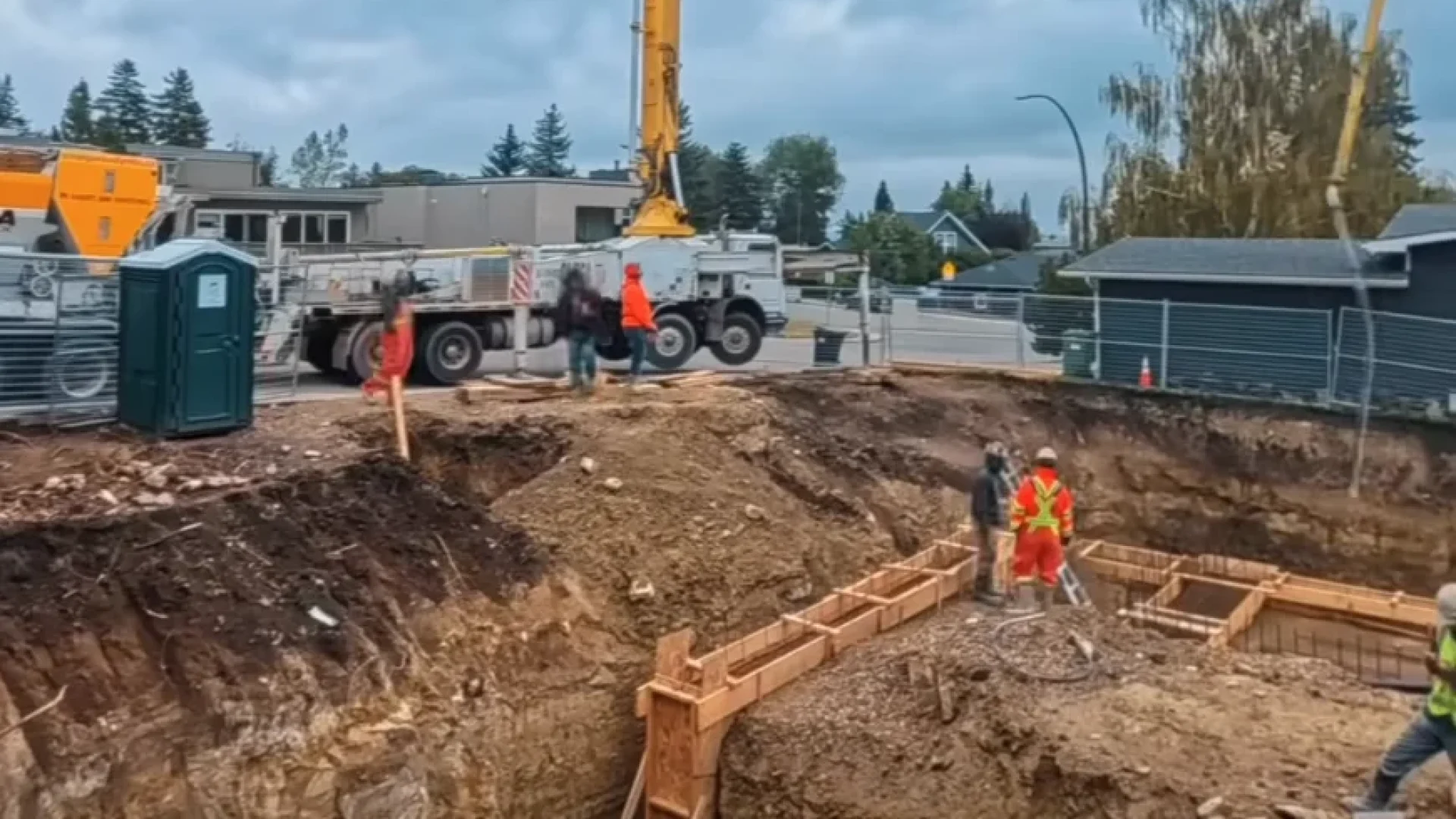
A custom builder should expect a foundation crew that pours exactly to the stamped spec, communicates before it deviates, and clears the City of Calgary pre-backfill inspection without a single redo, because on a custom home the foundation is the one trade the builder cannot personally inspect once it is buried. The work that protects your reputation happens inside the forms, where the rebar lives and nobody can see it after the pour. A crew worth keeping treats that invisible work as the whole job.
Why the foundation is the trade a custom builder loses sleep over
On a custom home, almost every trade leaves something you can walk a client through. Cabinetry, millwork, tile, the staircase: your client sees the craftsmanship and connects it to your name. The foundation is different. By the time the house is anything to look at, the footings and walls are buried under backfill, slab, and framing. If something was wrong in the forms, you find out years later, on a callback, on the most expensive house you have ever built.
That asymmetry is why the foundation crew is the one a custom builder cannot afford to get wrong. The whole business model of a custom builder is referral and reputation: every house either sends you the next three clients or costs you ten. A foundation flaw on a $2M home is not a line item; it is a referral lost and possibly a lawsuit. So the question is not “who is cheapest.” It is “which crew makes the invisible work right, and tells me the truth about it before it disappears under dirt.”
This piece lays out what a builder should actually expect — not a checklist of questions, but the standards and disciplines that separate a crew you can stop thinking about from one that becomes a liability.
Expectation 1: The crew communicates like a partner, not a sub who shows up
The single most common complaint custom builders raise about foundation crews is not workmanship; it is communication. No-shows. Silence between the quote and the pour. A change made in the field that nobody told the builder about until it was a problem.
A crew worth keeping does the opposite. It tells you the things you need to hear before they cost you:
- It flags the discharge clock before pour day. CSA A23.1 imposes a two-hour limit from batching to placement, with a 90-minute threshold to retest air content. On an acreage custom lot, a 45-to-60-minute drive can burn more than half of that clock before the truck even reaches the gate. A good crew raises that (and the volumetric or batching solution for it) at scheduling, not at 9 a.m. on pour day with concrete already turning over.
- It calls before it deviates. When the excavation reveals bedrock or seepage at footing depth that the drawings did not anticipate, the crew’s job is to stop and call the engineer and the builder, not to improvise a fix and keep the schedule. (More on this below; it is the single most important habit a crew can have.)
- It speaks both languages. A custom build runs on a triangle: the builder, the structural engineer, and increasingly the client standing on the lot asking questions. A crew that can “speak engineer and speak builder,” translating what the stamped drawing requires into what is happening in the dirt and back again, removes the friction that kills custom timelines.
Communication is not a soft skill on a custom foundation. It is the mechanism by which a problem stays small.
Expectation 2: Formwork and rebar fidelity — the work you will never see
Here is the uncomfortable truth a builder should internalize: the part of the foundation that determines whether it performs for forty years is the part nobody can inspect in the finished product. As one foundation contractor’s guidance puts it, “rebar placement is critical but often happens inside the forms where it’s not visible in the finished product.” A reliable crew “follows the engineer’s specifications precisely, maintains proper concrete coverage around the rebar, and uses the correct grade and size of steel” (Armada Poured Walls).
What “pouring to the spec” actually means, before any concrete arrives, is a short list a builder can verify or have verified at the pre-backfill inspection:
- Rebar size and spacing match the engineered drawing. Not “close enough,” but the actual bar size and centre-to-centre spacing the engineer specified.
- Reinforcement is tied and supported so it stays in position when concrete is placed around it: chairs and ties holding the steel where the drawing puts it, not lying on the footing.
- Lap splices and anchorage are compliant. Bars overlapped the required length, corners and intersections detailed as drawn.
- Cover depth meets design: the concrete thickness between the steel and the soil/air face, which is what protects the rebar from corrosion and the wall from sulphate ingress over decades.
(Concrete formwork & reinforcement inspection checklist, Quollnet.)
None of this shows on the surface of a finished wall. All of it determines whether the wall is what the engineer drew. A builder should expect a crew that treats the inside of the forms as the whole job, because that is where the reputation is poured.
Expectation 3: The crew clears the pre-backfill inspection cleanly
In Calgary, there is a literal moment when the builder’s reputation is inspected: the pre-backfill phase. The City of Calgary groups the footing and foundation, electrical underground, and sanitary and storm inspections into this phase, which “covers the foundation up to, and including, the subfloor, and prior to backfilling the excavation.” Critically, “the previous phase must pass all inspections before requesting an inspection for the next phase,” and trench photos are required before the pre-backfill inspection can be requested (City of Calgary — Inspections for contractors; City of Calgary — Inspections).
That gate is the builder’s friend. It is the independent check, before anything gets buried, that the foundation is what the drawing required. A crew worth keeping treats the pre-backfill inspection as a pass-first-time event (forms square, rebar placed and tied to the drawing, elevations correct, trench documented), not as a hurdle to scramble over. A failed pre-backfill inspection is not just a delay; it is the cascade every builder fears, where foundation slips into framing slips into a blown possession date with a buyer’s rate-lock attached.
When a crew clears that gate clean, job after job, that is the proof that the invisible work was done right.
Expectation 4: The crew pours to Calgary’s actual spec — without substitution
A builder should expect the crew (and its concrete supply) to pour to the Calgary default spec without a single quiet substitution at the truck. For a Calgary residential foundation that means Type HS or HSe sulphate-resistant cement; 32 MPa at 56 days as the CSA minimum (35 MPa is the common Calgary premium, not the floor); a maximum water-to-cementing-materials ratio of 0.45; 5–7% entrained air for freeze-thaw; footings bearing below the ~1.2 m frost depth; and 150 mm minimum above grade, all under CSA A23.1:24 (CSA A23.1:24; see our companion piece on Type HS chemistry below, which we will not re-derive here).
The reason this matters at the crew level, not just the supplier level, is substitution. The most dangerous failure on a custom foundation is not a visible mistake; it is the wrong cement type quietly delivered onto S-2 sulphate soil, a problem that shows up not in the warranty period but in the home’s second or third decade. A builder should expect a crew that pours what the engineer specified and can show, on the batch tickets, that it did.
Expectation 5: Call before you deviate
If a builder takes one habit from this piece and demands it of every crew, it is this: call before you deviate.
A stamped foundation drawing is a coordinated answer to the soil, the loads, and the code. When the dirt does not match the drawing (bedrock at footing depth, a seepage zone the geotech did not flag, an elevation that does not work), the crew faces a fork. It can improvise to protect the schedule, or it can stop, document, and call the engineer and the builder. Improvising on a stamped foundation is how a crew exposes the engineer’s professional liability and the builder’s reputation in a single afternoon.
The crews that earn a permanent place on a custom builder’s roster are the ones that pick up the phone. “We pour to the stamp, and we call you before we don’t” is not a slogan; it is the discipline that keeps a discovered problem from becoming a buried one. (We cover the crew-engineer-client communication protocol in depth in a companion piece, see internal links.)
Why crew experience matters more than the price — and why you can’t just swap crews
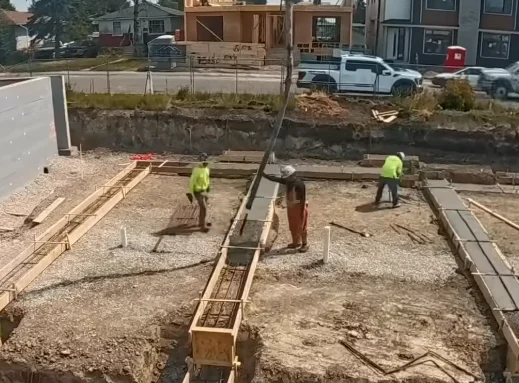
There is a structural reason a custom builder cannot treat foundation crews as interchangeable and shop on price. Cribbing is not a stand-alone Red Seal trade in Alberta; it falls under Construction Craft Worker, Carpenter (formwork), and Concrete Finisher classifications. There is no single certification that guarantees a crew knows how to form, reinforce, and pour a complex Calgary foundation. Crew experience is the only real quality guarantee.
And the labour math makes experienced crews scarce. Alberta faces roughly 42,500 construction retirements by 2033, about 23% of the 2023 labour force, against a projected ~22,000-worker net gap. Calgary alone had 5,300 trades vacancies in Q3 2025, one in four regional vacancies ([BuildForce Canada; Calgary Construction Association; Alberta apprenticeship data, via Master Knowledge Base §8/§11E]). In that market, a builder who burns a relationship with a crew that pours clean and communicates well is not easily replacing it.
This is exactly why the lowest bid is rarely the cheapest bid. The cheapest foundation is the one that generates no callback, passes pre-backfill the first time, and never blows a possession date. Experience buys all three.
How an integrated supplier reduces the seams — and the finger-pointing
A custom builder coordinating a foundation is managing seams: the cribbing crew, the concrete supplier, the precast elements, each a separate party that can point at the other when something is off. One way to reduce that risk is to reduce the seams.
When cribbing, the concrete mix (Omega Ready Mix volumetric, delivering the spec’d Type HS/HSe at the truck with no substitution), and precast elements (Omega Precast) come from one accountable group, the builder has fewer parties and fewer finger-pointing opportunities across the foundation system. Frame that correctly: it is not about “efficiency” or volume; it is about fewer seams, fewer places for accountability to fall through the gap. On a home where the foundation is the highest-stakes, least-visible part of the build, one accountable party across the system is a real de-risk.
And the heritage matters here. A crew that has been pouring complex Calgary lots since 1988 is the antidote to the fear that haunts every custom builder who has read the Calgary headlines: the crew that abandons the job, or the one whose work fails after the warranty runs out. Complex lots (walk-outs, hillsides, sloped infill) should be the crew’s default, not its exception.
FAQ
What should a custom-home builder expect from a foundation crew in Calgary? Expect a crew that pours exactly to the stamped spec, communicates before it deviates, clears the City of Calgary pre-backfill inspection the first time, and treats the invisible work inside the forms (rebar placement, tying, cover, lap splices) as the whole job. On a custom home the foundation is the trade you cannot inspect once it is buried, so the crew’s discipline is what protects your reputation.
What inspections does a Calgary foundation have to pass before backfill? The City of Calgary’s pre-backfill phase groups the footing-and-foundation, electrical underground, and sanitary-and-storm inspections, covering the foundation up to and including the subfloor before the excavation is backfilled. Trench photos are required before requesting it, and the previous phase must pass before the next can be requested.
How should a foundation crew communicate during a custom build? Proactively. It should flag the CSA two-hour discharge clock and acreage drive time at scheduling, call the engineer and builder before deviating when the dirt doesn’t match the drawing, and translate between the engineer’s stamped requirements and what’s happening in the field. Most foundation complaints from custom builders are about communication, not workmanship.
Why does the foundation crew’s experience matter more than the price? Because cribbing is not a stand-alone Red Seal trade in Alberta (it falls under Construction Craft Worker, Carpenter (formwork), and Concrete Finisher), crew experience is the only real quality guarantee. The cheapest foundation is the one with no callback that passes inspection the first time and never blows a possession date, and experience is what buys that.
What is the Calgary default foundation spec a crew should pour to? Type HS or HSe sulphate-resistant cement; 32 MPa at 56 days as the CSA minimum (35 MPa is the common Calgary premium, not the floor); maximum water-to-cementing-materials ratio of 0.45; 5–7% entrained air; footings below the ~1.2 m frost depth; 150 mm minimum above grade; all under CSA A23.1:24.
What does “pouring to the spec” actually mean for formwork and rebar? It means the rebar size and spacing match the engineered drawing, the steel is tied and supported so it stays in position during the pour, lap splices and anchorage are compliant, and concrete cover depth meets design. None of this is visible in the finished wall, which is exactly why a crew’s fidelity to it is the real measure of quality.
Is cribbing a certified trade in Alberta? No. There is no stand-alone Red Seal “cribber” designation in Alberta; the work falls under Construction Craft Worker, Carpenter (formwork), and Concrete Finisher classifications. That is why a crew’s demonstrated experience on complex Calgary lots, not a single certificate, is the meaningful quality signal.
How does an integrated cribbing-plus-concrete supplier reduce risk on a custom home? It reduces the number of seams in the foundation system. When cribbing, the concrete mix, and precast elements come from one accountable group, there are fewer separate parties and fewer finger-pointing opportunities if something is off, and the spec’d Type HS/HSe arrives at the truck without substitution. On the least-visible, highest-stakes part of a custom build, fewer seams is a real de-risk.