
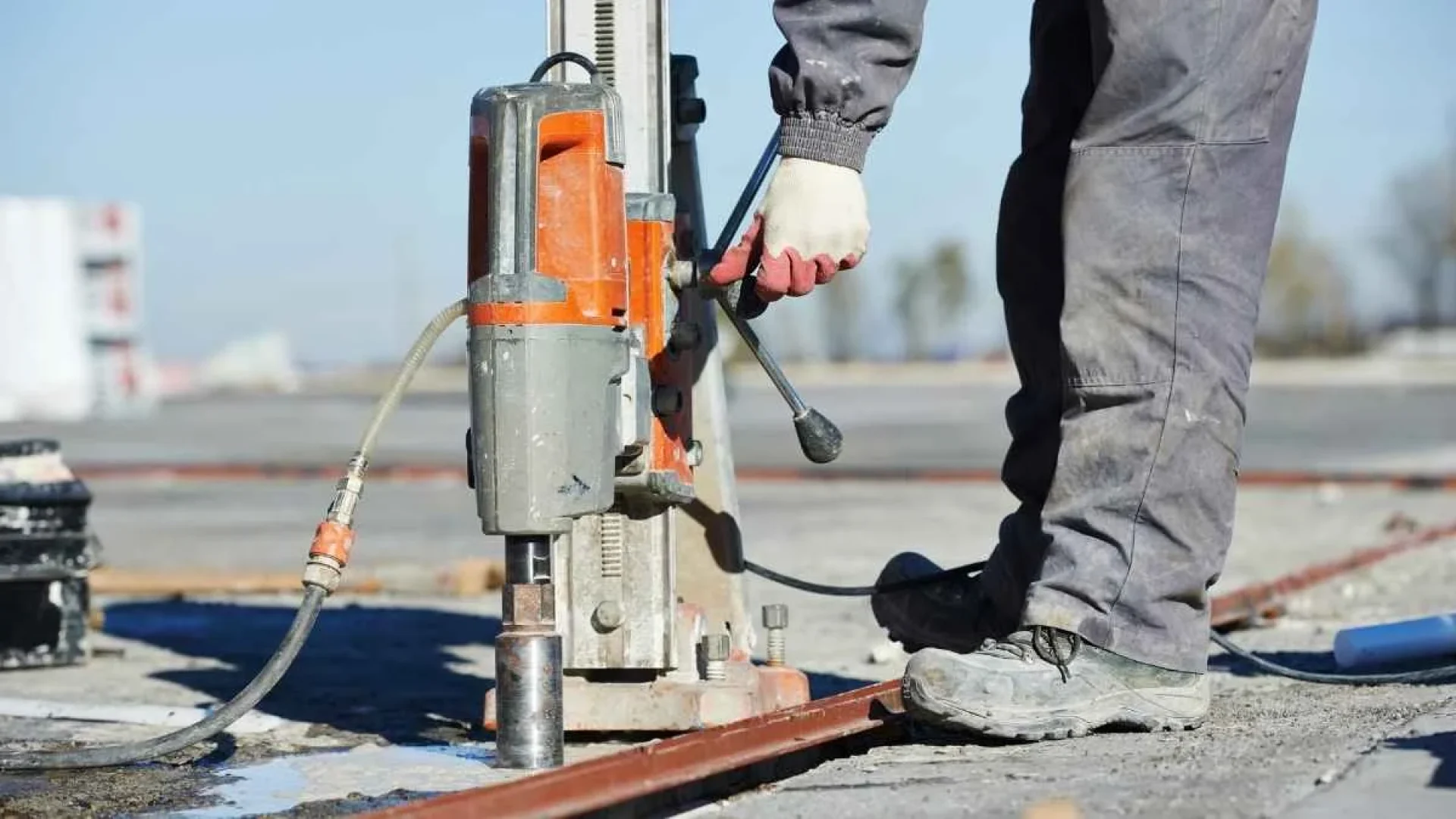
Non-destructive testing answers one question at a time. A covermeter tells you where the steel is and roughly how deep. Ground-penetrating radar maps what is buried across a whole bay. A half-cell survey tells you where corrosion is probably active. None of them tells you the strength of the concrete, and none of them replaces a core. Knowing which question each instrument answers is most of the job.
We have been pouring concrete in Calgary for 38 years, and across more than 52,000 projects the pattern has not changed much: the calls for testing come at four moments. Someone is about to cut into a slab. Someone is about to sign off on a pour that looks wrong. Someone has inherited a building and needs to know what is inside it. Or a repair scope has to be priced and nobody wants to guess at quantities. This article covers what to reach for in each case.
What non-destructive testing is, and what it is not
Non-destructive testing is any method that gathers information about hardened concrete without breaking it. The authoritative summary for North America is ACI 228.2R-13, Report on Nondestructive Test Methods for Evaluation of Concrete in Structures, produced by ACI Committee 228. It groups the methods into visual inspection, stress-wave methods, nuclear methods, magnetic and electrical methods, transport-property methods, infrared thermography, and radar.
One detail in that report saves a lot of argument on site. Estimating in-place compressive strength is deliberately not in its scope; 228.2R points you to a separate document, ACI 228.1R, for that. So when a consultant says “we’ll confirm strength non-destructively,” the honest version of that sentence involves correlation curves, companion cores, and an accepted margin of error. It is a different exercise from locating steel or mapping a delamination, and it should be priced and scheduled as one.
Put plainly: non-destructive testing narrows uncertainty. It rarely eliminates it. The good scopes we see pair a broad non-destructive sweep with a small number of verification openings in the spots the sweep flags.
The four methods a Calgary contractor actually meets
Covermeter: where the bar is, and how deep
A covermeter (also called a rebar locator or pachometer) works off the disturbance a steel bar creates in a magnetic field. It is the cheapest, fastest instrument on this list and the one most often used badly.
The IAEA’s Guidebook on Non-Destructive Testing of Concrete Structures puts the practical range of the instrument at roughly 100 mm. Beyond that depth you are reading noise. Two more limits from the same guide matter on real slabs: the bar diameter has to be known before a cover reading means anything, because the meter carries different scales for different bar sizes; and closely spaced bars, laps, transverse steel, tie wire and magnetic aggregate can all produce misleading results.
That last point is why covermeter readings taken over a congested pile cap or a doubly reinforced wall should be treated as indicative, not as a cover survey. In open flatwork with a single mat at known bar size, the same instrument is genuinely reliable. If you want the background on why cover matters in the first place, our piece on reinforcement in concrete covers the fundamentals.
Ground-penetrating radar: a map, not a measurement
Radar sends short radio-frequency pulses into the concrete and reads the reflections. The IAEA guidebook gives the working band as roughly 0.5 to 2 GHz, and the trade-off across that band is the single most useful thing a contractor can understand about the method: higher frequency means better resolution but shallower penetration; lower frequency means deeper penetration but coarser detail.
In practice, that means a high-frequency antenna will resolve a top mat and a conduit crisply in the first 200 mm of a slab and tell you very little about what is happening at the bottom. A lower-frequency antenna will see through a thick element but may not separate two bars 75 mm apart. Asking one antenna to do both jobs is the most common reason a scan report disappoints.
Moisture and dissolved salts also matter. Radar reads changes in dielectric properties, so a saturated slab, a chloride-contaminated parkade deck or a wet sub-base all change what comes back. That is not a defect of the method — mapping moisture variation is one of its uses — but it means a scan taken the morning after a March thaw and a scan taken in August are not the same scan.
The standardised use case is ASTM D6087, Standard Test Method for Evaluating Asphalt-Covered Concrete Bridge Decks Using Ground Penetrating Radar. Nothing in the method is unique to bridges. If you have a topped or covered deck and you want delamination mapped without lifting the covering, that is the test.
Half-cell potential: where corrosion is probably active
This is the one with the clearest numbers, and the one most often misquoted. ASTM C876 measures the electrical potential of reinforcing steel against a copper–copper sulfate reference electrode (CSE) placed on the concrete surface. The interpretation in the standard is expressed as probability, not as a verdict:
| Potential vs CSE | What the standard says |
|---|---|
| More positive than −0.20 V | Greater than 90% probability that no corrosion is occurring |
| −0.20 V to −0.35 V | Corrosion activity is uncertain |
| More negative than −0.35 V | Greater than 90% probability that corrosion is occurring |
Two cautions come straight from the standard itself. First, the numeric magnitude does not indicate corrosion rate except under specific conditions — a reading of −0.45 V does not mean the bar is rusting faster than one at −0.38 V. Second, half-cell potentials may or may not indicate corrosion current at all, and interpretation depends on the chemistry at the electrode.
Everything that changes the concrete’s electrical environment moves the numbers: how wet the slab is, how much chloride is in it, how much oxygen reaches the steel, cover depth, resistivity and temperature. In Calgary, where parkade decks take road salt from November through April and then dry out hard in summer, the season a survey is run in is part of the result. Run the survey when the deck is in its wet, salted state if you want the honest picture.
For repair work on buildings and parking structures, the Canadian reference framework is CSA S448.1, Repair of Reinforced Concrete in Buildings and Parking Structures. If a condition survey is feeding a repair design, ask whether the survey was scoped against it.
Stress-wave methods: voids, delamination and thickness
Ultrasonic pulse velocity and impact-echo both work by sending a mechanical wave through the element and timing what comes back. They are the tools for finding what is missing rather than what is present: honeycombing behind a wall face, a delaminated layer under a topping, a void under a slab, or the actual thickness of an element you have no drawings for.
They do not see reinforcement usefully, and while pulse velocity correlates loosely with strength, treating that correlation as a strength test on an unfamiliar mix is how disputes start. Use stress-wave methods to find anomalies, then open one up.
Matching the question to the method
| Your question | Reach for | What it will not tell you |
|---|---|---|
| Where is the steel before I core or saw? | Covermeter, then GPR for the full path | Bar size with certainty |
| Is cover on the as-built slab where it was specified? | Covermeter on known bar size, single mat | Anything below about 100 mm |
| What is buried across this whole bay? | GPR, antenna chosen for depth | Condition of what it finds |
| Is the rebar in this deck corroding? | Half-cell potential to ASTM C876 | How fast it is corroding |
| Is there a void or delamination in here? | Impact-echo or pulse velocity | Why it is there |
| What is the in-place strength? | Cores, correlated — not 228.2R methods | — |
How to scope testing so the numbers mean something
Four things separate a useful report from an expensive PDF.
- State the question in the scope. “Scan the slab” produces a scan. “Locate and mark all reinforcement and embedded services within 150 mm of the surface across grid B–E / 3–6, for a 200 mm core at each marked opening” produces something you can build from.
- Name the standard and the acceptance basis. ASTM C876 for half-cell, ASTM D6087 for radar over covered decks, CSA S448.1 where the survey feeds a repair design. Without a named basis, two consultants can report the same deck differently and both be defensible.
- Book verification openings in the same visit. A small number of confirmations in the flagged locations converts probability into fact while the crew and equipment are still on site.
- Record the conditions. Surface moisture, air temperature, whether the deck has been washed, and the date relative to the last salt exposure. On a Calgary parkade these are not footnotes; they are the difference between a −0.22 V and a −0.38 V reading on the same bar.
Where this fits on a Calgary project
On new work, the honest use of non-destructive testing is narrow and worth it: confirming cover on a flagged area before a pour is buried, or resolving a dispute about what got placed. It is not a substitute for inspection during placement, and a GC who plans to catch problems afterwards with a scanner is planning to pay twice.
On existing structures it earns its keep every time. Before a tenant improvement cuts a new opening, before a repair scope is priced, before an owner takes on a building whose drawings stop at 1994 — an afternoon of scanning is cheap against the alternative. When the survey turns up distress that needs fixing, our concrete repair crews work from the survey rather than from a guess, and scope partial-depth versus full-depth work off mapped quantities.
If what you are looking at is a foundation rather than a slab, the background in understanding your home’s foundation and the walk-through of 11 signs of foundation problems will help you decide whether a survey is even the right next step.
FAQ
Can non-destructive testing tell me the concrete’s compressive strength? Not on its own. ACI 228.2R-13 explicitly leaves in-place strength estimation to a separate document, ACI 228.1R. Strength estimates require correlation against companion cores and carry a stated margin of error.
How deep can a covermeter read? The IAEA guidebook gives about 100 mm as the practical maximum. Deeper than that, use radar.
Does a half-cell reading of −0.35 V mean the rebar has failed? No. It means ASTM C876 assigns a greater than 90% probability that corrosion is occurring at that location. It says nothing about section loss or about how fast the process is moving.
Why do two scans of the same slab disagree? Usually antenna frequency, moisture state, or both. Resolution and penetration trade against each other across the 0.5–2 GHz band, and a wet or salted slab returns different signals than a dry one.
Do I still need to open the slab? In almost every case, yes — but far fewer times, and in the right places. That is the actual value of the exercise.
Talk to us before the blade goes in
If you are scoping testing on a Calgary building, we are happy to look at what you are trying to find out and tell you plainly whether a scan will answer it. Our commercial concrete team works alongside testing consultants on projects across the city every month, and the fastest way to waste a testing budget is to order the wrong survey. Send us the drawings you have — or the fact that you have none — and we will tell you what we would do.
Sources
- IAEA, Guidebook on Non-Destructive Testing of Concrete Structures (TCS-17): https://www-pub.iaea.org/MTCD/Publications/PDF/TCS-17_web.pdf
- ASTM C876, Standard Test Method for Corrosion Potentials of Uncoated Reinforcing Steel in Concrete (copy hosted by KFUPM): https://faculty.kfupm.edu.sa/ce/sud/teaching/CE%20401-112/C%20876%20-%2091%20R99.pdf
- ACI 228.2R-13, Report on Nondestructive Test Methods for Evaluation of Concrete in Structures (preview): https://www.concrete.org/portals/0/files/pdf/previews/228213.pdf
- CSA S448.1, Repair of Reinforced Concrete in Buildings and Parking Structures: https://www.csagroup.org/store/product/S448.1-10/