

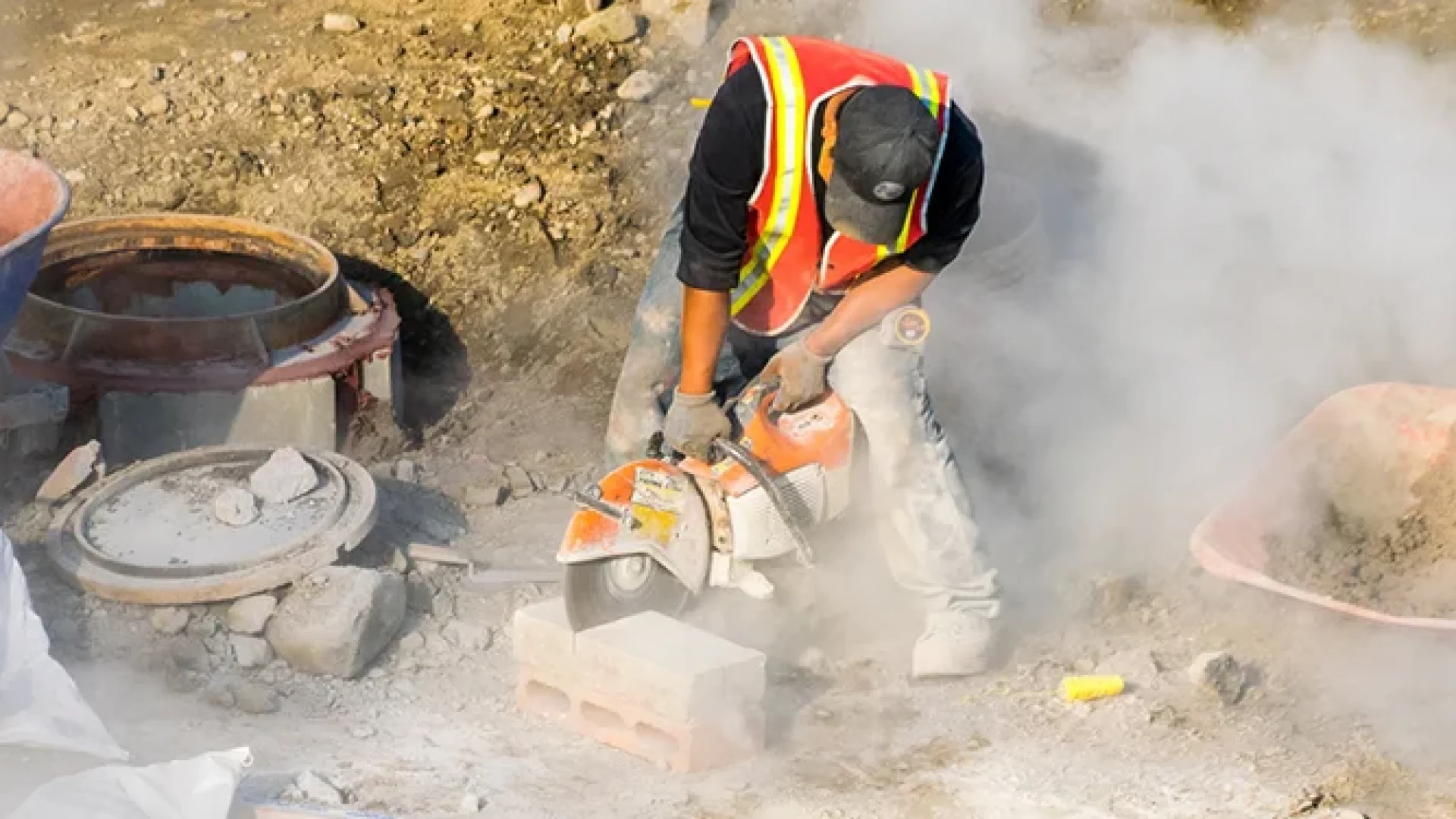
A dry saw cut through a 150 mm slab produces more regulated airborne hazard in ten minutes than most of the rest of the job produces in a week. Alberta’s occupational exposure limit for respirable crystalline silica is 0.025 milligrams per cubic metre, averaged over eight hours — a number small enough that a visible dust cloud has already blown past it, several times over, before anyone thinks to mention it at the morning huddle.
That single figure is the whole reason silica sits in a different legal category than noise, or ice, or the other things a Calgary site manages by habit. After 38 years cutting, coring and removing concrete around this city, we have watched the paperwork around that number grow from an afterthought into one of the first things a serious general contractor asks about. This page sets out what Alberta’s Occupational Health and Safety Code actually requires, who it requires it of, and what it looks like on a real jobsite.
The short answer
Alberta regulates respirable crystalline silica in two separate ways, and a site needs to satisfy both.
- An exposure limit. Schedule 1, Table 2 of the OHS Code sets the eight-hour occupational exposure limit for respirable crystalline silica at 0.025 mg/m3. Section 16 requires an employer to keep worker exposure as low as reasonably practicable, and below that limit.
- A written code of practice. Respirable crystalline silica is also listed in Schedule 1, Table 1 — the table of substances and processes that require a code of practice under section 26. This is the requirement most subcontracts miss. The exposure limit is a ceiling; the code of practice is a document, and it either exists before work starts or it does not.
Everything else — wet cutting, vacuum shrouds, respirators, health assessments — hangs off those two obligations.
Why concrete cutting is the sharpest hour on a concrete site
Concrete is roughly a quarter to a third crystalline silica by mass once you account for the sand and much of the coarse aggregate. Intact, it is inert. The hazard is created by the tool: a diamond blade, a core bit, a grinder cup or a hydraulic breaker fractures that silica into particles small enough to reach the deep lung and stay there.
The scale of the problem is not speculative. CAREX Canada estimates that approximately 429,000 Canadians are exposed to crystalline silica at work, with the construction sector — specialty trade contractors, building construction, and heavy and civil engineering — accounting for roughly 69 per cent of them, about 296,000 workers. Construction trades labourers alone account for around 133,000 of those, and heavy equipment operators another 46,000.
What the exposure produces is worth stating plainly, because it is the reason the Code treats silica differently. The Canadian Centre for Occupational Health and Safety describes three forms of silicosis: chronic silicosis, the most common, appearing after 15 to 20 years of moderate to low exposure; accelerated silicosis, detectable after 1 to 10 years of high exposure; and acute silicosis, which can appear after a few months and as little as two years of extremely high concentrations. CCOHS is blunt about the outcome: there is no effective treatment for silicosis. Untreated, it carries on into lung cancer, COPD, vulnerability to tuberculosis, and kidney disease.
That is the hazard a general contractor is signing for when a saw arrives on site.
What the Code requires, section by section
Part 4 of the OHS Code — Chemical Hazards, Biological Hazards and Harmful Substances — carries the operative sections. These are the ones that get cited when an officer walks a Calgary site during a cut.
| Section | What it requires | What it looks like on site |
|---|---|---|
| Section 16 | Worker exposure to a harmful substance kept as low as reasonably practicable and below the occupational exposure limit | The 0.025 mg/m3 ceiling, and the duty to work below it rather than just at it |
| Section 20 | Airborne concentration measured by a recognized method — NIOSH, OSHA, HSE, EPA, IRSST, ISO or DFG | Personal air sampling by a qualified hygienist, not a visual judgment call |
| Section 26 | A written code of practice for substances listed in Schedule 1, Table 1 | A silica code of practice on file before the first cut, naming controls, PPE, cleanup and monitoring |
| Section 28 | Minimize release to air, remove unnecessary accumulations, decontaminate without re-generating airborne dust | Wet methods, shrouded vacuums, no dry sweeping of slurry or settled dust |
| Section 39 | Restricts the use of crystalline silica in abrasive blasting | Rules out silica sand as a blasting abrasive for surface prep |
| Section 40 | Health assessments for workers exposed to asbestos, silica or coal dust | Baseline and periodic medical surveillance for the crew who actually cut |
Two of those deserve their own sections, because they are where most Calgary jobs come up short.
The control hierarchy, in the order the Code sets it out
The Code does not accept “we issued dust masks” as a silica control program. It expects a hierarchy, applied in order, with personal protective equipment as the last resort rather than the plan:
- Elimination or substitution. Score and snap instead of cutting. Cast the opening rather than cutting it later. Order a unit with the penetration already in it. The cut you never make is the only control with a 100 per cent success rate.
- Engineering controls. Wet cutting with a continuous water feed to the blade, and shroud-and-vacuum systems on grinders and hand saws. These are the workhorse controls, and they are the ones that actually move a measured result below the limit.
- Administrative controls. Scheduling cuts when the fewest trades are in the area, marking a controlled zone, rotating operators, and prohibiting dry sweeping. Section 28’s requirement to remove accumulations without generating airborne dust is an administrative rule as much as an engineering one.
- Personal protective equipment. Fit-tested respirators selected for the measured concentration — chosen after sampling, not instead of it.
The practical Calgary complication is water. From roughly November to March, wet cutting means managing slurry that freezes, a hose that freezes, and a surface that becomes a slip hazard the moment the saw stops. That is a real constraint, and the honest answer is not to quietly revert to dry cutting: it is to plan for tempered water, heated enclosures for interior work, or a shrouded vacuum system rated for the tool. Winter is a reason to change the method, not to drop the control.
Health assessments: the requirement subcontracts forget
Section 40 requires health assessments for workers exposed to silica, and it is specific about timing. A worker must have an assessment within 30 days of becoming an exposed worker, and then every two years afterward. The assessment includes health history, a chest x-ray with a radiologist’s report, lung function testing, and a physician’s interpretation. The physician retains those records for 30 years — a period that outlasts most companies, most contracts and most careers.
This is the clause that separates a contractor with a silica program from a contractor with a silica policy. Air sampling can be arranged in a week. A medical surveillance history cannot be backfilled, and nothing in a bid document creates one retroactively.
Where this page stops
This page is about a harmful substance and the controls attached to it. It is not about who holds the prime contractor designation on a multi-employer site, which is a separate question under the OHS Act with its own thresholds and its own paperwork. It is also not about vetting a contractor’s safety record before you hire — certificates, claims history and coverage letters live in a different conversation, and we have written about the questions that belong there in common mistakes when hiring a concrete contractor and in the questions worth asking before you sign.
What this page covers is narrower and more immediate: the hour the blade is in the slab.
What to ask before the saw starts
Four questions, asked at the pre-construction meeting rather than the day of the cut, settle almost everything:
- Is there a written silica code of practice, and can I see it? Table 1 makes this mandatory, not optional. Ask for the document, not a description of it.
- What method will be used on this cut, and what happens if it freezes? A crew that has thought about slurry in February has thought about the rest of it too.
- Has anyone sampled this method, on this kind of work? Section 20 wants a recognized method, and a real number beats an assurance.
- Are the operators current on their section 40 assessments? Thirty days in, every two years after. A straight answer here tells you how long the program has actually existed.
Across 52,000+ projects, the pattern we see is consistent: the sites where silica is handled well are the sites where these questions were asked before mobilization, not after a complaint. The cost of the controls is small and predictable. The cost of retrofitting a program mid-job — stopping work, sampling, re-sequencing trades around a controlled zone — is neither.
FAQ
What is the silica exposure limit in Alberta? The occupational exposure limit for respirable crystalline silica is 0.025 mg/m3 averaged over an eight-hour work shift, set in Schedule 1, Table 2 of the Alberta OHS Code. Section 16 also requires exposure to be kept as low as reasonably practicable, not simply under the number.
Do I need a silica code of practice for a single small cut? Respirable crystalline silica is listed in Schedule 1, Table 1, which is the trigger for the section 26 code of practice requirement. The size of the job does not create an exemption; the presence of the hazard is what matters.
Does wet cutting eliminate the need for respirators? Not automatically. Wet cutting is an engineering control that usually reduces airborne concentration dramatically, but whether respiratory protection is still required depends on the measured concentration for that task under section 20.
Who is responsible — the general contractor or the cutting sub? Both carry duties. The sub is the employer of the operators and owns the code of practice and the health assessments; the general contractor controls the site, the sequencing and the conditions the work happens in. Neither role absorbs the other.
Is dry cutting ever acceptable? Only where an equivalent control keeps exposure below the limit — typically a properly rated shroud-and-vacuum system on the tool, verified by sampling. Dry cutting with no capture at all is not a defensible position on a Calgary site.
Planning a cut, a core or a removal?
If you have penetrations, saw cuts, coring or a demolition scope coming up on a Calgary project, talk to us early — while the sequence can still be changed. Our concrete cutting and coring crews work to a written silica program, and our concrete removal teams plan dust control into the demolition sequence rather than around it. If you want to see how we put it in writing, our warranty and guarantee page sets out what we commit to and how.
Sources
- Alberta Occupational Health and Safety Code, Part 4 — Chemical Hazards, Biological Hazards and Harmful Substances: https://search-ohs-laws.alberta.ca/legislation/occupational-health-and-safety-code/part-4-chemical-hazards-biological-hazards-and-harmful-substances/
- Alberta Occupational Health and Safety Code, Schedule 1 — Chemical Substances (Table 1 and Table 2): https://search-ohs-laws.alberta.ca/legislation/occupational-health-and-safety-code/schedule-1-chemical-substances/
- Canadian Centre for Occupational Health and Safety, Silicosis: https://www.ccohs.ca/oshanswers/diseases/silicosis.html
- CAREX Canada, Silica (Crystalline) — Occupational Exposures: https://www.carexcanada.ca/profile/silica_crystalline-occupational-exposures/