

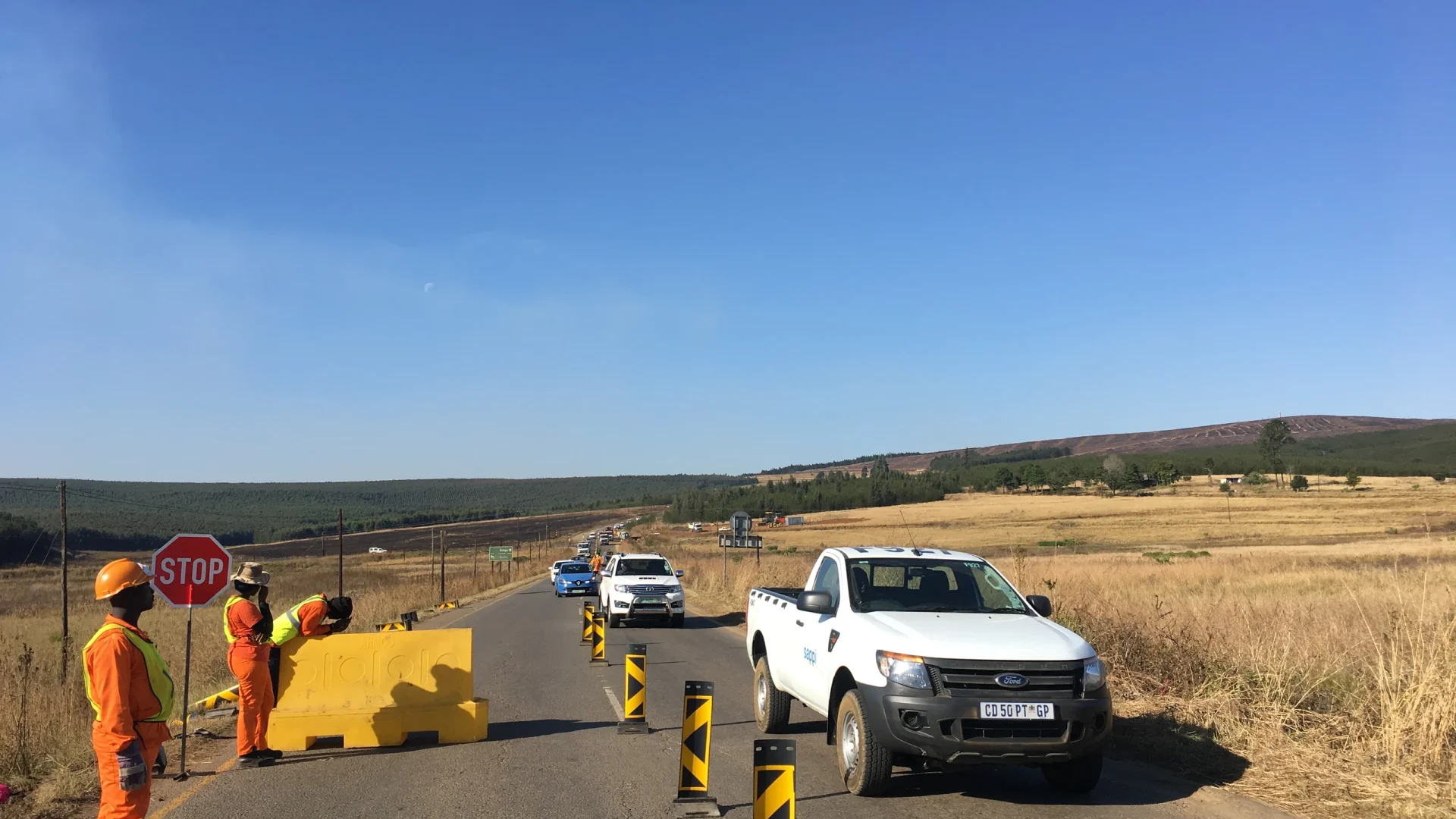
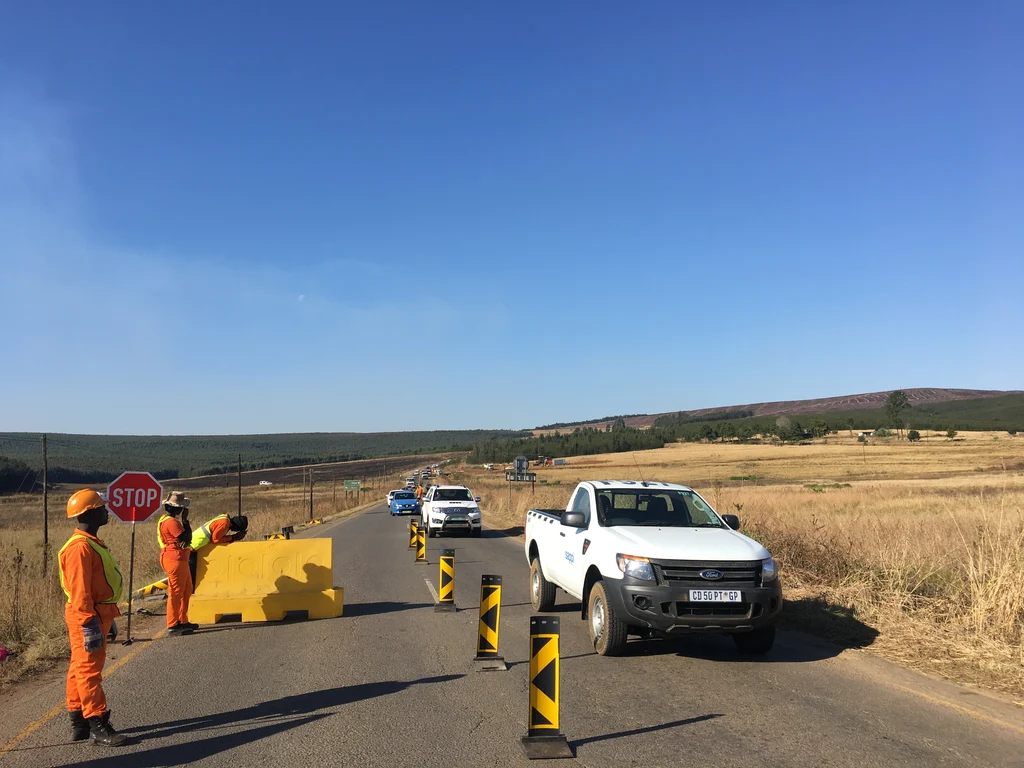
The curb return, the sidewalk crossing, the service walk that ties a new building to the public walk, the tear-out of an old driveway crossing — all of it sits in land the City owns, and none of it can be scheduled off a concrete crew’s calendar alone. The pour date is set by a permit queue, and the queue starts counting in business days from a complete application, not from the day you decide you want the lane.
After 38 years pouring concrete in this city, we have watched more pours slide on paperwork than on weather. The pattern is always the same: the mix was booked, the forms were ready, the lane was not. What follows is the approval stack as it runs on City right-of-way, with the numbers your plan has to hit and the lead times that decide whether next Tuesday is real.
The short answer: three approvals, and the longest lead time wins
Work in a City road right-of-way normally needs a street use permit, a temporary traffic control plan reviewed by the City, and — where you are breaking ground — a separate excavation permit. The City’s Temporary Traffic Control Manual puts it plainly: “All work on City-owned ROW requires authorization and applicable permit(s),” and the flow chart for work on City right-of-way states you “must obtain a street use permit or have a city-wide annual street use permit.”
Those approvals run in parallel, not in sequence, and your pour date is governed by whichever one has the longest clock. That is almost never the traffic plan itself.
What counts as the right-of-way is wider than the road
The right-of-way is not just pavement. The City defines the area a street use permit covers as “a street, a sidewalk, an alley, a walkway, a back lane, or a boulevard.” A permit is required “to exclusively use any City road right-of-way.”
This is where scopes get mispriced. Parking a pump on the boulevard, stockpiling forms on the walk, running a chute across a sidewalk, closing a back lane so a tandem can get to a tear-out — each one is exclusive use of the right-of-way, even when no travel lane is touched. If parking has to go, that is a further approval: a Temporary No Parking Permit is required “to temporarily restrict parking along a curb lane,” and the City notes these “are only issued in conjunction with a Street Use Permit.”
Current street use fees are published, so they belong in the bid rather than in a change order: $31.50 per day, or $7,528.10 per year for an annual permit, plus $119.10 per additional vehicle on an annual permit. Where the City has to coordinate the closure, planning and coordination is billed at $158.05 per hour, and site inspection is variable with complexity. These are the kinds of line items that separate a real number from an optimistic one when you are putting a concrete quote together.
Which manual governs your work zone
Two different documents apply in Alberta, and using the wrong one is a rejected plan.
On City of Calgary right-of-way, the governing document is the City’s Temporary Traffic Control Manual, and the City is explicit about who decides: “The Traffic Engineer is the final authority on temporary traffic control standards.” Submitted plans go to the City for review — “All Temporary Traffic Control Plans will be reviewed and approved by Mobility, Traffic.”
On provincial highways, the governing document is Alberta’s Traffic Accommodation in Work Zones, which uses different language and different geometry. It calls the document a Traffic Accommodation Strategy and assigns ownership by who is doing the work: “For work performed by a Contractor on a Department construction or highway maintenance contract, the TAS shall be developed by the Contractor.” Its taper rule is a ratio rather than a table — “Generally, on multi-lane highways, tapers shall be 40:1” and “On two-lane highways tapers shall be 5:1.”
For most Calgary flatwork and foundation work, the City manual is the one that matters. On ring-road and provincial connections, it is not, and a lane closure on Deerfoot or Stoney Trail carries its own permit with a stated two-week lead time.
The lead times that actually move your pour date
Apply by impact, because the City’s minimum review windows scale with it: high-impact closures require a minimum of 15 business days, moderate-impact 10 business days, and lower-impact 5 business days. The clocks “start once a complete and compliant application is submitted” — an incomplete package does not hold your place.
Then come the notifications, which are easy to miss and run just as long:
- Calgary Transit — at least 15 business days in advance for a traffic detour affecting a bus route or stop.
- Waste and Recycling — at least 15 business days in advance where a laneway or street closure affects collection for more than one day.
- Traffic signals — a minimum of 15 business days in advance for work affecting signal operations.
- No Parking zones — five business days advance notice.
- LRT crossings — Calgary Transit “shall be notified 48 hours in advance of work performed at or near an LRT crossing.”
Read that list against a typical commercial sidewalk and curb scope on a bus route and the honest answer is three working weeks from a complete application, not three days. Build it into the schedule at tender, the same way you would build in a strength milestone.
Who is allowed to draw the plan
Not whoever is free that afternoon. The City requires accreditation on both ends of the work: “It is required that all persons designing temporary traffic controls (TTCs) be accredited by an appropriate agency,” and the same applies to the people putting the plan in on site — “It is required that all persons involved in the implementation of TTC plans should be accredited by an appropriate agency.”
There are then two routes. A plan built from the City’s standard layouts is submitted referencing the manual. A plan for conditions the manual does not cover is site-specific and has to be authenticated: “Authenticated TCP must follow standards issued by The Association of Professional Engineers and Geoscientists of Alberta.”
The practical read: if your work zone is ordinary, use the manual and keep the submission simple. If you are closing a sidewalk on a collector or better, or your geometry does not match a standard layout, budget for engineering and add time.
The geometry your plan has to hold
These are the numbers that decide whether your layout survives review and whether your forms and placing crew actually fit.
| Element | City of Calgary requirement |
|---|---|
| Travel lane width | 3 m minimum per lane; 3.3 m on fire and bus routes |
| Sidewalk width | 2 m minimum in the city centre or high pedestrian volume areas; 1.5 m elsewhere |
| Merging taper | L (min) |
| Shifting taper | L/2 (min) |
| Shoulder taper | L/3 (min) |
| Two-way taper | 10 m – 30 m |
| Downstream taper | L/3 (min) |
| At 50 km/h | L = 30 m, buffer B = 35 m, device spacing D = 8 m, minimum 5 delineators |
| At 100 km/h | L = 125 m, buffer B = 70 m, device spacing D = 18 m |
| Cones | 450 mm minimum height at 50 km/h or less; 700 mm for speeds up to 60 km/h |
| Drums | Required on roadways at 70 km/h or more |
| Signs | All retro-reflective unless otherwise specified; regular size typically for 50 km/h or less, large for 60 km/h or more |
Two of these have direct construction consequences. The 3 m lane minimum is what squeezes a closure on a narrow collector until a two-way flagged operation is the only option. The sidewalk minimum is why a plan assuming a 1.2 m corridor past the work gets sent back.
Pedestrians are the part that gets plans rejected
Separate them physically and keep the route continuous. The City requires that “Pedestrian and cyclist traffic must be physically separated from workers and equipment in the work area,” and sets the standard for any detour: “A pedestrian detour route must provide a safe, continuous, accessible, and convenient route,” on a smooth hard surface.
Pushing pedestrians across the street is treated as a last option, not a default — a full closure that forces crossings “should only be done as a last resort,” and where it happens, advance signage is required at the nearest intersections. Above all, the approval is not yours to assume: “All full sidewalk closures must be approved by Traffic Services.”
On a sidewalk replacement, that single line often decides sequencing. Pouring in two halves to keep a walking route open costs more in mobilization and joints than a single pour, and it is frequently still the faster path to an approved plan. The joint and slope detailing on those stage lines matters as much as the schedule does, which is the same discipline that drives exterior slope tolerance on flatwork.
Flaggers: certified, and not at a signalized intersection
A traffic control person is required in defined cases, including “When two-way traffic has to be guided through a single lane,” and the person has to be trained: “Any individual who will be acting as a traffic control person shall be professionally trained in flagging.” Alberta’s provincial manual is stricter still on documentation — “All flagpersons must be certified and their certification must be readily available.”
The limit that surprises crews: a traffic control person is not authorized to flag at a signalized intersection. That work requires a Calgary Police Services pay duty officer, which is a cost and a booking, not a reassignment of someone on your crew.
What the OHS Code asks of the crew, not the plan
An approved plan does not discharge your duty to the people inside it. Section 194 of Alberta’s OHS Code deals with vehicle traffic control, and the province’s explanation guide sets the order of operations clearly: engineering and administrative controls come first, and “Highly visible apparel should be considered to be a second line of defense against such hazards.” The duty itself is not optional — “Workers on foot and exposed to the hazards of moving vehicles are required to wear highly visible apparel,” with CAN/CSA Z96-09 cited as guidance on the apparel.
Subsection 194(7) addresses traffic control devices, with the Manual of Uniform Traffic Control Devices for Canada identified as the design and application reference. Alberta’s work-zone manual makes the underlying obligation general: “the person(s) performing the work must take steps to ensure the safety of road users and workers.”
On a prime contractor job, the traffic plan and the site safety system have to agree on paper, because an inspector will read them together.
A short table for the project binder
| Item | Who | Minimum lead time |
|---|---|---|
| Street use permit, high impact | Contractor | 15 business days |
| Street use permit, moderate impact | Contractor | 10 business days |
| Street use permit, lower impact | Contractor | 5 business days |
| Temporary traffic control plan | Accredited designer; APEGA authentication if site-specific | Submitted with the permit application |
| Temporary No Parking | Contractor, with a street use permit | 5 business days |
| Calgary Transit / Waste / signals notification | Contractor | 15 business days |
| LRT crossing notification | Contractor | 48 hours |
| Excavation permit | Contractor | Before any excavation begins |
| Full sidewalk closure approval | Traffic Services | Before the plan is final |
Frequently asked questions
Do I need a street use permit for a one-day sidewalk pour? If the work exclusively occupies any part of the right-of-way — including the sidewalk or boulevard — a permit is required. Duration changes the impact classification and the lead time, not whether a permit applies.
Can I use a standard City layout instead of paying for an engineered plan? Yes, where your conditions match a layout in the Temporary Traffic Control Manual. The submission references the manual. Site-specific plans require authentication to APEGA standards.
Who approves my plan? Mobility, Traffic reviews and approves temporary traffic control plans, and the Traffic Engineer is the final authority on temporary traffic control standards.
Is a flagger enough to work through a signalized intersection? No. A traffic control person is not authorized to flag at a signalized intersection; a Calgary Police Services pay duty officer is required.
Does the provincial work-zone manual apply to my Calgary job? Only where the work is on a provincial right-of-way. On City right-of-way, the City’s manual governs, and a lane closure on Deerfoot or Stoney Trail carries a separate permit with a two-week lead time.
Do permit fees belong in the bid or in extras? In the bid. The daily and annual street use rates, the per-vehicle rate on annual permits, and the hourly coordination rate are all published, so there is no reason to carry them as an unknown — the same argument that applies to holdback and payment timing, covered in our note on Alberta construction holdback rules.
Talk to us before the street use application goes in
The cheapest version of this work is the one where the traffic plan, the staging and the pour sequence are decided together, before anything is submitted. We would rather look at your right-of-way scope while the application is still a draft than re-stage a sidewalk pour because the approved plan left no room for the forms.
Reach our commercial concrete contractors in Calgary to set that up, or see our concrete removal page if the scope starts with a tear-out in the right-of-way.
Sources
- City of Calgary, Temporary Traffic Control Manual, 2025 Edition — https://www.calgary.ca/content/dam/www/transportation/roads/documents/contractors-and-consultants/temporary-traffic-control-manual.pdf
- City of Calgary, Street use permit — https://www.calgary.ca/roads/permits/street-use.html
- Alberta Transportation, Traffic Accommodation in Work Zones, 2018 — https://www.transportation.alberta.ca/Content/docType233/Production/TAWZ2018-2.pdf
- Government of Alberta, OHS Code Part 12 Explanation Guide — General Safety Precautions — https://open.alberta.ca/dataset/757fed78-8793-40bb-a920-6f000853172b/resource/16b5e158-0cca-4308-ad00-aee67a3283ae/download/4403880-part-12-general-safety-precautions.pdf