
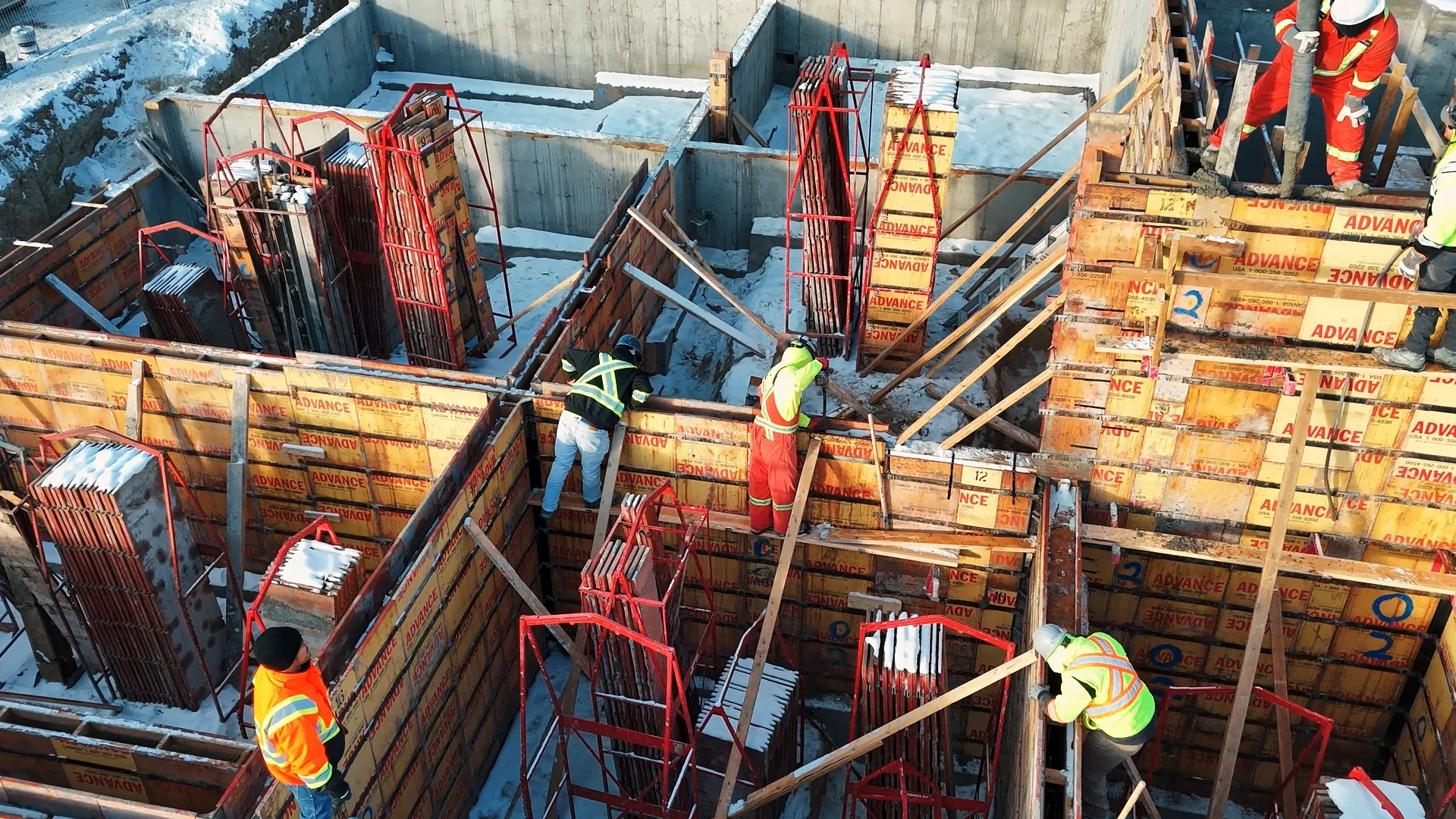
In Calgary, the foundation-system choice is decided by the ground first, the structure second, and the season third. Start with the geotechnical bearing value: NBC (Alberta Edition) Part 9 presumes 75 kPa allowable soil bearing for prescriptive footings. At or above that, a poured (cast-in-place) or precast concrete foundation on conventional footings is usually the call; below it, or for problem soils, you need an engineered (Part 4) design, which is where helical/screw piles and grade beams enter.
As a rule of thumb: cast-in-place is the honest default for full basements and one-off custom geometry; precast wins on repeated plans, heavy lateral load, and shoulder-season schedule; helical piles suit decks, garages, additions, and light structures on poor, soft, or high-groundwater soil, rarely a full-basement house on their own. Every concrete option still answers to Calgary’s S-2 sulphate soil; every system needs a P.Eng.-stamped design, and piles need a CCMC evaluation number.
This is a system-selection tree, not a wall-product comparison. For the concrete-wall fork specifically (solid precast vs Superior Walls composite vs poured), see the Omega Precast guide linked below; we don’t re-run that R-value/joint comparison here.
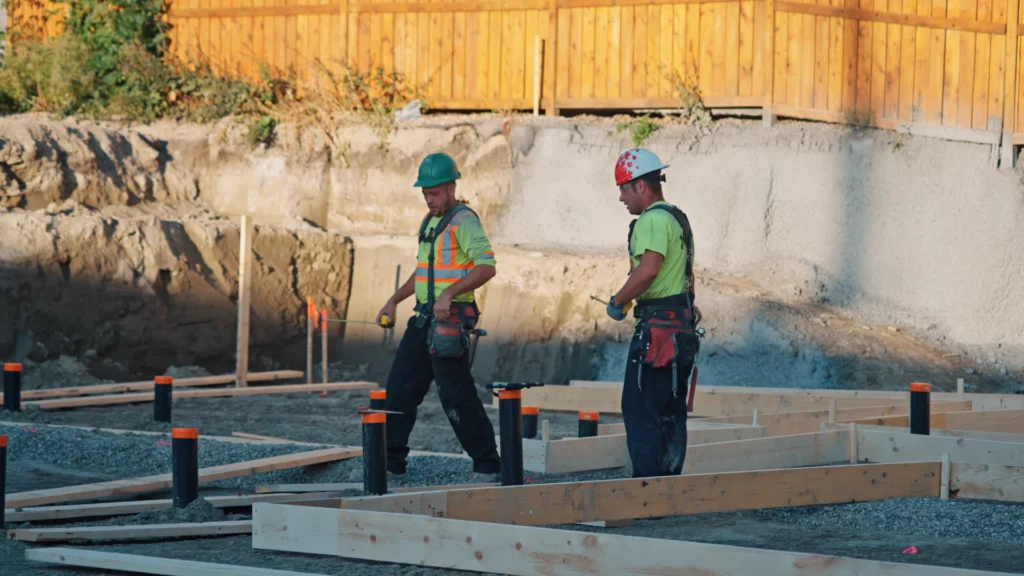
The decision tree, in one table
Read it top-down: the geotech report sets the first fork, structure and season set the rest.
| Driver (in order) | Points toward cast-in-place | Points toward precast | Points toward helical/screw pile |
|---|---|---|---|
| 1. Soil bearing (geotech) | ≥75 kPa, conventional footings | ≥75 kPa, conventional footings | <75 kPa, soft/loose, high groundwater → engineered design |
| 2. Structure & geometry | Full basement; one-off custom shapes, stepped walk-outs | Heavy lateral load; repeated plans; R-CG row blocks | Decks, garages, additions, light structures |
| 3. Season & access | Warm season; tight infill where a crane won’t fit | Q4/shoulder season (off-site pour); crane access | Winter install; immediate load (no cure); low vibration |
| 4. Finished basement? | Yes (adaptable interior) | Yes (schedule compression) | Usually N/A (not a basement system) |
| 5. Calgary sulphate (S-2) | Type HS concrete required | Type HS concrete required | Sidesteps concrete sulphate attack; adds steel-corrosion/galvanizing consideration |
Sources for the table are cited inline in the sections below. Validate every project against a P.Eng.-stamped design and current Calgary quotes.
What’s the structural fork at the top of the tree?
The geotechnical bearing value. Under NBC (Alberta Edition) Part 9 §9.15, prescriptive footings rest on undisturbed soil or engineered fill with a presumed allowable bearing pressure of 75 kPa. When a geotechnical report finds bearing below that, or flags a problem soil, the prescriptive path closes and you need an engineered (Part 4) design; pile-plus-grade-beam systems are, by definition, engineered designs. (Sources: City of Edmonton Footing and Foundation permit guide.)
So the first question is never “poured or piles?” It’s “what did the geotech report say the soil will carry?” That number routes you down the tree. (For how to read the rest of that report, including sulphate, frost, slope, and deep fill, see the geotech-decoder companion article linked below.)
This fork is real in Calgary because the soil varies by corridor. On acreage, Springbank can present Bearpaw bedrock at footing depth, Priddis has fluvial-gravel terraces with variable bearing, and De Winton runs deep till: different bearing and foundation drivers within an hour’s drive. (Source: Omega Knowledge Base §7, the five acreage soil profiles.)
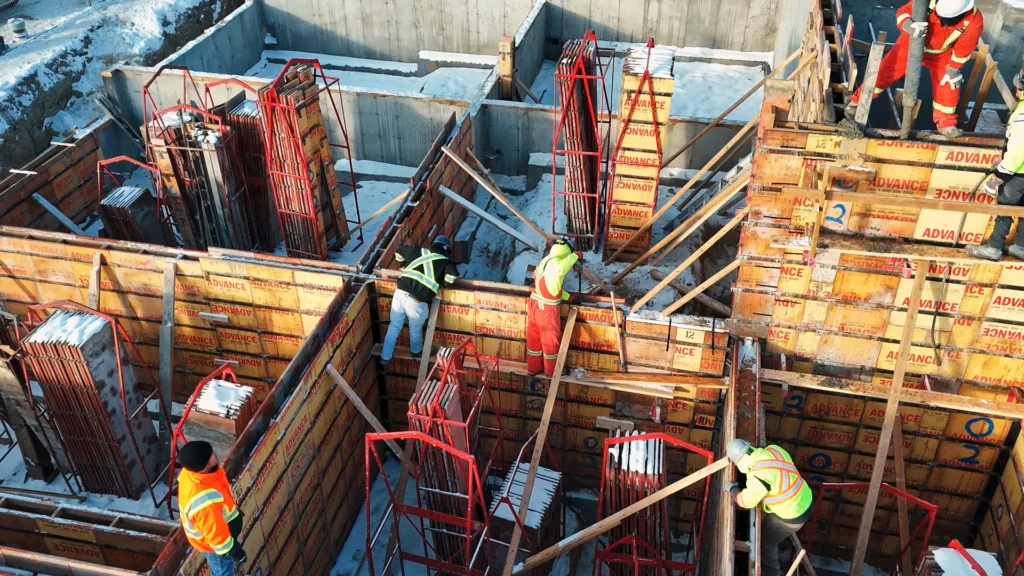
When is a poured (cast-in-place) foundation the right choice?
It’s the honest default for full basements and anything with one-off geometry. A cribbing crew sets formwork on the lot, places rebar, pours from a ready-mix truck, and the wall cures in place. Its defining structural virtue is a monolithic pour with no seams or joints, which is an advantage on potential leak paths. (Source: NJGCB.)
Cast-in-place wins when:
- You need a full basement with conventional spread footings on soil that carries ≥75 kPa.
- The geometry is one-off: stepped walls, irregular walk-out elevations, architecturally driven shapes that don’t fit standard panels.
- It’s a warm-season build (May–September) with no cold-weather premium.
- The lot is tight infill (Inglewood, Hillhurst, Bridgeland) where a crane footprint won’t fit.
Governing standards: CSA A23.1:24 (concrete materials and methods) and CSA A23.3:24 (design of concrete structures, including footings and grade beams). (Source: Omega Knowledge Base §5.) This is Omega 2000 Cribbing’s daily default, and we’ll say plainly when one of the other two systems is the better call.
When does precast make more sense?
On repeated plans, heavy lateral load, and shoulder-season schedule. A plant casts a solid reinforced concrete wall, cures it under controlled temperature and humidity, and ships it to site at full design strength for a crane-and-set install: the same material as a poured wall, cured indoors instead of on your lot. Governed by CSA A23.4 (precast) plus CSA A23.1:24 and A23.3:24.
Precast leans ahead when:
- The engineer wants sectional thickness for heavy lateral load: deep backfill, multi-storey load above, walk-out steps.
- Plans repeat at scale: same-spec single-family or townhome blocks, R-CG row blocks (precast’s economic sweet spot).
- The build runs Q4 into Q1: the off-site wall pour bypasses the September 30 cold-weather premium.
- You’re compressing a finished-basement schedule: panels arrive at design strength and set in about a day.
For the full concrete-wall comparison (solid precast vs the Superior Walls insulated composite vs poured, including R-value and joint detailing), see “Solid precast vs Superior Walls vs poured” (Omega Precast). We point there rather than re-run it, because that’s a wall-product question and this is a system question.
When are helical/screw piles the right call, and when are they not?
Right for light structures and poor soil; generally wrong as a full-basement house foundation on their own. A helical (screw) pile is a steel shaft with one or more helical plates, turned into the ground to bear below the frost line. There’s no concrete to cure, so it takes load immediately, installs in winter, and produces minimal vibration on tight urban lots. Presented here as the pile case, balanced against concrete, not as an anti-concrete argument.
Helical piles tend to win when:
- The soil is poor: low-bearing topsoil, high groundwater, waterlogged or soft clay where a conventional footing would need to be oversized or won’t perform. (Source: GoliathTech house/garage guide, https://www.goliathtechpiles.com/what-is-the-best-type-of-foundation-for-a-house-screw-piles-concrete-slab-or-strip-footings ; Postech, https://postechpiles.com/blogs/other/screw-piles-advantages-disadvantages-and-comparisons/ .)
- The structure is light: decks, detached garages, additions, sunrooms. (Source: Olshan helical guide, https://www.olshanfoundation.com/foundation-repair/foundation-repair-methods/helical-piers/ .)
- You need immediate load or a winter install: no cure window, no cold-weather concrete procedure stack.
- Vibration must be minimal: adjacency to existing structures on a tight lot.
They are generally not a standalone full-basement house solution; that’s where a poured or precast foundation remains the default. The honest read: a pile is a tool for the light/poor-soil case, not a universal replacement for a concrete basement.
Do screw piles need to go below Calgary’s frost line?
Yes; the helix must bear below frost, and good systems isolate the shaft from frost jacking. Calgary’s frost line runs roughly 1.2–2.1 m (4–7 ft), deeper in extreme years, and a helical pile’s bearing plate must sit below it so seasonal frost doesn’t lift the structure. (Source: Calgary Screw Piles science page, https://www.calgaryscrewpiles.com/science ; screwpilescalgary.com, https://screwpilescalgary.com/do-screw-piles-need-to-go-below-the-frost-line/ ; vendor sources, pro-pile framing, presented as the pile case.)
The frost-heave physics cuts in piles’ favour for light structures: a narrow, smooth steel shaft below the frost line gives frost less to grip than a wide concrete pier, and CCMC-evaluated systems such as Techno Metal Post include a polyethylene frost sleeve that isolates the shaft from frost jacking. The balanced counterpoint for concrete: a properly designed and drained concrete footing at the 1.2 m embedment, with Type HS concrete, has performed in Calgary ground for decades. The issue isn’t “concrete vs steel,” it’s matching the system to the soil and the load.
What soil conditions push you off a standard poured footing?
Anything that drops measured bearing below ~75 kPa, or otherwise triggers an engineered design. That includes:
- Low-bearing or loose soils below the Part 9 presumed 75 kPa.
- High groundwater / waterlogged ground, which undermines a shallow footing and favours a deep-foundation (pile) solution.
- Deep fill: soils filled more than two metres deep require geotechnical analysis and can require bearing certificates and special foundation designs.
- Expansive clay that swells and shrinks seasonally, a known Calgary driver.
- Loads exceeding the prescriptive Part 9 envelope regardless of soil.
In any of these, the prescriptive footing closes and a P.Eng. designs the alternative: wider engineered footings, a raft, or a pile-and-grade-beam system. (Sources: Edmonton Footing/Foundation guide + BCBC §9.15, URLs above; Omega Knowledge Base §7/§8.) The bearing number on the geotech report is the single most action-changing line in the whole decision.
How does Calgary’s S-2 sulphate soil affect each system?
It governs the concrete in every option, and it’s the one variable a steel pile partly sidesteps. Calgary soil routinely tests S-2 (soluble sulphate ≥0.20%), which mandates Type HS/HSb sulphate-resistant cement and, under CSA A23.1:24, a minimum of 32 MPa at 56 days for S-2 exposure (35 MPa is a common premium, not the minimum). (Sources: Concrete Alberta, https://concretealberta.ca/ ; CSA A23.1:24, https://www.csagroup.org/store/product/CSA%20A23.1%3A24/ ; Omega Knowledge Base §3.)
- Cast-in-place and precast both require Type HS concrete; the chemistry is identical, only the cure environment differs.
- Helical piles sidestep sulphate attack on concrete (there’s far less or no concrete in the load path) but introduce a steel-corrosion consideration, which is why galvanizing and a P.Eng.’s durability assessment matter. (Source: GoliathTech, URL above.)
So S-2 doesn’t pick a system by itself, but it sets the concrete spec on two of the three paths and reframes the durability question on the third. (For the full Type HS chemistry, and why Calgary needs it, see the Type HS companion article linked below; we don’t re-derive it here.)
Do I need a P.Eng. and a CCMC number for screw piles?
Yes to both, for a code-compliant pile foundation. Helical/screw piles are CCMC-evaluated to the National Building Code as foundation systems, and the installed design must be stamped by a P.Eng. licensed in Alberta (APEGA member under a valid permit to practice). The CCMC number is your evidence the product is evaluated; the P.Eng. stamp is your evidence the design fits your soil and loads.
Examples of CCMC-evaluated systems to ask about by number:
- Almita: CCMC 13691-R. (https://ultimatefoundations.com/wp-content/uploads/2019/08/Almita-CCMC-13691-R_2019.pdf )
- Techno Metal Post: CCMC 13059-R (includes the polyethylene frost sleeve). (https://www.technopieux.com/wp-content/uploads/13059-R_e-1.pdf )
- Hubbell/CHANCE: CCMC 13193-R. (https://hubbellcdn.com/testdoc/13193_e.pdf )
(General CCMC reference: NRC Canadian Construction Materials Centre, https://nrc.canada.ca/en/certifications-evaluations-standards/canadian-construction-materials-centre/ccmc-technical-bulletin-auger-installed-steel-pile-foundations . APEGA: https://www.apega.ca/ .)
The neutral due-diligence rule for any system: ask for the standards it’s built to. For piles, that’s a CCMC number + a P.Eng.-stamped design; for concrete, that’s CSA A23.1:24 / A23.3:24 / A23.4 compliance + Type HS for S-2 soil + a P.Eng. stamp where the design is engineered. The system that can show its paperwork is the system that earned the spec.
FAQ
Cast-in-place vs precast vs helical pile: which foundation is right in Calgary? The ground decides first. NBC (Alberta Edition) Part 9 presumes 75 kPa soil bearing; at or above that, a poured or precast concrete foundation on conventional footings is usually right; below it (or for problem soils) you need an engineered design, which is where helical piles and grade beams come in. Cast-in-place is the default for full basements and custom geometry; precast wins on repeated plans, heavy load, and shoulder-season schedule; helical piles suit decks, garages, additions, and light structures on poor soil.
When is a poured (cast-in-place) foundation the best choice? For full basements on soil carrying ≥75 kPa, one-off custom geometry (stepped walls, irregular walk-outs), warm-season builds, and tight infill where a crane won’t fit. Its structural virtue is a monolithic pour with no seams or joints. It’s governed by CSA A23.1:24 and CSA A23.3:24 and is the everyday default in Calgary.
When does precast make more sense? On repeated plans at scale (single-family or townhome blocks, R-CG rows), heavy lateral load where the engineer wants sectional thickness, Q4/shoulder-season builds (the off-site pour bypasses the September 30 cold-weather premium), and finished-basement schedule compression (panels set in about a day at design strength). For the full solid-precast vs Superior Walls vs poured wall comparison, see the dedicated Omega Precast guide.
When are helical/screw piles the right call, and when are they not? Right for decks, garages, additions, and light structures, and for poor, soft, or high-groundwater soils, immediate-load or winter installs, and low-vibration sites. Generally not a standalone full-basement house foundation; that stays with poured or precast concrete. Presented as the pile case, balanced against concrete.
Do screw piles need to go below Calgary’s frost line? Yes. Calgary’s frost line is roughly 1.2–2.1 m (4–7 ft), deeper in extreme years, and a helical pile’s bearing plate must sit below it so frost doesn’t lift the structure. CCMC-evaluated systems such as Techno Metal Post add a polyethylene frost sleeve to isolate the shaft from frost jacking. A properly designed, drained concrete footing at the 1.2 m embedment also performs; match the system to soil and load.
What soil conditions push you off a standard poured footing? Measured bearing below the Part 9 presumed 75 kPa, loose or soft soils, high groundwater, deep fill (more than two metres, which can require bearing certificates), expansive clay, or loads beyond the prescriptive envelope. Any of these closes the prescriptive footing and triggers a P.Eng.-engineered design: wider footings, a raft, or a pile-and-grade-beam system.
How does Calgary’s S-2 sulphate soil affect each system? Calgary soil routinely tests S-2 (soluble sulphate ≥0.20%), requiring Type HS/HSb cement and a CSA A23.1:24 minimum of 32 MPa at 56 days for S-2 (35 MPa is a common premium, not the minimum). Cast-in-place and precast both need Type HS concrete. Steel piles sidestep sulphate attack on concrete but introduce a steel-corrosion/galvanizing consideration that a P.Eng. should assess.
Do I need a P.Eng. and a CCMC number for screw piles? Yes to both. Helical piles are CCMC-evaluated to the National Building Code (ask for the number, e.g., Almita CCMC 13691-R, Techno Metal Post CCMC 13059-R, CHANCE CCMC 13193-R), and the installed design must be stamped by a P.Eng. licensed in Alberta. The CCMC number evidences the product; the P.Eng. stamp evidences the design fits your soil and loads.