
Cost Comparison: Traditional vs. Eco-Friendly Concrete Mixes
Looking at the price tag for a new foundation in Killarney or a stamped patio in McKenzie Towne can feel daunting. The choice between standard concrete and emerging eco-friendly mixes adds another layer of complexity—is green concrete just a premium for environmental goodwill, or does it offer real financial and performance benefits?
This guide breaks down the cost comparison between traditional and eco-friendly concrete mixes for Calgary homeowners, contractors, and developers. We’ll look beyond the sticker price to consider durability, availability, and how Calgary’s climate factors into the decision. Omega2000, a concrete supplier familiar with projects across our city, sees this conversation become more practical every year.
Let’s get into the details.
Introduction to Traditional and Eco-Friendly Concrete
Concrete is the foundation of our built world, from the sidewalks along Stephen Avenue Mall to the foundations of homes in Bridlewood. For decades, one formula has dominated. Now, new mixes are challenging the old standard, promising lower environmental impact and, in some cases, better long-term value.
Understanding the basics of each is the first step to making an informed choice for your project.
What is Traditional Concrete?
Traditional, or conventional, concrete is a mixture of Portland cement, water, and aggregates (like sand and gravel). The cement acts as the glue, binding everything together once hydrated. It’s a proven, reliable material with predictable strength and a well-established supply chain.
Its production, however, is energy-intensive. Manufacturing Portland cement involves heating limestone and other materials to extreme temperatures in kilns, a process that releases significant carbon dioxide. This has made cement production one of the largest industrial sources of CO₂ emissions globally.
The material itself is incredibly durable when properly mixed and placed, resisting Calgary’s freeze-thaw cycles if air-entrained and cured correctly. For most contractors working on projects in areas like Tuscany, it’s the default, familiar option.
What are Eco-Friendly Concrete Alternatives?

Eco-friendly concrete isn’t a single product but a category of mixes designed to reduce the environmental footprint. This can be achieved by replacing a portion of the Portland cement with industrial by-products like fly ash or slag, using recycled aggregates, or incorporating innovative materials like hemp or specially treated ash.
These alternatives aim to lower the carbon emissions from production while often maintaining or even enhancing certain performance characteristics, such as long-term strength or chemical resistance. Their availability in Calgary is growing, but it’s not yet as ubiquitous as traditional mixes.
The key idea is substitution: finding materials that perform the same cementing function without the high carbon cost. It’s a shift from a linear “mine, heat, mix” process to a more circular one.
Carbon Emissions and Environmental Impact
For many, the decision starts with the environmental ledger. The carbon footprint of a construction project is becoming a tangible factor, especially for commercial developers aiming for LEED certification or homeowners mindful of their impact.
Let’s look at why traditional concrete is so carbon-heavy and how green mixes change the equation.
High CO₂ Emissions in Traditional Concrete

The CO₂ emissions from traditional concrete come primarily from cement production. Making one tonne of Portland cement typically releases nearly one tonne of CO₂ into the atmosphere. This stems from both the chemical reaction of calcining limestone (releasing “process CO₂”) and the fossil fuels burned to heat the kilns.
Given that cement is about 10-15% of a typical concrete mix by volume, but contributes the vast majority of its carbon impact, it’s the obvious target for improvement. On a large-scale project, like a multi-unit development in East Village, the embodied carbon in the concrete can be a substantial part of the total building footprint.
Simply put, if you’re using a lot of traditional concrete, you’re locking in a lot of upfront carbon emissions.
Reduced Emissions in Low-Carbon and Sustainable Mixes
Eco-friendly mixes tackle the cement problem directly. By replacing 20% to 50% (or even more) of the Portland cement with supplementary cementitious materials (SCMs), the carbon intensity of the mix drops proportionally. These SCMs are often pre-processed industrial materials that don’t require fresh kiln heating.
For example, a mix using 30% fly ash will have roughly 30% lower embodied carbon from the cementitious portion. This can make a significant difference in the overall environmental assessment of a building, an important factor for projects near the Bow River seeking sustainability accolades.
Bottom line: choosing a low-carbon mix is the most direct way to reduce the environmental impact of your concrete work.
Supplementary Cementitious Materials (SCMs) like Fly Ash and Slag
Fly ash is a fine powder recovered from the flue gases of coal-fired power plants. Slag is a by-product of iron and steel production. Both have latent cementitious properties—they react with water and other compounds to form a binding gel, similar to cement, but without the high-carbon manufacturing process.
They are not just waste products; in concrete, they improve workability, reduce permeability, and can lead to higher ultimate strength over longer curing periods. Their use turns an industrial by-product into a valuable resource, closing a material loop.
In Calgary, the availability of these SCMs is linked to regional industrial activity and supply chain logistics, which can affect cost and accessibility for smaller residential projects.
Cost Analysis and Pricing Factors
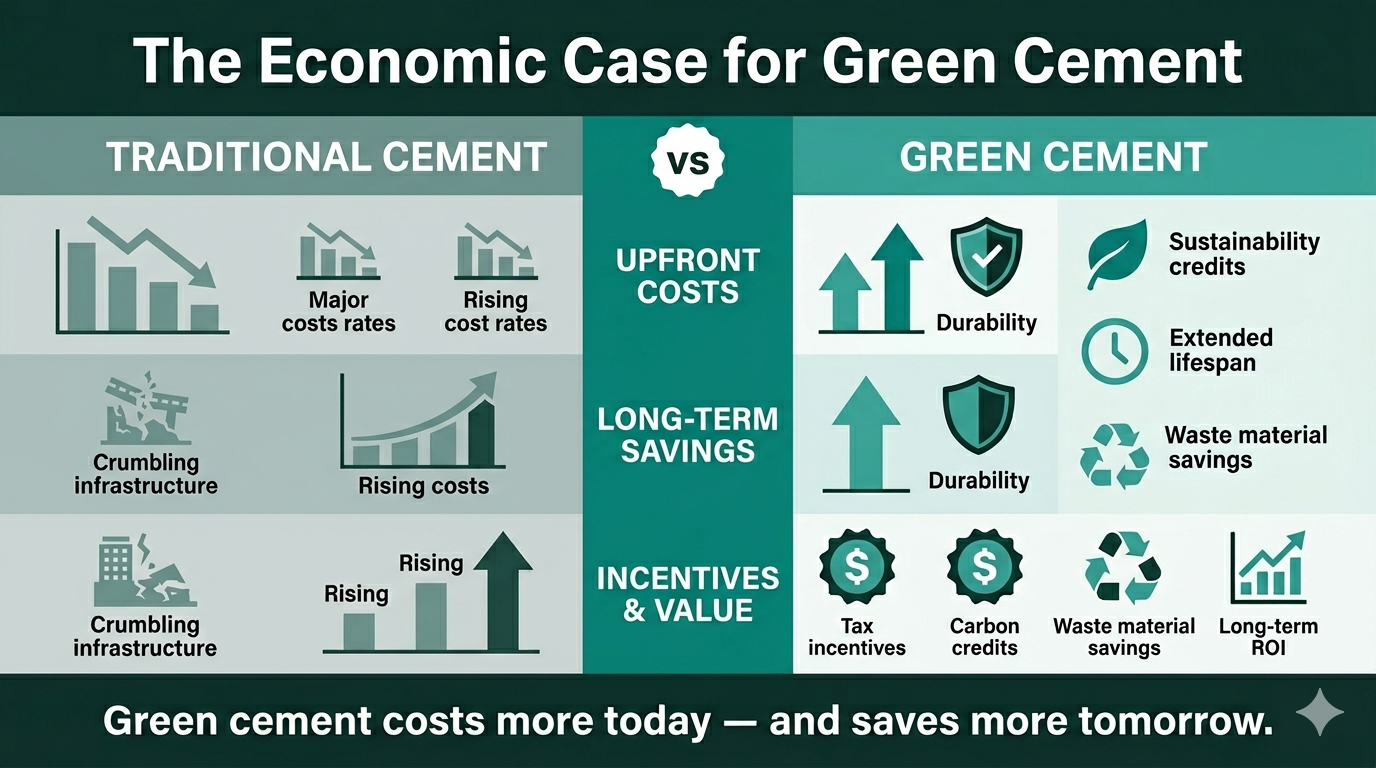
This is where the rubber meets the road for most decisions. Is eco-friendly concrete more expensive? The answer isn’t a simple yes or no, as it depends on the specific mix, project scale, and timeframe considered.
Upfront Costs: Traditional vs. Eco-Friendly

On a per-cubic-yard basis, traditional concrete often has a lower initial price tag. Its materials are mined and processed at massive scale, creating a cost-efficient commodity. For a standard 4-inch slab for a garage floor in a community like Huntington Hills, the quote will typically be based on this familiar mix.
Some eco-friendly mixes, especially those using novel or less common materials, can carry a premium due to smaller-scale production, specialized processing, or transportation costs. However, mixes using widely available SCMs like fly ash can be cost-competitive, sometimes even cheaper, as the SCM itself is a lower-cost material than Portland cement.
The upfront cost difference, therefore, can range from a slight premium to a slight discount, depending entirely on the specific alternative chosen.
Long-Term Cost Savings and Incentives
The financial picture changes when you look beyond the pour date. Eco-friendly mixes often offer enhanced durability—like better resistance to sulfate attack or chloride ingress (important for foundations in Calgary’s variable soil conditions). This can translate to lower maintenance costs and a longer service life.
There may also be indirect financial incentives. For commercial projects, using low-carbon concrete can contribute points toward LEED or other green building certifications, which can increase property value, attract tenants, or qualify for grants. For municipal projects in Alberta, environmental performance is increasingly a criterion.
Thinking long-term turns the cost comparison from a simple snapshot into a more comprehensive value assessment.
Regional Cost Variations
Costs are not uniform. In Calgary, the price of both traditional and eco-friendly concrete is influenced by local factors: the distance from cement plants and SCM sources, the availability of recycled aggregates, and even seasonal demand during our short construction season.
A mix using fly ash might be more economical if sourced from a nearby supplier, while a specialty hempcrete might incur significant transportation costs. It’s crucial to get quotes based on local supply, not national averages.
Always ask your supplier, like Omega2000, for a breakdown that reflects Calgary-specific sourcing and logistics.
Cost per Cubic Yard or Ton Comparisons
When comparing quotes, ensure you’re comparing the same unit. Concrete is typically sold by cubic yard (volume), while cementitious materials might be discussed by ton (weight). A lower price per ton for an SCM doesn’t automatically mean a lower price per cubic yard for the finished mix.
The final in-place cost also includes labour, placement, and finishing, which are generally the same for either mix type. The core comparison should focus on the delivered price of the ready-mix concrete itself, assuming similar performance specifications for your project.
This unit consistency is key to making an apples-to-apples financial comparison.
Durability and Performance Comparison
Cost savings vanish if the material fails prematurely. Performance is paramount, especially in an environment like Calgary with its harsh winters, temperature swings, and alkaline soils.
How do these new mixes stand up over time?
Strength and Lifespan of Traditional Concrete
Traditional concrete, when properly designed, mixed, and cured, offers excellent compressive strength and a long lifespan. Its behaviour is well-understood, and engineers have decades of data to support their designs. For critical structural elements like foundations or bridge supports, its reliability is a major advantage.
The potential weaknesses are often related to permeability and chemical resistance. Over decades, water and aggressive chemicals can penetrate, leading to corrosion of reinforcement or internal damage. This is why air-entrainment and proper curing are so critical here.
In many Calgary applications, from driveway aprons to basement walls, traditional concrete performs very well when the installation is done right.
Durability of Low-Carbon and Green Alternatives
Many eco-friendly mixes actually improve upon certain durability aspects. Concretes with high SCM content, like fly ash or slag, often develop lower permeability over time. This creates a denser, less porous matrix that better protects against water ingress and chemical attack.
They can also exhibit higher ultimate strength at later ages (e.g., 90 days instead of 28 days) and better resistance to thermal cracking due to lower heat of hydration. For a large patio slab in a sunny, exposed yard in Chestermere, this could mean fewer shrinkage cracks.
The performance is mix-specific, so it’s essential to review test data and perhaps even conduct trial batches for large projects to confirm the properties meet your needs.
Testing and Research for Performance
Don’t rely on marketing claims. Reputable suppliers should provide mix designs with accompanying test results: compressive strength at various ages, permeability tests, freeze-thaw resistance (critical for Calgary), and perhaps shrinkage data.
For innovative mixes like hempcrete or AshCrete, look for case studies or research papers documenting real-world performance. The industry is moving fast, but proven, long-term data (20+ years) for some newer alternatives is still accumulating.
What does the test data say for the specific mix you’re considering?
Materials and Production Processes
The difference in environmental impact and cost stems from what goes into the mix and how it’s made. Let’s peel back the layers on the ingredients and processes.
Ingredients in Traditional Mixes
The core ingredients are Portland cement (the high-carbon binder), water, fine aggregate (sand), and coarse aggregate (gravel or crushed stone). The aggregates are typically virgin materials mined from quarries. The entire process is linear: extract, process, combine, use.
The quality and consistency of these ingredients are high, thanks to established industry standards. This reliability is a major reason traditional concrete remains the go-to for many engineers and builders on fast-paced projects, like those in the bustling Beltline district.
Its environmental cost is baked into this linear, extractive model.
Alternative Materials: Fly Ash, Hempcrete, AshCrete, and RCA
Fly Ash and Slag: As discussed, these are the most common SCMs, turning industrial by-products into performance-enhancing concrete ingredients.
Hempcrete: A biocomposite using the woody core of the hemp plant mixed with a lime-based binder. It’s lightweight, has excellent insulation properties, and is carbon-negative (the plant absorbs CO₂). It’s more niche, often used in residential walls for its thermal performance.
AshCrete: A proprietary mix that uses a high percentage of fly ash and other materials to virtually eliminate Portland cement. It claims high strength and durability with a drastically reduced carbon footprint.
Recycled Concrete Aggregate (RCA): Crushed old concrete used as a replacement for virgin coarse aggregate. This reduces landfill waste and quarry demand, though it may require adjustments to the mix design to maintain strength.
Each alternative offers a different path to reducing the environmental impact, with varying implications for cost, strength, and availability.
Energy Use in Production
The energy savings are primarily in the binder production. Making Portland cement requires heating materials to about 1450°C in a kiln, a process that consumes vast amounts of fuel, usually coal or natural gas.
SCMs like fly ash require no such kiln processing—they are essentially “ready-to-use” as they come from the power plant. Using them bypasses that immense energy input. Similarly, using RCA avoids the energy cost of mining and crushing new stone.
The energy savings directly translate to lower greenhouse gas emissions and, often, lower production costs for the binder material itself.
Supply Chain and Availability
Can you actually get the mix you want, when you need it, in Calgary? Availability is a practical hurdle that can sway the decision.
Standard Processes for Traditional Concrete
The supply chain for traditional concrete is mature and robust. Multiple ready-mix plants serve the Calgary area, offering a range of standard mixes (e.g., 25MPa, 30MPa, air-entrained) that can be delivered on short notice. This reliability is vital for contractors who have tight schedules and need material exactly when the forms are ready and the crew is on site.
For a homeowner replacing a driveway in Springbank, the convenience and predictability of this supply chain are significant advantages.
It’s a system built for speed and certainty.
Challenges in Eco-Friendly Supply Chains
The supply chain for many eco-friendly mixes is less developed. Specialized SCMs or aggregates might come from fewer sources, potentially requiring longer lead times or more complex logistics. A mix specifying a certain type of fly ash might not be available if the local source changes its output.
For very innovative mixes like hempcrete, the materials might need to be sourced from outside Alberta, adding cost and complexity. This can make them less feasible for small, time-sensitive residential projects.
Always verify local availability and lead times with your supplier before committing to a specific eco-friendly mix design.
Benefits and Drawbacks
Every choice has trade-offs. Let’s summarise the key advantages and potential downsides of each path to help you weigh them against your project’s priorities.
Sustainability and LEED Certification Benefits
The primary benefit of eco-friendly concrete is its reduced environmental impact: lower CO₂ emissions, less virgin material extraction, and often, the productive use of industrial by-products. For projects targeting sustainability certifications like LEED, using these mixes can contribute directly to earning points in the Materials & Resources category.
This can enhance the marketability of a commercial building or align with a homeowner’s personal environmental values. In a community like Currie Barracks, where modern, sustainable design is prominent, this aspect can be a tangible asset.
It’s a benefit that extends beyond the property line to the broader environment.
Construction and Maintenance Considerations
Potential drawbacks often relate to the novelty of some mixes. They may have different curing times, requiring adjusted construction schedules. Placement and finishing techniques might need slight modification based on the mix’s workability.
For maintenance, many green concretes perform excellently, but unfamiliarity can lead to concerns. Ensure your concrete contractor, whether a large firm or a local Omega2000, is experienced with the specific mix you choose.
The learning curve is diminishing as these materials become more common, but it’s still a factor to discuss with your team.
Quick Comparison Table: Traditional vs. Eco-Friendly Concrete
| Factor | Traditional Concrete | Eco-Friendly Concrete |
|---|---|---|
| Cost | Lower upfront cost per cubic yard; stable, predictable pricing. | Can be competitive or slightly higher; long-term value may be better. |
| Durability | Excellent, well-understood long-term performance. | Often improves permeability & chemical resistance; long-term data growing. |
| Best For | Projects prioritizing lowest upfront cost, tight schedules, and absolute predictability. | Projects valuing reduced environmental impact, LEED points, or specific durability perks. |
| Calgary Climate Suitability | High – when properly air-entrained and cured for freeze-thaw cycles. | High – many mixes offer good freeze-thaw resistance; confirm with test data. |
| Maintenance Required | Standard sealing and crack monitoring. | Similar to traditional; potential for less permeability-related maintenance. |
This table provides a snapshot, but your specific project details will determine which factors matter most.
A cost-sensitive infill project in Hillhurst might lean one way, while a landmark commercial build aiming for net-zero status might lean another.
Case Studies and Real-World Applications
How are these mixes performing in real buildings and infrastructure? Seeing them in action adds crucial context to the specs and cost sheets.
Low-Carbon Concrete in the Northeastern US
Several large-scale projects in the northeastern United States have successfully utilised high-volume fly ash concrete (HVFAC) in foundations, parking structures, and even paving. These mixes, with 40-50% cement replacement, have demonstrated excellent strength development and durability, often at a cost saving compared to traditional mixes due to the low price of fly ash.
The lessons are transferable: successful use depends on careful mix design, proper curing protocols, and a supplier familiar with the material. It proves that low-carbon concrete isn’t just a theoretical product—it’s a practical, proven option for demanding applications.
The takeaway: eco-friendly concrete is already out of the lab and performing in real-world, demanding environments.
FAQ
Is eco-friendly concrete actually stronger?
It can be, but not necessarily right away. Many mixes with SCMs like fly ash gain strength more slowly than traditional concrete but often achieve higher ultimate strength at 90 or 120 days. For structural elements where early strength is critical (e.g., removing forms quickly), this requires planning.
For long-term durability, measures like permeability and chemical resistance are often superior. Always review the specific strength curve and durability data for the mix you’re considering.
Can I get eco-friendly concrete for a small residential project in Calgary?
Yes, but availability varies. Mixes using common SCMs like fly ash are increasingly available from local ready-mix suppliers for residential scale projects. More specialized mixes (e.g., hempcrete) might require sourcing from specialty providers and could involve higher cost or longer lead times.
Discuss your goals with a local supplier like Omega2000—they can tell you what’s readily available for a driveway in Silverado or a garden wall in Coach Hill.
Does the City of Calgary offer incentives for using sustainable concrete?
Currently, there are no direct cash incentives from the city for choosing eco-friendly concrete. However, using such materials can contribute to achieving a higher green building standard, which may be required or encouraged for certain developments, especially larger commercial or multi-family projects.
It also aligns with broader municipal sustainability goals, which could become more relevant in future bylaws or development approvals.
Will eco-friendly concrete look different?
Generally, no. In its finished state, the visual appearance is largely determined by the aggregates, finishing technique (broom, stamp, expose), and any colourants used. The cementitious portion (whether traditional cement or SCMs) is a fine powder that doesn’t alter the final colour or texture in a noticeable way.
Your stamped patio in McKenzie Lake will look the same whether the binder is 100% Portland cement or a 30% fly ash blend.
Conclusion
The cost comparison between traditional and eco-friendly concrete mixes is multifaceted. While the initial invoice for a green mix might sometimes be higher, the total value picture includes potential long-term durability benefits, lower environmental impact, and alignment with sustainability goals.
For Calgary projects, the decision hinges on your specific priorities: absolute lowest upfront cost and schedule certainty, or a balance of cost, performance, and environmental stewardship. With our local climate and soil conditions, performance should never be compromised.
Discussing your project’s scale, budget, and values with an experienced supplier is the best next step. They can provide Calgary-specific availability, pricing, and performance data for the options that make sense for you.
Ready to explore the right concrete mix for your Calgary home or development? Omega2000 can help you navigate this cost comparison and source a mix that meets your needs for performance, price, and sustainability.