
How Permeable Concrete Reduces Flooding Risks in Calgary
After a heavy summer downpour, do you watch water cascade off your Brentwood driveway towards the street? Or perhaps you’re a developer planning a build near the Elbow River and want smarter stormwater management. The solution lies not in moving more water away, but in letting it soak in. Here’s exactly what Calgary homeowners, contractors, and developers need to know about how permeable concrete actively fights local flooding.
This isn’t just a theoretical fix for other cities. With our unique clay soils and flash storm events, traditional paving creates runoff that overwhelms local systems. Omega2000 has seen how smarter paving choices in communities like Bridgeland and along Memorial Drive can make a measurable difference.
What is Permeable Pavement?
Permeable pavement is a surface designed to let rainwater and snowmelt pass directly through it, rather than sheeting off. Think of it like a hard sponge. While traditional concrete and asphalt create an impervious barrier, permeable systems are intentionally porous, with interconnected voids that channel water downward.
This technology transforms paved areas from stormwater generators into active infiltration zones. It’s a key tool for modern, climate-resilient construction right here in Calgary, where managing sudden water volume is critical.
Permeable Concrete and Asphalt
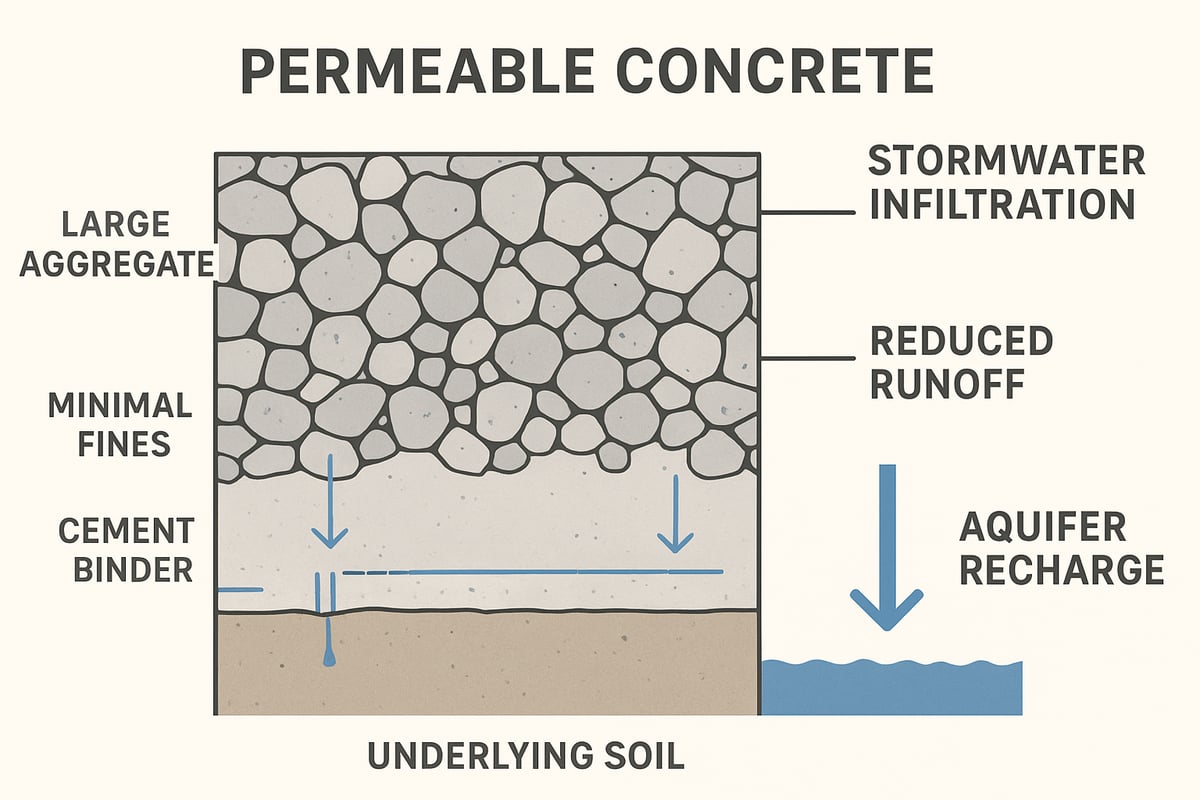
Permeable concrete uses a special mix with little to no fine sand, creating a honeycomb-like structure of aggregates bound together. Similarly, permeable asphalt uses an open-graded mix. The result is a durable driving or walking surface with a high void content, typically between 15% and 25%.
These materials look similar to their traditional counterparts but function completely differently. They are ideal for driveways, parking lots, and low-traffic roads where you need both strength and superior drainage.
Permeable Paving Stones
Also known as permeable interlocking concrete pavers (PICP), these are individual units laid over a thick, open-graded gravel base. The joints between the pavers are filled with small, washed stone, creating the primary path for water infiltration.
This system offers great flexibility in design and is easier to repair section-by-section. You’ll see it used effectively in Calgary for walkways, plazas, and residential patios where aesthetics are also a priority.
Bottom line: it’s engineered porosity that turns a hard surface into a water management asset.

How Does Permeable Pavement Work?
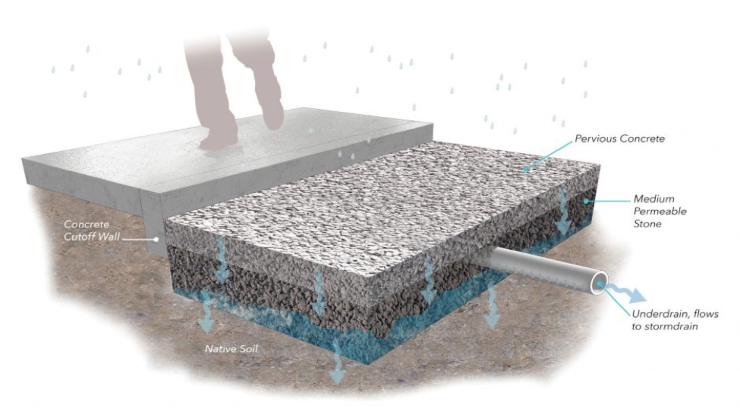
The magic happens below the surface you walk or drive on. A permeable pavement installation is a multi-layered system, each part with a specific job to capture, store, and infiltrate water. It’s a complete rethinking of what a paved surface does.
Infiltration and Drainage Process
First, water passes through the porous surface layer. It then flows into a thick reservoir base made of clean, uniformly sized crushed stone. This base layer temporarily stores the water during a storm event, preventing immediate overload.
Finally, the water slowly percolates down through this reservoir and into the native subsoil below. In Calgary’s clay-heavy areas, this process might be slower, which is why proper engineering of the base depth is absolutely critical for it to work.
Role in Low Impact Development
This approach is a cornerstone of Low Impact Development (LID), a planning strategy that mimics natural water cycles. Instead of piping all runoff away as quickly as possible—which concentrates volume and pollutants—LID treats water at its source.
For a new infill project in Hillhurst or a commercial lot in the Southeast industrial area, using permeable surfaces means you’re managing rain where it falls. This reduces the burden on the city’s centralized storm sewers, which are the very systems that can get overwhelmed during our intense summer thunderstorms.
By storing and releasing water slowly, you’re effectively putting the storm drain underground.
Benefits of Permeable Pavement for Flood Reduction
The primary reason Calgarians should care about this technology is its direct impact on flooding risk. But the benefits cascade out from that core function, improving both your property and the wider community.
Reducing Stormwater Runoff and Peak Flows
Impervious surfaces can convert over 90% of rainfall into immediate runoff. Permeable pavement can cut that volume by 70% to 90%, depending on the design and soil conditions. This drastic reduction means less water hits the storm drains during the peak of a storm.
Lower peak flows are the single biggest factor in preventing sewer overflows and street flooding. It’s the difference between a system coping and a system failing during an event like the one that impacted communities along the Bow River in 2013.
Minimizing Local Flooding in Calgary
This isn’t just about major river flooding. It’s about the localized ponding that floods basements, erodes landscaping, and creates icy hazards in winter. Areas with poor drainage or older, undersized sewer lines feel this acutely.
By intercepting water from your own driveway or parking lot, you prevent it from contributing to the problem downstream. For a homeowner in a low-lying part of Riverbend or a business in Manchester Industrial, this is direct risk mitigation.
Replenishing Groundwater Levels
Instead of being treated as waste and sent down the river, water infiltrates back into the local aquifer. This helps maintain groundwater levels, which support vegetation and can contribute to base flows in local streams during dry periods.
In our semi-arid climate, every drop of water we can retain and reuse in the natural system is a win. It’s a long-term, sustainable approach to water stewardship that begins at the ground level.
Filtering Pollutants and Improving Water Quality
As water filters down through the pavement layers and stone base, a biological film forms on the aggregate. This film traps and breaks down common urban pollutants like oil, grease, heavy metals, and fertilizers.
The water reaching the groundwater is significantly cleaner than runoff from a traditional surface. This means fewer contaminants wash into our rivers, protecting aquatic life and improving water quality for everyone downstream.
You’re not just managing water volume—you’re cleaning it before it re-enters the ecosystem.

Permeable Pavement Applications in Calgary
This technology is moving from pilot projects to mainstream application in our city. Understanding where and how it’s being used helps visualize its potential for your own property.
City of Calgary Initiatives and Testing
The City has been actively testing and implementing permeable surfaces for years. You can find pilot projects in local parks, green streets initiatives, and as part of new community development standards. Their goal is to integrate LID principles into public infrastructure to build resilience.
This municipal support is crucial. It means guidelines are being developed, and contractors like Omega2000 are gaining the specific experience needed to install these systems correctly for Calgary’s climate and soils.
Use on Flood-Prone Roads and Event Spaces
Beyond parks, permeable paving is ideal for overflow parking lots, low-traffic lanes, and access roads in flood-prone areas. Its ability to handle large volumes of water without pooling makes it a smart choice for these applications.
Imagine a community pathway along the Westhills escarpment or a parking stall pad that doesn’t turn into a lake. These are practical, everyday applications that add up to significant city-wide runoff reduction.
Comparison to Traditional Impervious Surfaces
To see the true value, you need a direct comparison. The difference isn’t just superficial; it’s fundamental to how water interacts with the urban landscape.
Issues with Concrete and Asphalt
Traditional surfaces create what hydrologists call “effective impervious area.” They generate rapid, warm runoff that carries pollutants and delivers a hydraulic shock to stream channels. This erodes banks, degrades habitat, and floods infrastructure.
In winter, this runoff freezes on roads and sidewalks, creating safety hazards and requiring more salt and sand. It’s a cycle of managing symptoms rather than solving the root cause of the water volume.
Runoff Reduction Percentages
The numbers tell a compelling story. While a standard asphalt parking lot might produce nearly 100% runoff, a properly designed permeable pavement system can reduce that to 10% or less. That’s a reduction of thousands of litres of water from a single storm event on a typical driveway.
For a large commercial site, the volume of water kept out of the storm sewer is enormous. This is why many new developments are now required or strongly incentivized to include permeable areas in their site plans.
Switching surfaces changes your property from a flood contributor to a flood mitigator.

Additional Environmental Advantages
Beyond flood control, permeable pavement delivers a suite of co-benefits that make our urban environment more livable and sustainable.
Mitigating Urban Heat Island Effect
Dark, impervious surfaces absorb solar radiation and re-radiate it as heat, making cities significantly warmer than surrounding rural areas. The open structure of permeable pavement and the moisture within it allow for some evaporative cooling.
This can slightly reduce local ambient temperatures on hot summer days. In a paved area like a shopping mall parking lot, that can improve comfort and even reduce cooling costs for adjacent buildings.
Promoting Sustainability and Public Health
By cleaning water and reducing runoff, these systems protect river health, which is integral to Calgary’s identity and recreation. They also reduce the need for costly expansions of gray infrastructure like pipes and treatment plants.
Less standing water means fewer breeding grounds for mosquitoes. It’s a holistic approach that links infrastructure choices directly to community well-being and environmental stewardship.
FAQ: Permeable Concrete in Calgary
Here are the most common questions we get from Calgary homeowners and builders about making the switch to permeable surfaces.
Does permeable concrete work in Calgary’s freeze-thaw cycles?
Yes, when installed correctly. The key is ensuring the system drains fully before a freeze. A properly designed base with adequate drainage prevents water from being trapped and expanding. Reputable local installers understand this and design for our specific climate, often using slightly different aggregate gradations than in warmer regions.
In fact, because it allows meltwater to drain through instead of pooling and refreezing on the surface, it can reduce ice formation compared to traditional pavement.
How much more does permeable pavement cost than regular concrete?
Initial installation costs are typically 10-20% higher than traditional concrete, due to the specialized mix and the deeper, engineered stone base required. However, this is a classic case of evaluating total cost versus initial price.
You may save on costs elsewhere, like needing fewer or smaller storm drains on your property. More importantly, you’re investing in long-term resilience and potentially increasing property value by solving drainage issues.
Can it handle heavy vehicles like fire trucks or delivery vans?
Absolutely. Permeable concrete and pavers are designed to meet standard load-bearing requirements for residential and commercial traffic. The structural strength comes from the stone aggregate and binding paste, not from a dense, impermeable matrix.
For exceptionally heavy loads, the base can be specially engineered and reinforced. It’s a common misconception that porous means weak—modern mixes are very durable.
How do you maintain permeable pavement?
Maintenance is different, not necessarily more difficult. The primary task is preventing the pores from clogging with silt or sand. This involves occasional vacuum sweeping (not blowing) to remove surface debris.
Every few years, a more intensive vacuuming might be needed to restore full infiltration capacity. Avoid storing piles of soil or sand on the surface, and you’ll maintain its performance for decades.
Proper installation and simple maintenance ensure it performs for its entire design life.
Conclusion
Permeable concrete and pavement systems represent a fundamental shift from treating stormwater as a waste problem to managing it as a resource. For Calgary, with our intense seasonal rains and community-specific flood risks, this technology is a practical tool for building resilience right at the property level.
Whether you’re replacing a driveway in Dalhousie, designing a commercial site in Quarry Park, or planning a public space, incorporating permeable surfaces is a proactive choice. It reduces your contribution to runoff, protects local waterways, and invests in a more sustainable urban landscape.
The science is proven, and local expertise is growing. Now that you understand how permeable concrete reduces flooding risks in Calgary, the next step is to apply that knowledge. For a site-specific assessment and a quote tailored to your project’s needs, reach out to the local experts at Omega2000. Let’s build surfaces that work with our climate, not against it.