
There are two truths every inner-city Calgary builder is already living with, and they are colliding through the summer.
The first truth is the calendar. On April 8, 2026, Calgary City Council voted 12–3 to repeal the 2024 blanket residential rezoning. The implementation date is August 4, 2026. A separate public hearing on July 21, 2026 will finalize the R-CG and H-GO amendments. The proposed numbers — max units per parcel dropping from four to three, mid-block rowhouses prohibited, density falling from 75 to 60 units per hectare, a reinstated 10 m height limit, tighter contextual setbacks — are the numbers the trade is now running pro formas against.
The second truth is the lot itself. The 25-foot wide parcel in Bridgeland. The 30-foot lot in Hillhurst with a 1948 footing already sitting half on the property line. The Inglewood site where the heritage-area setbacks turn a “four-unit fits” file into a four-unit-doesn’t-quite-fit file. The Marda Loop redevelopment where the neighbour’s wall is fifteen inches from where your forms need to land. The August 4 cliff lands on top of those lots — not on a flat suburban quarter-section.
We’ve spent thirty-seven years pouring foundations on these blocks. We started Omega 2000 Cribbing in 1988, when most of Bridgeland’s character homes were still on their original cribbing, when “infill” meant a single rebuild rather than a four-unit R-CG file, and when the City planning office was a different building. The crew has been on these streets through every regulation change since.
The point of this piece is not the regulatory overview — our cross-brand August 4 piece covered that ground. The point here is operational: what changes on a 25- to 30-foot inner-city lot that does not change on a suburb lot, and what 36 years of working those lots actually means for the foundations that get poured between today and the cliff.
What changes operationally on a 25–30 ft Calgary lot vs a suburb lot
The honest answer is: almost everything from the curb in.
Calgary’s R-CG rules allow a 7.5 m (roughly 25-foot) minimum parcel width for individual rowhouse or duplex units. A traditional 75-foot inner-city lot subdivides into three 25-foot parcels under those rules. The mature-neighbourhood reality is that 25-foot parcel widths are common in Bridgeland, Hillhurst, Sunnyside, Renfrew, Killarney, Mission, Inglewood and parts of Ramsay — and they bear no operational resemblance to the 38- to 50-foot lots our crews work on in Belmont, Mahogany, Livingston, Cornerstone, Seton, Lewiston or Pine Creek.
What actually changes operationally:
Footprint geometry. A four-unit R-CG file on a 25-foot lot means the wall lift footprint is long and thin. The internal cross-walls multiply. Forming time on a four-unit narrow footing is not four times a single-detached — it’s closer to five-and-a-half times, because every internal party-wall footing carries an engineering load detail the single-detached footing does not. Suburban two-storey single-detached pours are simple rectangles. Four-unit inner-city pours are not.
Sub-trade choreography. On a 38-foot suburban lot you have working room for the excavator to swing, the rebar trailer to stage, the form-truck to back in, and the pump truck to set up. On a 25-foot inner-city lot you have approximately one of those things at a time, and the rest are waiting in alleys, on side streets, or on the avenue. Choreography that takes two days of standard sequencing on a Pine Creek block can take five days of staggered sequencing in Hillhurst.
Inspection and permit-window timing. Inner-city building inspectors run different routes than suburb inspectors. The 2-hour CSA A23.1:24 discharge limit on ready-mix is harder to meet when your truck has been waiting through a 40-minute inspector slip in heritage-overlay Bridgeland than when the same truck is on a Seton dispatch route with a standing inspection window.
Adjacent-structure liability. On a suburb lot the neighbour’s house is twelve to twenty feet away across a yard. On an inner-city lot the neighbour’s foundation is sometimes six inches from your form-board. Excavation shoring, vibration management, and dewatering decisions on a 25-foot inner-city lot are not the same decisions on a 45-foot Mahogany lot. The cribbing crew that does not understand that distinction will find out the hard way.
This is the work our crew has built muscle memory around. It is also the work the August 4 grandfathering rush will compress into ten to twelve weeks.
The party-wall coordination problem
Calgary’s inner-city housing stock includes a meaningful share of attached and semi-attached structures dating back to the 1910s through the 1960s. When a four-unit R-CG file goes in on a 25- or 30-foot lot, there is almost always a neighbour’s wall, a neighbour’s footing, or a neighbour’s foundation somewhere in the equation — sometimes physically touching the new structure, sometimes within the construction-influence radius, sometimes both.
Three things have to be coordinated before the first scoop of dirt comes out:
One: the existing wall’s structural condition. A 1952 stone-and-mortar foundation on the neighbour’s side is not the same as a 1989 poured-wall foundation. The historic wall may have voids, moisture damage, or settlement movement the neighbour does not know about. The crew that excavates adjacent to it without an honest pre-condition assessment owns whatever happens next. We document — photographs, level readings, crack maps — before excavation begins. Every time. On every inner-city file.
Two: shoring and dewatering against the neighbour’s structure. The clay soils that hold pressure across most of inner-city Calgary do not release that pressure obligingly when you cut a 9-foot hole beside an existing foundation. Trench-box shoring that is fine on a wide suburban lot is not fine 14 inches from a 70-year-old wall. We spec engineered shoring on every adjacent-structure infill. The cost gets built into the quote. It is not optional.
Three: the new party-wall footing detail itself. When a four-unit R-CG file shares party-wall footings between units, the engineered detail typically includes a thicker footing section, additional rebar mat, and a continuous keyway. That spec carries through to the wall lift above. The cribbing crew that has poured ten of these is faster, cleaner and more accurate than the crew that has poured none — and on a compressed grandfathering timeline that difference is days, not hours.
What 36 years of inner-city Calgary cribbing actually buys a builder on the party-wall question is this: we have a written internal protocol for adjacent-structure documentation, our forming crew has run the engineered party-wall detail enough times that the rebar mat goes in correctly the first time, and we know which engineers to call when an unexpected condition shows up six feet down. None of that is in a marketing line. All of it shows up in the schedule.
Truck access and crane placement on tight infill lots
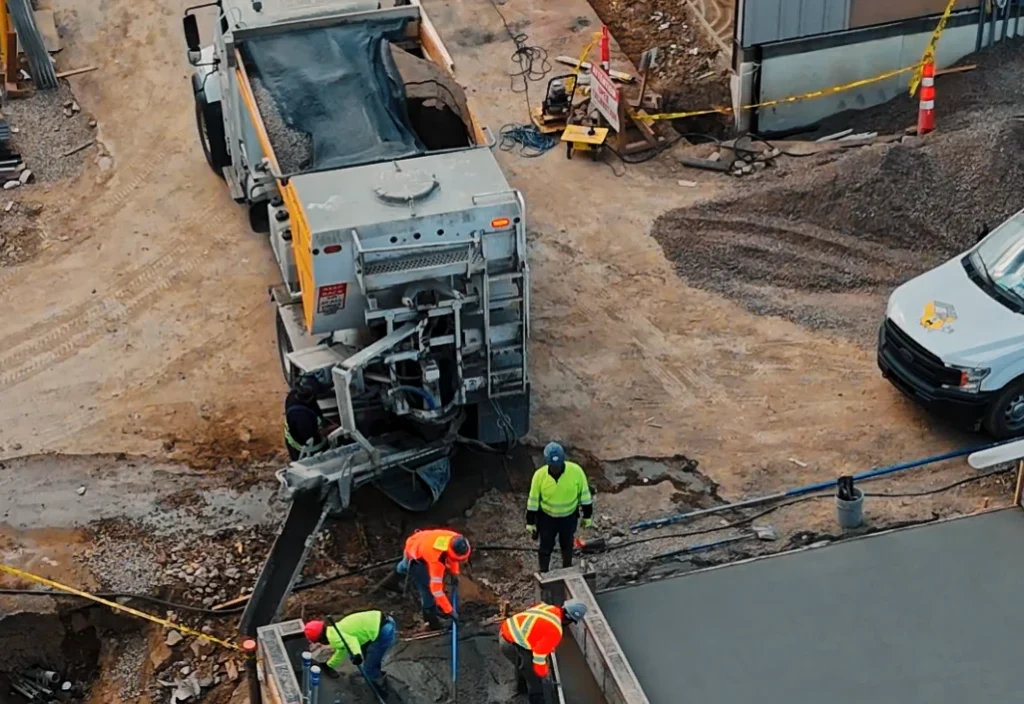
A four-unit R-CG file on a 25-foot lot still needs the same trucks a suburban single-detached needs: excavator on a low-bed, pump truck for the pour, ready-mix trucks staging through the day, a rebar trailer, a form-truck, eventually a crane if precast is in the mix. The difference is everything about how those trucks reach the lot, how they stage, and how they leave.
Calgary inner-city infill access pinch-points we plan around:
Avenue and street-width constraints. The numbered avenues through Hillhurst, Sunnyside and Bridgeland are not wide. The streets in Killarney and Marda Loop are narrower than the City’s road-allowance maps suggest because of resident parking. A 12 m pumper-truck boom needs setup room the lot does not have, which means the boom sets up in the avenue — which means a traffic permit, a flagger, and a coordinated 2-hour window. On a suburb lot the boom sets up on the lot itself.
Alley access. Most inner-city infill lots have an alley behind. Whether the alley can carry a fully-loaded ready-mix truck depends on (a) the alley surface, (b) the overhead utility lines, (c) whether the City has flagged the alley as a winter-snow-storage route, and (d) whether the neighbour’s parking pad is encroaching by 18 inches. We walk the alley before every infill quote. Every time.
Crane placement for precast. When Omega Precast walls are in the mix on a four-unit file, the crane has to land somewhere. On a Mahogany lot the crane lands on the lot itself. On a 25-foot Bridgeland lot the crane lands on the avenue, which requires coordinated road-closure permits, neighbour notification, and a window of two to four hours for the precast set. We schedule precast sets first thing in the morning on inner-city files to clear the avenue before peak traffic — it is a workable system, but it does not work without planning two weeks ahead.
Sub-trade waiting room. Every inner-city pour has a side-street holding area where ready-mix trucks queue between dispatch. That holding area is somebody’s parking spot. We send the neighbour-notification letter for every infill file we run. Every time. The letter has saved more pour days than we can count.
On the August 4 grandfathering rush, what changes is not the access problem itself — those problems are constant on inner-city work. What changes is the density of crews trying to solve those problems simultaneously through July. The first-call advantage on inspector slots, pump-truck windows and alley permits will tighten week-over-week from now until the cliff.
Soil conditions that vary lot-by-lot
The City of Calgary’s soil-mapping data treats the inner-city as roughly homogeneous clay overlying glacial till. Our crew has been on these lots long enough to know the mapping is a starting point, not a finishing point.
What varies lot-by-lot in mature Calgary neighbourhoods:
Legacy fill. The 1910s through 1960s inner-city building era left a lot of unmarked fill. A site where a 1925 detached home was demolished in the 1970s and the basement was backfilled with whatever was on hand often contains coal-ash, brick rubble, scrap timber, and the occasional twentieth-century artifact. That fill compacts differently than native clay and changes the footing-bearing assumption in ways the soil report sometimes does not catch.
Historic structure remnants. Pre-1960 inner-city builds occasionally left in-ground oil tanks, abandoned cisterns, root cellars, and original wooden cribbing in place when the new construction went up. We have hit all of the above. Hitting one of them in the middle of a four-unit excavation on a August-grandfathering timeline is a problem nobody wants. Geotechnical pre-investigation on inner-city files is not optional.
Sulphate exposure. Calgary’s residential soils across the entire footprint of the city show S-2 sulphate exposure conditions. Every Calgary residential foundation requires 35 MPa HS (Type HS sulphate-resistant cement) at the 56-day specification point per CSA A23.1:24, with 5–7% entrained air for freeze-thaw resistance. Inner-city does not get a different spec. What inner-city does get is more variable groundwater contact, more freeze-thaw cycling against the foundation (because there is more surrounding hardscape than on a suburb lot), and more cumulative exposure over a 50- to 75-year design life. The City of Calgary’s climate-hazards data tracks roughly 128 freeze-thaw cycles per year. On an inner-city basement wall with limited landscaping buffer, every one of those cycles matters more.
Groundwater and drainage history. Bridgeland sits on the Bow River escarpment. Sunnyside is the same. Mission abuts the Elbow. Inglewood is between both rivers. Drainage patterns on these neighbourhoods include both historic flood activity and inconsistent grading from a century of redevelopment. Excavation dewatering plans on these lots get reviewed differently than on a Cornerstone lot 35 km from the nearest river.
The cribbing-crew translation: we do not trust a soil report alone on an inner-city file. We dig a test pit. We talk to the neighbour about what they remember from their own renovation. We pull the City’s site-history records. We do this because the alternative on a four-unit file with a regulatory cliff is finding out about the fill at footing-pour time.
Heritage zone implications (Bridgeland, Inglewood, Mission)
The heritage overlay layer is the part most builders new to inner-city work underestimate.
Calgary’s heritage planning framework specifically identifies older communities — Ramsay, Inglewood and Bridgeland among them — as carrying the most complex Area Redevelopment Plans precisely because of heritage sensitivity. Inglewood’s Area Redevelopment Plan specifies 1.5 m building setbacks (with exceptions where a heritage structure is being protected) for sidewalk-width reasons. The Beltline / Victoria Park, Mission and Marda Loop transitional zones carry their own context-sensitive rules. Direct Control districts with heritage incentive provisions exist for portions of Bridgeland.
What that means at the foundation level:
Setback geometry constrains the footing footprint. A 1.5 m heritage setback on the street side does not feel like much until the lot is 7.6 m wide. The remaining footing footprint after street setback, rear-yard setback, and side-yard separations is what the four-unit pro forma is built around. If a context-sensitive review pushes the setback by even 0.3 m, the footing footprint changes and the engineered drawings re-stamp. Re-stamps cost days. Days are the resource August 4 is taking away.
Adjacent-heritage structure documentation. If your file is next to a designated or inventoried heritage building — and Bridgeland, Inglewood, Mission and parts of Sunnyside have meaningful concentrations of these — the pre-excavation documentation we run gets longer. Photographic record, vibration-monitoring spec, written acknowledgment from the heritage planner’s office. The crew that has done this on past files knows what the documentation package looks like and how long it takes. The crew that hasn’t will find out at week three.
Permit-review timing in heritage overlays. Files in heritage areas frequently route through a Heritage Calgary review step before the development permit clears. We have seen that step add anywhere from two to six weeks depending on the year and the file complexity. Builders running August 4 grandfathering math on a Bridgeland or Inglewood file need to be honest about that review step in their submission timeline.
This is not advocacy or opposition to heritage policy. It is operational reality. The four-unit R-CG file in Bridgeland is a different file than the four-unit R-CG file in Renfrew, even if the unit count and density numbers look the same on paper. The foundation lane is where the difference compounds.
The cribbing-crew muscle memory: what 36 years of inner-city work actually means
Marketing language calls this “experience.” On a foundation crew, it is something more specific and more useful: a sequence of pattern-recognition shortcuts that show up at decision moments and shave hours or days off the schedule.
A non-exhaustive list of the muscle-memory moments that 36 years of inner-city Calgary cribbing produces:
The pre-pour walk-through. Our forming foreman walks the formed footing and wall layout the morning of every pour. On an inner-city file, that walk-through catches things a paper checklist does not — a rebar tie that loosened overnight from a vibration source three lots over, a form-board kicked half an inch by an after-hours cat tracking through, a sleeve missing from a service penetration because the plumber’s apprentice took it home. The pattern-recognition is what catches the missing sleeve. The protocol exists because we have eaten the cost of a missing sleeve before.
The neighbour conversation. Every inner-city file has a neighbour conversation that has to happen before the excavator arrives. We send the letter. We walk the lot line with the adjacent owner. We give the foreman’s cell number. The conversation costs nothing in dollars and is worth several days of avoided friction over the course of a four-unit build.
The “this footing is non-standard” call. When the engineered footing detail on a 25-foot four-unit file shows up with a non-standard pier or stepped section, the right call is sometimes “build it as drawn” and sometimes “ring the engineer back before we form.” A crew that has poured the engineer’s standard details fifty times reads the drawing in two minutes and knows which call to make. A crew that has poured them once does not.
The mix-spec handoff to the ready-mix dispatcher. A four-unit inner-city file often runs three different mix designs on the same day — a footing pour at 35 MPa HS, a wall lift at 35 MPa HS with adjusted slump, a slab section at a slightly different design. Coordinating that with a drum-mix dispatcher who is also routing four other GCs on the same morning is a skill. We have a written mix-handoff sheet our crew uses on every inner-city pour. It is one page. It saves on average about 25 minutes of dispatcher confusion per pour day.
The post-strip inspection routine. When the walls strip after the cure cycle, the surface tells you what the form pressure, the consolidation, and the temperature management actually did. Reading that surface — water marks, honeycomb risk, cold-joint visibility — is a skill. The crew that has stripped a thousand inner-city wall lifts reads the surface in 90 seconds. The crew that has stripped a hundred takes longer and sometimes calls things wrong.
The honest version of “37 years of experience” is not a stat in a brochure. It is the cumulative weight of those pattern-recognition moments compounding across thousands of inner-city pours. That weight is what the August 4 rush is asking for, in compressed form, between now and the cliff.
Sister-brand integration: where Omega Ready Mix and Omega Precast fit on inner-city files
The cross-brand piece we published last week covered this in regulatory terms. Here is the inner-city operational version.
Omega Ready Mix volumetric is structurally well-suited to small-volume, multi-spec inner-city pours. The volumetric truck holds two or three mix designs simultaneously, mixes on site, and charges on what it discharges. On a four-unit R-CG file where the morning runs a footing pour, a wall lift section, and a small slab section, a volumetric unit can run all three from the same truck without burning a load or waiting for a separate dispatch.
For an inner-city lot where the drum-mix dispatcher’s optimal route is large-volume suburban work, volumetric is often the more reliable schedule option for the small-multi-spec days. Omega Ready Mix dispatches out of the city, not out of an acreage staging yard, which matters on inner-city access timing. The same 35 MPa HS sulphate-resistant specs that the cast-in-place inner-city work requires are what we run.
Omega Precast earns its place on four-unit R-CG files where the cast-in-place wall cure cycle is the critical-path constraint. A cast-in-place wall lift wants seven to ten days of cure before stripping and backfill. On a four-unit file with a hard August 4 grandfathering cliff, that cycle compounds across multiple wall lifts and can push the file outside the “submitted complete with credible construction underway” window.
Precast walls fabricated to spec in a CPCQA-certified plant — and set on a prepared footing the next morning — take that cure cycle off the on-site critical path. The on-site schedule moves from cure-driven to crane-driven. On a 25-foot inner-city lot the crane logistics get tight (we discussed crane placement above), but they are workable with two-week-out coordination.
Where the sister-brand integration actually lands for an inner-city infill builder on an August 4 file:
- Footing pour: Omega 2000 Cribbing crew, concrete supply via Omega Ready Mix volumetric (for the small-volume multi-spec efficiency).
- Foundation walls: cast-in-place by our crew on standard files; Omega Precast where cure cycle is critical-path.
- Same-day slab section: volumetric ready-mix continuation.
The decision isn’t ideological. It’s a per-file schedule question. We will walk through which combination fits a specific file at quote stage.
The CICBA and BILD Calgary advocacy context
The R-CG repeal debate has had two distinct industry voices through the spring.
Grace Lui, President of the Calgary Inner City Builders Association, has been CICBA’s public voice through council debates on R-CG and missing-middle policy. CICBA’s “Hidden Cost of Housing” report, published in late September 2025, anchored the regulatory-cost conversation council kept returning to in April: $146,098 per unit on a Calgary infill townhome, $87,380 on a single-detached, $47,688 on a semi-detached. CICBA’s published analysis of the proposed three-unit R-CG cap concluded the math does not pencil at current cost structure — and that a three-unit file, if it proceeds at all, adds roughly $143,000 per unit at end-user pricing.
Brian Hahn, CEO of BILD Calgary Region, has been the most-quoted Calgary residential industry voice through the same window. BILD’s “Home is Here” letter to council on May 6, 2026 pressed for a refreshed housing strategy ahead of Q3 2026 that reflects supply, affordability, and current market conditions.
The point is not that CICBA and BILD are advocacy peers — they are. The point is that the regulatory cost figures, the four-to-three unit viability gap, and the labour-pipeline pressure all show up at the cribbing crew’s morning meeting. The crew is the receiver of every cost line item, every viability decision, and every schedule compression that those advocacy conversations are about. The August 4 grandfathering window is when those abstractions become concrete pours.
We support the advocacy work. We also pour the footings.
The honest take: what we’d tell a CICBA member building a 4-unit R-CG before August 4
Operator to operator, here is the close.
This week — by May 24. If your four-unit R-CG file is real and the lot is in Bridgeland, Hillhurst, Inglewood, Sunnyside, Killarney, Marda Loop, Mission, Renfrew, Capitol Hill, Ramsay, Altadore, Richmond or Crescent Heights — call us. Put a foundation calendar on paper. Footing pour week, slab week, wall lift week, backfill week. Walk it backward from a July 30 “submitted complete” target. The footing pour has to be on a confirmed dispatch slot in the last week of May or the first week of June for the rest of the schedule to be credible. The neighbour-notification letter goes out at the same time.
By end of May. Engineered drawings stamped. Site servicing and grading sign-off in motion. Adjacent-structure documentation complete on the heritage-overlay or close-neighbour files. Geotechnical pre-investigation done — including a test pit if the site history flags legacy fill. Mix designs confirmed with the supplier. Form crew and rebar crew confirmed for the specific weeks. Crane permit application in motion if precast is in the mix.
By mid-June. Foundation work underway on the first of any multi-file program. Footings poured. Walls cured or being set. Backfill scheduled. The submission package reflects on-site progress, not a paper promise. That is the file that lands as “submitted complete” with no friction from the City reviewer. Anything less is rolling dice with a 12–3 council vote that is not going to be re-litigated before August 4.
What we want CICBA members to know is that 36 years of inner-city Calgary cribbing experience is on the phone and on the lot through this window. We are running our own pro formas backwards from August 4 the same way you are. The pattern-recognition the crew brings — on the party-wall coordination, on the truck and crane choreography, on the lot-by-lot soil reality, on the heritage-overlay timing — is the resource that is hardest to staff up under deadline pressure. We had it on May 1 and we will still have it on July 31.
The crew has been on these blocks since 1988. Whether August 4 reshapes the R-CG framework as proposed or in some amended form following the July 21 hearing, the work on a 25-foot inner-city lot is going to need cribbing crews who know what those lots actually need. Our team is one of them.
FAQ
My four-unit R-CG file is on a 25-foot Bridgeland lot. What is the first foundation question we need to answer?
Whether the lot has a credible footing pour window in the last week of May or first week of June. Working backward from a July 30 “submitted complete” target, that is the only window that leaves enough time for slab, wall lift, cure, strip and backfill before the file goes in. If the footing pour date is not on a confirmed dispatch slot this week, the rest of the schedule is fiction. Call us — we will walk the math with you.
My lot is next to a heritage-designated building in Inglewood. How does that change the foundation timeline?
It adds a documentation and review step before excavation. Photographic and condition record of the heritage structure, vibration-monitoring spec, written acknowledgment from the planner’s office, and sometimes a Heritage Calgary review pathway on the development permit side. Plan for an additional two to six weeks on the permit review in heritage overlays. On the foundation side, the engineered shoring spec will typically be more conservative than on a non-heritage adjacent file. Build that into the quote and the schedule.
What does “party-wall coordination” actually require on an inner-city four-unit file?
Three things, in order. First, pre-condition documentation of the neighbour’s existing wall — photos, level readings, crack mapping. Second, engineered shoring and dewatering spec for the excavation adjacent to that wall. Third, the engineered party-wall footing detail itself — typically a thicker section with continuous keyway and additional rebar mat. Our crew has run this protocol on hundreds of inner-city files. The cost gets built into the quote up front.
Can volumetric ready-mix actually run a four-unit inner-city footing pour on its own?
Yes — and it is often the more reliable supply option for small-volume multi-spec days. Omega Ready Mix volumetric units hold two or three mix designs at once, mix on site, and don’t burn a load if the inspector slips by 40 minutes. For a four-unit inner-city pour day running a footing, a partial wall lift and a small slab section, volumetric handles all three from the same truck. For larger continuous pours, drum-mix supply still wins on raw volume.
When does Omega Precast actually save a four-unit R-CG file?
When the cast-in-place wall cure cycle is the critical-path bottleneck. A cast-in-place lift wants seven to ten days of cure before stripping; across a four-unit file that compounds. Precast walls fabricated to spec in a CPCQA-certified plant and set on a prepared footing take that cure cycle off the on-site sequence. The schedule moves from cure-driven to crane-driven. On a 25-foot inner-city lot the crane placement is workable but requires two-week-out coordination.
What happens if I miss August 4 on a four-unit file?
Under the proposed R-CG amendments going to the July 21 hearing, a post-August 4 file is capped at three units per parcel, restricted to corner or end-of-block lots (no mid-block), density-capped at 60 units per hectare, and held to a 10 m height limit with tighter setbacks. CICBA’s published analysis indicates a three-unit R-CG file adds roughly $143,000 per unit at end-user pricing relative to four-unit math, and may not pencil at current cost structure. Whether your file survives the change is a pro forma question.
Why does the cribbing crew’s specific inner-city experience matter on the August 4 timeline?
Because the August 4 compression squeezes out the slack that lets less-experienced crews learn on the job. On a normal-year file, a crew can take a day to figure out the engineered party-wall detail and adjust. On a July 30 submission deadline, a day lost on a footing detail can push the wall pour into a week where every dispatcher is double-booked. The pattern-recognition that 36 years of inner-city Calgary cribbing buys is what closes that gap without a schedule hit.
How tight will sub-trade capacity actually get through July?
Tight. CMHC’s Spring 2026 Supply Report confirms Calgary recorded 27,684 housing starts in 2025 — a fourth consecutive record, up 13.6% on 2024 — with apartment completions down 10%. The completions gap is a labour signal: crews are running long on 2025 commitments. Layer the August 4 grandfathering rush onto inner-city files specifically and the squeeze concentrates exactly on the contractors and dispatchers serving CICBA-member inner-city work. The May confirmation is the cheap one. The July call is the expensive one.
What if my file is a 2-unit semi-detached under R-G, not a 4-unit R-CG?
The August 4 reversion applies to R-G as well, though the proposed amendments are less dramatic than the R-CG cliff. The submission-completeness rules are the same. The foundation-schedule pressure is real but the four-unit critical-path compounding is not. CICBA’s $47,688 per-unit regulatory cost figure is the relevant benchmark. The math has more room than the four-unit case, but the call-Omega-this-week advice still applies.
Does heritage-overlay work change the concrete spec?
The concrete spec is the same: 35 MPa HS at 56 days per CSA A23.1:24, 5–7% entrained air, Type HS sulphate-resistant cement. What changes is everything around the spec — adjacent-structure documentation, engineered shoring, sometimes more conservative excavation methods. Heritage policy is a process layer, not a concrete-mix layer.
Pre-confirm your August 4 inner-city foundation calendar
If you’re a CICBA-member inner-city Calgary builder running an R-CG or R-G file you’re trying to grandfather before August 4, the foundation lane needs to be on the calendar by end of May to be credible.
- Omega 2000 Cribbing — 36 years of inner-city Calgary cast-in-place foundation work. Bridgeland, Hillhurst, Inglewood, Sunnyside, Killarney, Marda Loop, Mission, Renfrew and the rest of the mature-neighbourhood map.
- Omega Ready Mix — Calgary’s only city-based volumetric concrete fleet. Built for small-volume multi-spec inner-city days.
- Omega Precast — schedule-certain foundation walls when the cure cycle can’t compress. CPCQA-certified plant.
Our Omega 2000 Cribbing team has been building foundations on Calgary’s tight inner-city lots since 1988 and can help identify scheduling risks before they affect your permit timeline.
Email info@omega2000.ca or call 403-217-4888 to walk through which combination fits your specific file.
Sources and citations
- City of Calgary newsroom — “Council approves repeal of blanket rezoning / Land Use Bylaw 1P2007 amendments implementing citywide residential rezoning.” https://newsroom.calgary.ca/council-approves-repeal-of-blanket-rezoning-land-use-bylaw-1p2007-amendments-implementing-citywide-residential-rezoning/
- LiveWire Calgary — “Calgary city council approves the repeal of citywide rezoning” (April 8, 2026). https://livewirecalgary.com/2026/04/08/calgary-city-council-repeal-citywide-blanket-rezoning/
- Global News Calgary — “Calgary proposes ban on midblock rowhouses as part of citywide rezoning repeal.” https://globalnews.ca/news/11748818/calgary-proposes-ban-midblock-rowhouses-citywide-rezoning/
- Global News Calgary — “Typical Calgary infill townhouse includes $147K in extra regulatory costs: report” (CICBA “Hidden Cost of Housing” coverage). https://globalnews.ca/news/11458743/typical-calgary-infill-townhouse-extra-regulatory-costs/
- CICBA — “Hidden Cost of Housing” full report (September 2025). https://cicba.ca/wp-content/uploads/2025/09/CICBA-Hidden-Cost-of-Housing-Full-Report.pdf
- City of Calgary — Repeal of Citywide Rezoning project page (effective date August 4, 2026). https://www.calgary.ca/planning/projects/rezoning-for-housing.html
- BILD Calgary Region — “Home is Here” letter (May 6, 2026). https://bildcr.com/advocating-for-industry-bildcr-home-is-here-letter-may-6-2026/
- City of Calgary — Climate Hazards reference (~128 freeze-thaw cycles per year). https://www.calgary.ca/environment/resources/climate-hazards–heavy-rain-and-flooding.html
- Concrete Alberta — Cement reference (Type GU, HE, HS, MS). https://www.concretealberta.ca/concrete-101/cement
- CSA Group — CSA A23.1:24 Concrete materials and methods of concrete construction.
- Inglewood Area Redevelopment Plan (City of Calgary). https://s3.ca-central-1.amazonaws.com/hdp.ca.prod.app.cgy-engage.files/1216/1308/5813/2017-0686_Inglewood_ARP_FC_web.pdf
- City of Calgary — Heritage Planning. https://www.calgary.ca/planning/heritage.html
- CMHC — Spring 2026 Housing Supply Report. https://www.cmhc-schl.gc.ca/professionals/housing-markets-data-and-research/market-reports/housing-market/housing-supply-report