
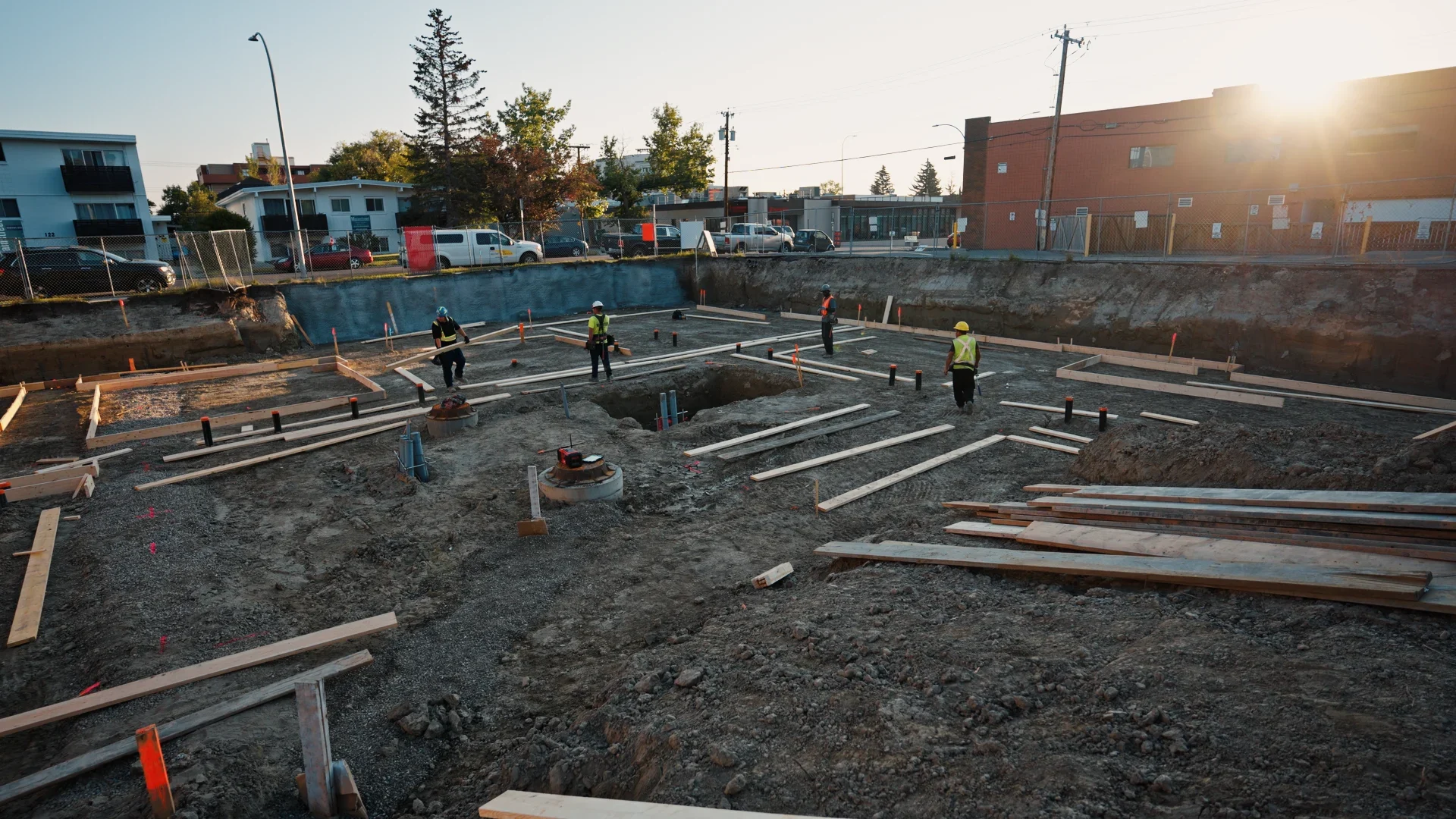
Calgary foundations need Type HS (high-sulphate-resistant) cement because Calgary’s soil routinely tests at S-2 severe sulphate exposure — water-soluble sulphate of 0.20% or more. Ordinary Portland cement (Type GU) degrades in that ground over decades as sulphates attack it from the inside out. Type HS, and the modern Type HSe equivalent, cap the vulnerable chemistry so the foundation survives. CSA A23.1:24 makes it the spec, not an upgrade — and the failure shows up not in your warranty period but in the home’s second or third decade.
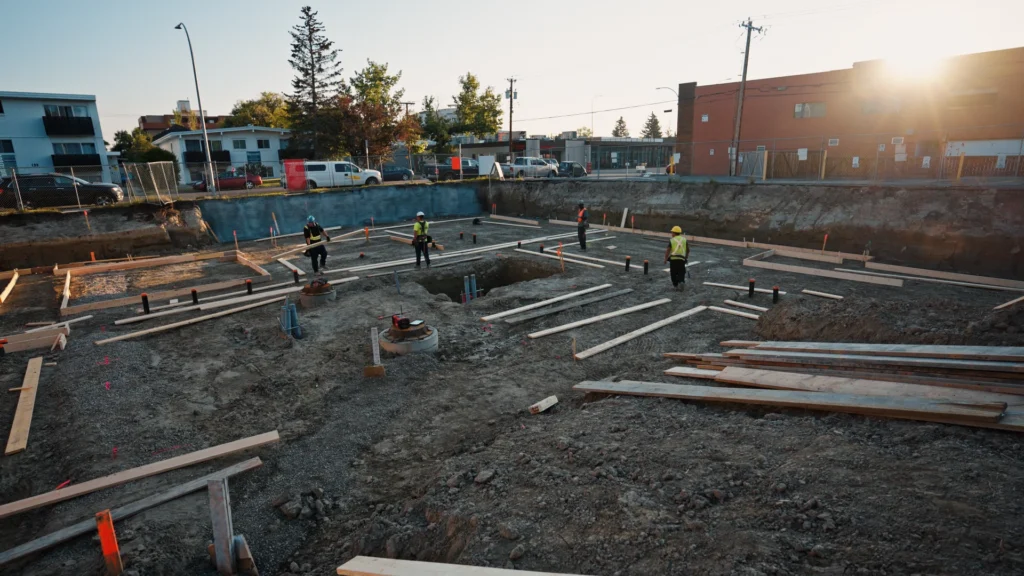
What is Type HS sulphate-resistant cement?
Type HS is a high-sulphate-resistant Portland cement governed by the Canadian Standards Association under CSA A3001 (Cementitious Materials for Use in Concrete). CSA A3001 defines the cement designations that matter for Canadian foundations:
- Type GU — General Use (formerly Type 10). The most common cement in Canada; fine where sulphate exposure isn’t a concern.
- Type MS — Moderate Sulphate-resistant. For S-1 exposure. Lower C3A than GU.
- Type HS — High Sulphate-resistant. For S-2 and S-3 exposure. Much lower C3A than GU or MS.
- Type HSb — High Sulphate-resistant blended, made with supplementary cementitious materials (SCMs) like fly ash or slag. Same sulphate-resistance class as HS, lower carbon footprint.
The defining technical difference is tricalcium aluminate (C3A) content. CSA caps Type HS at 5% C3A; ordinary Portland typically runs 8–12%. That gap is small on paper and enormous in the ground, because C3A is the component sulphates feed on.
Type HS vs. Type HSe — the modern reality
Worth knowing if you’re reading a 2026 mix design: straight Type HS cement “is still available but on a decreasing basis.” The most common Alberta approach today is Type GU or GUL cement plus SCMs, batched to a Type HS-equivalent — “HSe” — and validated under CSA A3004-C8. Both straight HS and HSe are compliant for S-2 exposure. So don’t be alarmed if a ticket reads “HSe” rather than “HS”: it’s the same sulphate-resistance outcome, achieved with blended materials. (Source: Concrete Alberta Technical Bulletin #6, “Sulphate Resistant Concrete using Type HSe (Type HS equivalent) cement.”)
A bit of history (why this is Alberta’s problem specifically)
This isn’t new chemistry. As Concrete Alberta documents it: “‘Kalicrete’ (known today as Type HS cement) was developed and introduced to the Alberta market by the Canada Cement Company in 1930. It was purported to be the solution to placing concrete in high sulphate conditions. It has been employed very successfully for over 80 years.” (Source: Concrete Alberta Technical Bulletin #6.)
That’s one of the longest continuous real-world field tests of sulphate-resistant cement chemistry in North America — and it’s an Alberta story because Alberta’s ground demanded it.
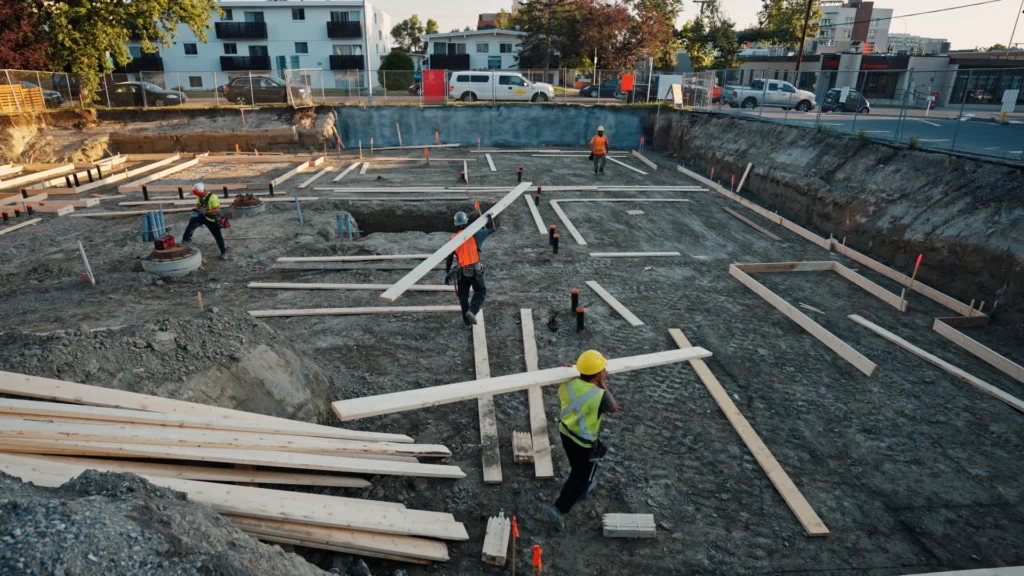
The chemistry: how sulphates attack ordinary cement
The mechanism is worth understanding, because it’s why HS isn’t optional here.
When concrete made with ordinary Portland cement meets sulphates dissolved in groundwater or soil moisture, a chain reaction unfolds over years:
- Sulphate ions migrate into the concrete’s pore structure. Sulphate is water-soluble; wet soil plus porous concrete equals sulphate transport into the cement paste.
- Sulphate reacts with the C3A in the cement, combining with water to form ettringite, a needle-shaped crystal.
- Ettringite expands. The crystals take up more room than the C3A they came from, creating internal pressure that eventually exceeds the concrete’s tensile strength — producing cracking, spalling, and progressive structural decay from the inside out.
How do SCMs and low-C3A cement stop this? The authoritative explanation comes from cement-chemistry researchers M.D.A. Thomas and R.D. Hooton, cited in the Concrete Alberta bulletin. SCMs improve sulphate resistance by “(a) reducing the rate of ingress of sulfate ions… (b) diluting and, through pozzolanic reactions, reducing the content of calcium hydroxide… (c) diluting the amount of C3A in the total cementitious binder; and (d) possibly altering hydrated aluminate phases to ones less susceptible to sulfate attack.” (Source: Thomas & Hooton, “Sulphate Resistance of Mortar and Concrete Produced with Portland Limestone Cement and SCMs,” PCA SN3285, 2016, as cited in Concrete Alberta TB#6.)
In plain terms: cap the C3A (Type HS) or dilute and block it with SCMs (HSb/HSe), and you starve the reaction that destroys ordinary concrete in sulphate soil.
What is S-2 sulphate exposure, and why is Calgary soil S-2?
CSA defines four sulphate exposure classes by how much water-soluble sulphate is in the soil and groundwater:
| Class | Severity | Water-soluble sulphate in soil | Sulphate in groundwater | Cement |
|---|---|---|---|---|
| S-0 | Negligible | < 0.10% | < 150 mg/L | Type GU fine |
| S-1 | Moderate | 0.10–0.20% | 150–1,500 mg/L | Type MS |
| S-2 | Severe | 0.20–2.0% | 1,500–10,000 mg/L | Type HS / HSe |
| S-3 | Very severe | > 2.0% | > 10,000 mg/L | Type HS + extra protection |
(S-2 thresholds per Concrete Alberta TB#6 / CSA A23.1.)
Calgary’s residential soils — across the CMA, including Airdrie, Cochrane, Chestermere, Okotoks, and the acreage corridor — routinely test at S-2. That’s the classification that triggers the Type HS / HSe mandate under CSA A23.1:24.
Why here? The geology traces to the Bearpaw Formation and the broader Western Canadian Sedimentary Basin. The shales and clays under southern Alberta carry naturally occurring sulphate minerals — gypsum (calcium sulphate), sodium sulphate, and the pyrite/bentonite that weather into more of the same. Groundwater dissolves those sulphates and delivers them to the soil moisture surrounding your footings. The lot looks ordinary; the ground under it isn’t — which is why soil sulphate testing on Calgary residential lots is standard practice, and why the result so often comes back S-2.
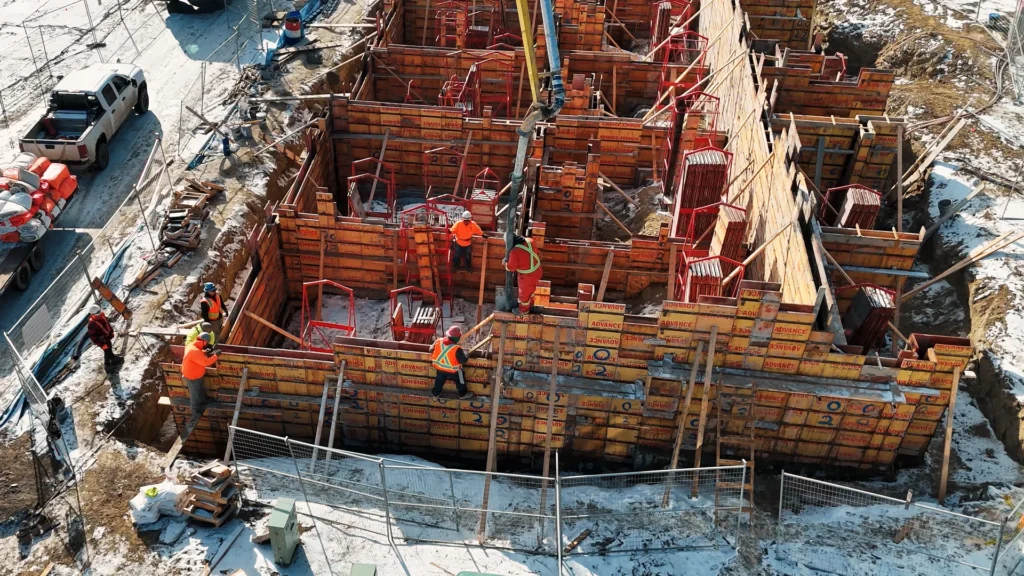
What CSA A23.1:24 actually mandates for an S-2 foundation
For S-2 sulphate exposure, CSA A23.1:24 (the current edition; the Concrete Alberta bulletin references A23.1-19 Table tables) sets a combined spec:
- Cement: Type HS (or HSb / HSe equivalent)
- Strength: 32 MPa at 56 days as the CSA minimum — 35 MPa is the common Calgary residential spec (a market premium, not the code floor)
- Spec point: 56 days (not 28 — see below)
- Maximum water-to-cementing-materials ratio: 0.45
- Air content: 5–7% entrained air (for freeze-thaw, a separate Calgary requirement)
- Maximum C3A in the cement: 5% (per the CSA A3001 Type HS definition)
When a Calgary crew or precast plant writes “32 MPa-min/35 MPa HS at 56 days,” that’s the CSA A23.1:24 requirement for S-2 exposure, not a number someone made up. Note the correction many older guides get wrong: 35 MPa is the typical spec, but the CSA minimum for S-2 is 32 MPa at 56 days — don’t call 35 MPa the minimum.
Why the 56-day spec point (not 28 days)?
This is one of the most confused points in homeowner-facing concrete content.
Most Canadian concrete is specified at 28-day strength — drive past a commercial site and the tickets read “25 MPa at 28 days.” That’s when ordinary Portland cement reaches design strength.
Sulphate-resistant mixes mature on a slower curve. With less C3A and more long-term hydration (and SCMs in HSe blends contributing strength gradually), the concrete is still gaining strength at 28 days and reaches its design value by 56 days. So a Calgary foundation spec that reads “HS at 56 days” isn’t a slow-pour excuse — it’s the structurally correct spec point for the chemistry. For an S-2 foundation, the 56-day strength is the number that matters.
For anyone doing due diligence: if a mix ticket cites “28-day strength” for a Calgary residential foundation wall, ask why — the Alberta/CSA S-2 convention is 56 days.
What happens if a builder skips Type HS cement?
The honest answer: nothing visible for years, then trouble that outlives the warranty.
- Years 1–5: identical to a correct foundation. Sulphate attack is slow; no cracks, no spalling. Builder warranties expire, the owner moves in.
- Years 5–15: micro-cracking begins, often where nobody looks — the lower basement walls, the inside face behind insulation, the footing-to-wall joint. Small efflorescence may appear. Most owners never notice.
- Years 15–30+: visible spalling, surface scaling, cracks wide enough to admit water, basement humidity, and movement on load-bearing walls. The fix at this stage is expensive: excavation, partial wall replacement, exterior waterproofing, ongoing monitoring.
Alberta’s New Home Warranty provides structural coverage during the protection period, but the sulphate-attack timeline often runs past it. A homeowner who buys new in 2026 and sees sulphate damage in 2046 has limited recourse against the original builder. That’s why the chemistry matters at spec time, not at claim time.
How do I verify my foundation was poured with Type HS / HSe?
Three checks, all available to a Calgary homeowner or buyer:
1. Ask for the concrete mix tickets (batch tickets). Every ready-mix or volumetric delivery issues a ticket documenting the mix design. For a Calgary residential foundation it should specify Type HS or HSe (or HSb) cement, a strength of 32 MPa-min/35 MPa typical at 56 days, and an HS/HSe designation in the product code. Buying a new build? Ask your builder for the foundation-pour tickets — a reputable one provides them, and hesitation is worth investigating.
2. Check the inspection and NHBPS records. Calgary’s foundation inspection (the Pre-Backfill phase) and the Alberta New Home Buyer Protection System documentation create a paper trail for the pour. These records — not a visual inspection — are how spec compliance is confirmed.
3. For precast walls, ask for the panel paperwork. Factory-cast walls carry per-panel QC documentation (mix design, cure data, strength tests) recording the cement type at the plant. Ask for it — it’s a standard part of the precast supply chain.
A visual home inspection cannot tell you the cement type. The chemistry doesn’t show on the surface; you confirm it on paper.
Do precast foundation walls in Calgary also need Type HS?
Yes. Both cast-in-place and precast foundation walls need Type HS / HSe for S-2 compliance — the chemistry doesn’t change based on where the wall was cured. A precast wall cast from sulphate-resistant cement is protected; one cast from ordinary Portland carries the same long-term vulnerability as a mis-spec’d cast-in-place wall. Calgary residential precast should be manufactured to the same CSA A23.1:24 S-2 spec (Type HS/HSe, 32 MPa-min/35 MPa typical at 56 days), with each panel’s QC paperwork on file.
The decarbonization angle (why HSb / HSe is also the lower-carbon choice)
The blended cements that achieve sulphate resistance with SCMs also cut carbon — which matters as the industry decarbonizes. Adam Auer, President & CEO of the Cement Association of Canada, frames the national roadmap this way: “By working together, Canada’s cement and concrete industry will remain competitive throughout the low-carbon transition, delivering emissions reductions while supporting jobs in communities across the country.” The CAC’s Concrete Zero plan targets a 40% reduction in carbon intensity by 2030 (more than 15 Mt cumulative) on the way to net-zero by 2050. (Sources: Cement Association of Canada — Concrete Zero; Government of Canada roadmap announcement.)
For a Calgary foundation, that’s a rare alignment: the HSb/HSe mixes that protect against S-2 sulphate are also the ones moving the carbon number in the right direction.
FAQ
Why does Calgary need Type HS (sulphate-resistant) cement? Calgary’s residential soil routinely tests at S-2 severe sulphate exposure (water-soluble sulphate ≥ 0.20%). Ordinary Portland (Type GU) cement degrades in that ground over decades as sulphates form expansive ettringite. Type HS / HSe caps the vulnerable C3A so the foundation survives. CSA A23.1:24 makes it the spec.
What is S-2 sulphate exposure and why is Calgary soil S-2? S-2 is the CSA “severe” class: water-soluble sulphate of 0.20–2.0% in soil (1,500–10,000 mg/L in groundwater). Calgary is S-2 because the Bearpaw Formation and Western Canadian Sedimentary Basin shales/clays carry gypsum, sodium sulphate, and pyrite that dissolve into the soil moisture around foundations.
What is the difference between Type HS, HSb, and HSe cement? Type HS is high-sulphate-resistant Portland cement (C3A capped at 5%). HSb is the blended version made with SCMs (fly ash/slag) — same resistance, lower carbon. HSe is a Type GU/GUL + SCM mix batched to an HS-equivalent and validated under CSA A3004-C8. All three are CSA-compliant for S-2.
What happens if my Calgary foundation uses regular (Type GU) cement? Nothing visible for years, then sulphate attack: micro-cracking around years 5–15, then spalling, water-admitting cracks, and load-bearing movement by years 15–30+. The timeline often outlasts the warranty period, leaving limited recourse against the builder.
How do I verify my foundation was poured with Type HS / HSe? Ask for the concrete batch tickets (should read Type HS/HSe, 32 MPa-min/35 MPa at 56 days), check the City inspection and NHBPS records, and for precast ask for the per-panel QC paperwork. A visual inspection can’t determine cement type — it’s confirmed on paper.
Is Type HS cement specified at 28 or 56 days, and what strength? 56 days. Sulphate-resistant mixes gain strength on a slower curve, so the design strength is taken at 56 days, not 28. The CSA A23.1:24 minimum for S-2 is 32 MPa at 56 days; 35 MPa is the common Calgary residential spec (a premium, not the code minimum).
Does Type HS cement also resist Calgary’s freeze-thaw cycles? No — that’s a different problem solved by a different measure. Sulphate resistance comes from low C3A / SCMs; freeze-thaw resistance comes from 5–7% entrained air. A proper Calgary foundation needs both, specified separately under CSA A23.1:24.
Do precast foundation walls in Calgary also need Type HS? Yes. The chemistry is independent of where the wall is cured. Precast walls for S-2 soil must be cast from Type HS / HSe cement to the same CSA A23.1:24 spec, with per-panel QC paperwork recording the cement type.
Before You Pour a Calgary Foundation, Verify the Mix
Most homeowners never see the concrete batch tickets for their foundation — and by the time sulphate damage appears, the warranty period is often long over.
If you’re building in Calgary, Airdrie, Cochrane, Okotoks, Chestermere, Springbank, or Rocky View County, we can help you verify the correct Type HS / HSe specification for your site before the pour happens.
Request a foundation mix review or quote with Omega 2000 Cribbing today.