

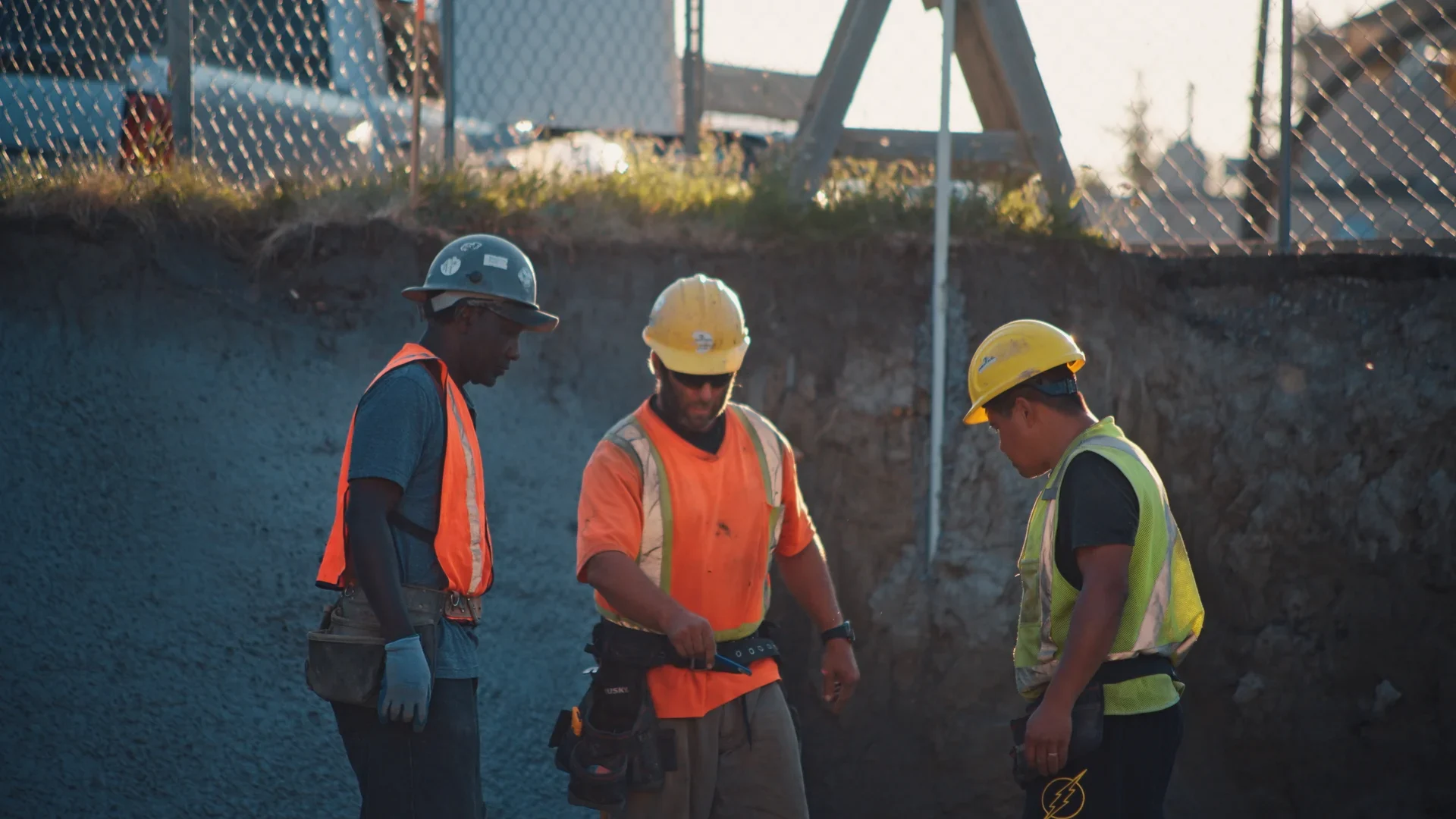
Calgary’s construction labour shortage has flipped trade capacity from something you buy on demand to the binding constraint on your schedule. With roughly 5,300 unfilled trade jobs — nearly one in four regional vacancies — and a structural gap that BuildForce projects will persist to 2033, builders are now building 10–15% labour float into plans and booking critical trades a season ahead. The way to protect your starts is to lock foundation capacity early, with a crew that can commit and that controls its own concrete supply.
How bad is Calgary’s construction labour shortage in 2026?
It’s the tightest it has been in this cycle, and the data says it’s structural rather than temporary.
- Calgary had roughly 5,300 trades, transport, and equipment vacancies in Q3 2025, or 23.8% of all 22,290 regional job vacancies. Nearly one in four open jobs across the entire Calgary region is a skilled-trade or trade-adjacent role.
- The demand side is enormous. The Calgary Construction Association points to roughly $20 billion in major commercial projects coming online over the next three to five years, on top of the City of Calgary’s $3.7 billion capital plan. That’s the demand engine pulling on the same finite crew pool.
(Source: Calgary Construction Association.) - It’s not a Calgary-only blip. BuildForce Canada projects that 42,500 Alberta construction workers will retire by 2033 (about 23% of the 2023 labour force) against roughly 41,100 under-30 new entrants, leaving a net recruiting gap of about 22,000 workers by 2033, with non-residential employment running 14% above 2023 levels.
Bill Ferreira, Executive Director of BuildForce Canada, frames the root cause: “Like many provinces, Alberta is facing a shift in its population age structure. Many trades across the residential and non-residential sectors are facing recruiting challenges.”
(Source: BuildForce Canada.)
Why is this called a “20-year issue” and not a passing shortage?
Because the math is demographic, not cyclical. The retirements are baked in: the workers leaving are a known quantity, and the entrant pipeline doesn’t refill the gap. Bill Black, President and CEO of the Calgary Construction Association, puts it bluntly: “It is tight. People are hiring constantly and looking constantly. Nobody’s unable to perform a project yet… but it’s on everybody’s mind.” And on the horizon: “this is a 20-year issue. This isn’t going to go away.” He also notes there are “more than 130 different careers connected to construction” competing for the same shrinking entrant pool. (Source: ConstructConnect, Mar 24 2026.)
Nationally the picture matches: the Canadian Construction Association estimates roughly 270,000 construction workers will retire over the decade, driving a total hiring requirement of 380,500 by 2034. (Source: ConstructConnect.)
The takeaway for a builder’s schedule: you cannot plan as if next year’s crew availability will be looser than this year’s. The structural trend points the other way.
How are Calgary builders adjusting their schedules for the labour crunch?
Three adaptations have moved from “nice to have” to standard practice on well-run builds:
- Building in 10–15% labour float. Schedulers are padding plans so a single trade slip doesn’t blow the whole sequence. Float is now a deliberate budget line, not luck.
- Booking critical trades earlier, a season ahead, not a month. When a crew can’t be replaced on short notice, the only way to guarantee the slot is to reserve it before the surge. Early booking is the new normal for the trades that sit on the critical path.
- Reducing the number of independent sub-schedules. Every separate subcontractor is a separate schedule that can fail. Builders are consolidating where they can: fewer vendors, fewer seams, fewer independent points of failure in a tight market.
The foundation is where all three matter most, because (as we cover in our companion piece on the cost of a foundation slip) it sits at the front of the critical path, so its capacity risk cascades through the entire build.
How far ahead should I book a foundation crew in 2026?
Earlier than you did in 2023. There’s no single regulated lead time, but the logic is straightforward: in a market with one-in-four trade vacancies and a demand pipeline measured in tens of billions, the reliable crews fill their calendars during a starts surge. If you wait until the slot is imminent, you’re competing for whatever capacity is left, which is exactly when a foundation slip becomes unrecoverable, because there’s no idle crew to catch you up.
The practical rule we’d give a scheduler: treat foundation capacity the way you treat your highest-value, longest-lead trade. Reserve the season, not the week. A crew worth booking will hold a committed pour window for you. A crew that can’t commit a season out is telling you something about how reliable that date will be.
Why foundations specifically are fragile in a labour squeeze: cribbing is not a stand-alone Red Seal trade in Alberta. The work falls under Construction Craft Worker, Carpenter (formwork), and Concrete Finisher designations, with no single credential pipeline feeding it, which makes the experienced-crew pool harder to grow quickly. With Calgary’s demand engine running hot (a record 27,684 housing starts in 2025, the fourth consecutive record, up 13.6%, roughly 60% of it missing-middle product), the crews that can actually pour to spec are the binding constraint. (Sources: KB §8/§11E on Red Seal designations; CMHC Spring 2026 Housing Supply Report for starts. Re-verify apprenticeship figures at write time.)
Garden suites have become one of the biggest drivers of residential foundation demand. See Garden Suite Foundations: Why a Garage Slab Won’t Cut It to understand why these projects require engineered foundations rather than standard detached-garage slabs.
Does the labour shortage affect concrete supply too?
Yes, and it’s the part most scheduling plans ignore. The crew pours the concrete, but someone has to deliver it, and the mix-supply side has its own labour squeeze.
The clearest signal comes from the US ready-mix sector, where the National Ready Mixed Concrete Association reports roughly 35% annual mixer-driver turnover, about 28% of new drivers quitting in their first year, and a striking 68% of producers reporting they lost business because of the driver shortage, all while the driver pool stays flat against rising production demand. (Source: NRMCA driver survey via Aggregates Business. US benchmark, flagged as a directional Canadian correlation, not a Canadian figure.)
The relevance for a Calgary builder: if your foundation depends on a third-party drum-mix fleet to show up on the day, you’re exposed to that fleet’s staffing problems, not just your cribbing crew’s. A mix truck that doesn’t arrive (or arrives too late in its discharge window) slips the pour just as surely as a missing crew.
How does an integrated foundation supplier reduce my labour-scheduling risk?
By collapsing several independent sub-schedules into one. The single most effective way to reduce schedule failure points in a tight labour market is to reduce the number of vendors who can independently fail you.
The Omega Group is built around exactly that consolidation for the foundation scope: Omega 2000 Cribbing (forming and pouring, since 1988), Omega Ready Mix (volumetric concrete, since 2023), and Omega Precast (residential solid-concrete precast, since late 2025) operate under common ownership. For a scheduler, that means the cribbing crew and the concrete supply aren’t two calendars that can drift apart; they’re coordinated under one accountable party. (See “One Stack, Zero Seams” for the full coordination math.)
Two specific labour hedges fall out of that structure:
- Volumetric mix sidesteps the drum-mix driver-shortage exposure. Omega Ready Mix batches on arrival from a volumetric truck, so the foundation isn’t hostage to a third-party drum-mix fleet’s staffing or to the CSA two-hour discharge clock running out on a long drive. When 68% of US producers report lost business to driver shortages, a builder booking the integrated stack isn’t carrying that risk on the mix side.
- One crew that survived prior boom-bust cycles. Operating continuity since 1988 means Omega 2000 has scheduled foundations through previous Alberta labour squeezes. That continuity is the asset: a crew that’s still here after multiple cycles is a crew that can commit to your pour window and keep it.
Will the August 4, 2026 R-CG change make the capacity squeeze worse?
Possibly, by reshaping what gets built rather than easing demand. On April 8, 2026, Calgary City Council voted 12–3 to repeal key R-CG provisions, effective August 4, 2026: reducing units from four to three (corner lots only), density from 75 to 60 units per hectare, coverage from 60% to 55%, banning mid-block townhouses, eliminating zero-lot-lines, and capping height at 10 m, with a secondary-amendment hearing slated for July 21, 2026. (Source: City of Calgary council vote, Apr 8 2026. Date-stamped; re-verify on calgary.ca at write time.)
For multi-family GCs (the Density Builder), the practical effect is a near-term rush to lock in pre-deadline approvals, which can concentrate starts (and therefore foundation demand) into a tighter window. That makes early capacity-booking more important, not less. We’ll treat the full R-CG budget impact in a dedicated article; the scheduling point here is simply that a regulatory cliff tends to bunch demand, and bunched demand strains an already-tight crew pool.
The bottom line for a scheduler
The labour data isn’t background noise. It’s the binding constraint on your 2026 schedule. The builders who protect their starts are the ones who treat foundation capacity as a long-lead reservation, cut the number of independent vendors who can fail them, and choose a crew with the continuity to commit and keep a date. Capacity you can book a year out is the product. Lock the slot before the surge, not during it.
FAQ
How bad is Calgary’s construction labour shortage in 2026? Calgary had roughly 5,300 trades, transport, and equipment vacancies in Q3 2025, about 23.8% of all 22,290 regional job vacancies, nearly one in four. With ~$20B in major commercial projects and a $3.7B City capital plan pulling on the same crew pool, it’s the tightest the market has been this cycle.
How many skilled-trade vacancies does Calgary have right now? About 5,300 as of Q3 2025, per the Calgary Construction Association: 23.8% of the region’s 22,290 total job vacancies.
Why is the trade-labour shortage called a “20-year issue”? Because it’s demographic, not cyclical. BuildForce projects ~42,500 Alberta construction retirements by 2033 against ~41,100 under-30 entrants, a net gap of ~22,000. CCA’s Bill Black says plainly, “this is a 20-year issue. This isn’t going to go away.”
How are Calgary builders adjusting their schedules for the labour crunch? Three moves: building in 10–15% labour float, booking critical trades a season ahead instead of a month, and reducing the number of independent sub-schedules (fewer vendors, fewer seams, fewer points of failure).
How far ahead should I book a foundation crew in 2026? Earlier than in 2023: reserve the season, not the week. There’s no fixed lead time, but reliable crews fill calendars during a starts surge, and a crew that can commit a season out a firm pour window is signalling how reliable that date will be.
Does the labour shortage affect concrete supply too? Yes. US NRMCA data shows ~35% mixer-driver turnover and 68% of producers losing business to the driver shortage (a directional Canadian correlation). If your pour depends on a third-party drum-mix fleet, you’re exposed to that fleet’s staffing, not just your cribbing crew’s.
How does an integrated foundation supplier reduce my labour-scheduling risk? By collapsing several independent sub-schedules into one accountable party. When the cribbing crew and the concrete supply are coordinated under common ownership, there are fewer calendars that can drift apart, and volumetric mix sidesteps the drum-mix driver-shortage exposure.
Will the August 4, 2026 R-CG change make the capacity squeeze worse? It can bunch demand. The April 8, 2026 council vote repeals key R-CG provisions effective August 4, 2026, prompting a rush to lock pre-deadline approvals. Concentrated starts strain an already-tight crew pool, which makes early capacity-booking more important.
Don’t Wait for the Labour Shortage to Choose Your Foundation Crew
Calgary’s construction labour market isn’t giving builders more spare capacity. If your foundation is on the critical path, waiting until the start date to find a crew is a schedule risk you don’t need to take.
Omega 2000 Cribbing has been forming and pouring Calgary foundations since 1988, giving builders the continuity and experience needed to plan foundation work well ahead of the start date.
With Omega 2000 Cribbing, Omega Ready Mix and Omega Precast operating under one group, builders can also reduce the number of independent schedules involved in the foundation package — fewer handoffs, fewer coordination gaps and one accountable relationship.
Whether you’re planning custom homes, infill, acreage builds, walk-outs or multi-family foundations, reserve your foundation capacity before the next starts surge.
Contact Omega 2000 today to discuss your upcoming Calgary projects and lock in your foundation crew and concrete supply before your schedule gets squeezed.