

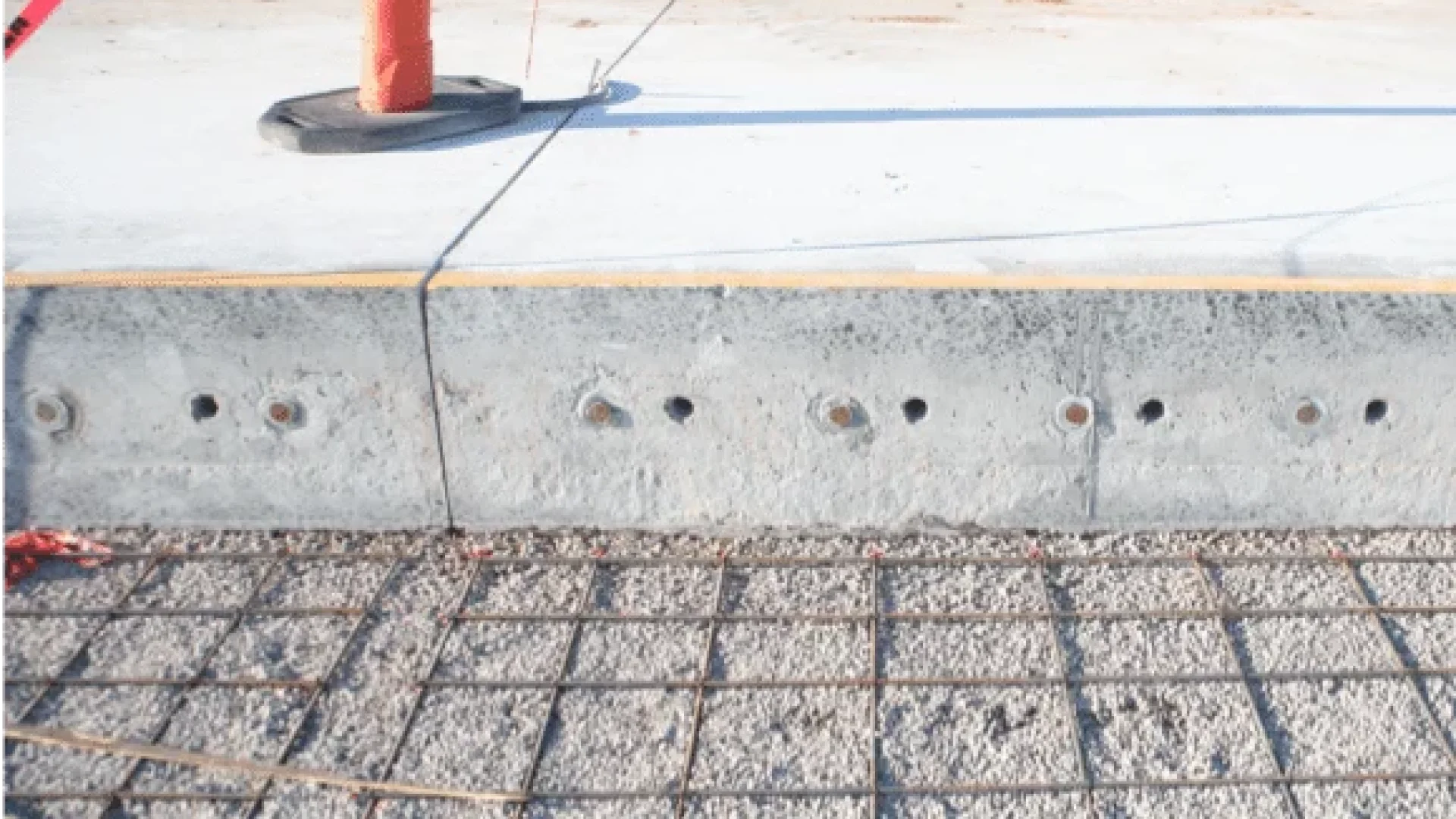
Two things decide whether a spalled slab gets a partial-depth patch or a full-depth replacement: how far the deterioration reaches through the slab, and whether the reinforcing steel is corroding. Everything else — material choice, cure time, traffic staging, price — follows from those two answers.
After 38 years pouring and repairing concrete in Calgary, we’ve found most repair budgets go sideways at the scoping stage, not the pouring stage. The crew prices what it can see. The delamination goes further than that. Here is how the boundary actually gets established, and what a defensible repair scope looks like before anyone quotes a number.
The short version: depth decides the method
A partial-depth repair removes and replaces deteriorated concrete in the upper portion of a slab, leaving the bottom intact. A full-depth repair takes the slab out through its entire thickness. The working threshold used across North American practice is one-third. The Federal Highway Administration’s design guidance for partial-depth repairs states plainly that “partial-depth repairs should be limited to the top one-third of the pavement,” and that the repair must not extend deep enough to contact load-transfer steel below. Once deterioration reaches past that, a patch is sitting on unsound material and the bond has nothing to hold onto.
| Condition found | Method | Why |
|---|---|---|
| Deterioration in the top third of the slab, reinforcement sound | Partial-depth | Bottom of slab still carries load; patch only restores the wearing surface |
| Deterioration below mid-depth, or through-slab cracking | Full-depth | No sound substrate left to bond to |
| More than half the perimeter of a bar exposed, or visible section loss | Full removal around the bar, engineer review | Corrosion continues under a patch and pushes it off |
| Spall smaller than 150 mm long and 35 mm wide | Leave it, monitor | FHWA guidance treats these as not worth a formal repair |
| Two separate spalls less than 300 mm apart | Combine into one repair | Two small patches share a weak edge and both fail |
What a properly scoped partial-depth repair looks like
Partial-depth work has dimensional rules, and they exist because thin, ragged, feather-edged patches fail first. FHWA’s construction guidance sets out the shape of the excavation clearly:
- Repair boundaries square or rectangular, not irregular
- Minimum length 300 mm (12 in.), minimum width 100 mm (4 in.)
- Repair limits extended 75–100 mm (3–4 in.) beyond the marked delamination
- Perimeter sawcut straight and vertical, typically 25–50 mm (1–2 in.) deep
- Removal by light pneumatic hammers, no heavier than 13.5 kg (30 lb), with 7 kg (15 lb) preferred to avoid microfracturing the substrate
Building-repair practice adds two more: a minimum perimeter sawcut of about 12 mm (1/2 in.) so the patch has a shoulder instead of a feather edge, and a minimum repair thickness of roughly 12 mm (1/2 in.). A patch tapered to nothing at its edge chips out in the first winter of traffic no matter how good the mortar is.
The prepared surface also has to be rough enough for the material to key into, and that roughness is specified, not eyeballed. The ICRI Concrete Surface Profile scale runs CSP 1 to CSP 10; bridge-deck practice at agencies such as Texas DOT calls for a minimum profile of about 3 mm (1/8 in.) — roughly CSP 6 — for structural repair mortars. If the product data sheet names a CSP number, that number is a requirement.
When the repair has to go full depth
Three findings move a job from patch to replacement.
The deterioration passes mid-depth. Sound concrete below the repair is the entire premise of a partial-depth fix. Without it, the patch is a lid.
The reinforcement is exposed around more than half its perimeter. Standard practice, including Texas DOT’s bridge repair manual, is to then remove concrete from around the entire bar rather than half of it, holding a minimum clearance of 19 mm (3/4 in.) — or 1.5 times the largest aggregate in the repair material, whichever is greater — so the mortar fully encapsulates the steel. You cannot clean and passivate the back half of a bar you can’t reach.
The steel has lost cross-section. Cleaning corroded reinforcement is routine. Replacing it is an engineering decision, and repair specifications that reference ACI 562 send it to the engineer of record rather than leaving it to the crew. On any element carrying load — a suspended slab, a parkade deck, a grade beam — that call gets made before demolition starts, because the shoring plan depends on it.
Find the boundary before you price the job
Delaminated concrete looks like sound concrete. It sounds different, and that is the whole trick.
Sounding. A steel rod, a ball-peen hammer or a dragged chain across the surface: sound concrete gives a clear ring, delaminated concrete a dull thud. Marked out in paint, it converts a vague “the slab is spalling” into a measured square metre count. It is the cheapest and most under-used step in the whole process.
Half-cell potential testing (ASTM C876). Where corrosion is suspected but not yet visible, potential readings map where the steel is actively corroding. Readings more positive than −200 mV indicate less than a 10% probability of corrosion activity; readings more negative than −350 mV indicate more than a 90% probability; everything between is uncertain. Moisture, cover depth and temperature all shift the numbers, so it is a mapping tool, not a verdict.
Chloride sampling. Powder samples drilled at depth intervals show whether salt has reached the steel — most relevant on parkade decks, loading aprons and any slab that gets plowed and salted every winter.
Together those three steps usually cost less than one unnecessary square metre of full-depth replacement.
Why Calgary slabs fail where they do
Calgary’s climate is unusually hard on horizontal concrete, and the numbers explain the pattern of damage better than any general durability discussion.
The City of Calgary’s climate hazard reporting tracked 128 freeze-thaw cycles per year as the 30-year average through 2022 (117 in 2022), alongside an average of 46 chinook days per year (54 in 2022). Most Canadian cities freeze in November and thaw in March. Calgary freezes and thaws over a hundred times a year, and a chinook can run a slab through a full cycle in an afternoon.
Add de-icing salt and you get the classic sequence: chloride reaches the reinforcement, the steel corrodes, corrosion products expand, and the cover concrete delaminates and spalls. Parkade decks, ramps, loading aprons, exposed stairs and sidewalk-level slabs all fail this way. For parking structures specifically, CSA S413 governs design in Canada, and CSA S448.1, Repair of reinforced concrete in buildings and parking structures, is the repair standard a consultant will reference in the specification.
The practical takeaway: on a Calgary slab, an isolated spall is rarely isolated. Sound the whole bay, not just the visible damage. Our crews have carried that habit through 52,000+ projects, and it is still the most reliable way to keep a repair budget honest.
The season window is real, and it is shorter than people think
Repair mortars have temperature limits at both ends. Bridge-deck practice sets substrate and material temperature between about 4°C and 35°C at placement, with a minimum 72-hour cure for batched concrete repairs. FHWA guidance advises against normal-set concrete repairs below 4°C, and warns that below about 13°C extended curing or insulation is needed.
In Calgary that puts unheated exterior repair work between roughly May and early October, with shoulder-season work needing hoarding and heat. A repair scoped in November either gets hoarded properly or gets scheduled for spring, and the honest answer is usually spring. We’ve written elsewhere about what changes when concrete goes down in winter; repair work is less forgiving than new placement, because the patch has to bond to a cold substrate rather than simply cure on its own.
What belongs on a concrete repair quote
A quote that lists “concrete repair — allow” is not a quote. On any commercial repair we price, these lines are stated explicitly:
- Sounding and marking — who does it, and whether the quantity is firm or provisional
- Removal method and depth — sawcut depth, hammer weight limit, hand chipping around steel
- Reinforcement treatment — cleaning method, clearance behind bars, who approves replacement
- Surface preparation and material — target CSP, substrate moisture at placement, named repair product and thickness range
- Protection and cure — hoarding, heat, cure duration, when traffic returns
- Reinstatement — joints, sealer, membrane, line painting on parkade decks
- Unit rate for overrun — the price per square metre if sounding finds more than the base scope
That last line prevents the argument. Delamination quantities move once demolition starts; agreeing the unit rate in advance keeps the change order boring. It is the same discipline that avoids the coordination failures that delay projects — settle the ugly questions before the crew is standing on site.
FAQ
Is a partial-depth repair a temporary fix? Not when it is scoped correctly. Placed on sound substrate, with a proper sawcut shoulder, adequate thickness and clean reinforcement, it is a permanent repair. What fails is thin, feather-edged patching over unsound material.
Can you patch over corroded rebar? Not safely. If more than half the perimeter of a bar is exposed or the bar shows significant corrosion, the concrete has to come out from around the entire bar with clearance behind it — typically 19 mm minimum — so the repair material fully surrounds the steel. Section loss is an engineering decision.
When is full replacement cheaper than repair? Roughly when repair quantities pass about a third to a half of the area, or when deterioration is full-depth in several locations. At that point mobilisation, staging and unit repair costs converge on the price of a new slab — and the new slab starts a fresh service life.
Can concrete repairs be done in winter in Calgary? Under hoarding and heat, yes. But repair materials generally need a substrate above about 4°C and 72 hours of protected cure, so unless the schedule demands it, spring through early fall is the cheaper and lower-risk window.
Does a spalling parkade deck need an engineer? If the element carries load and reinforcement is affected, yes. Parking structures in Canada fall under CSA S413 for design and CSA S448.1 for repair, and both point toward a consultant-prepared repair specification rather than a contractor-scoped patch.
Getting a straight answer on your slab
If you have spalling on a commercial slab, a parkade deck, a loading apron or a building foundation, the first step is not a price — it is a sounding survey and a measured scope, and it usually takes a morning.
Take a look at what our concrete repair services in Calgary cover, or if the damage is at foundation level, start with the signs of foundation problems worth acting on. Either way, answer the depth question before you ask for a number — the number means nothing until you know how deep the fix goes.