

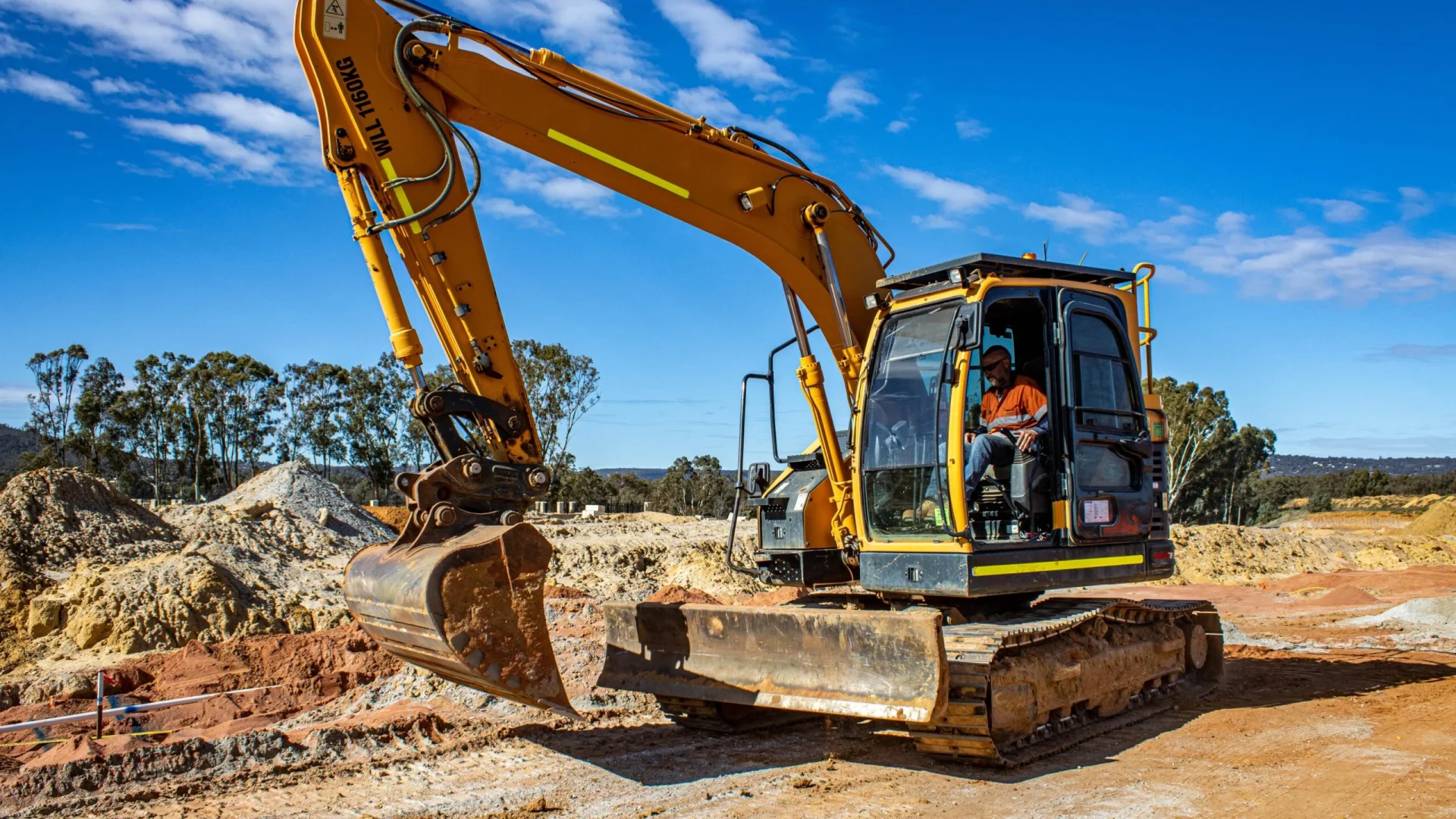
Before a worker starts a skid steer, loader, telehandler or ride-on buggy on an Alberta job site, three things have to be true: the worker has been trained to operate that machine safely, the worker has demonstrated competency to someone the employer has designated as competent, and the employer has authorized the worker to run it. All three. A ticket from a weekend course satisfies the first and says nothing about the other two.
That distinction is where most equipment paperwork on a Calgary site falls apart.
The short version
Alberta’s OHS Code Part 19 governs powered mobile equipment. It does not set out a provincial licence or a certificate number you can look up. It sets out a chain of conditions — trained, demonstrated competent, authorized — plus requirements for the machine itself and for how it moves around people. The employer owns most of that chain; the operator owns the walkaround.
The practical consequence: your equipment file needs to show who assessed the operator, on what machine, and who signed off.
What counts as powered mobile equipment
The definition is broader than most people assume. Alberta describes powered mobile equipment as a self-propelled machine or combination of machines, including a prime mover or motor vehicle, designed to manipulate or move material, or to provide a powered aerial device for workers.
On a concrete job in Calgary that pulls in more than the obvious yellow iron:
- Skid steers moving forms, gravel and spoil
- Tracked and wheeled loaders
- Backhoes and excavators on footing and foundation work
- Telehandlers setting panels, block and bundled rebar
- Motor graders and compaction equipment on subgrade
- Ride-on power buggies, self-propelled screeds and riding trowels
A machine does not escape Part 19 because it is small, because it is rented, or because the person running it is only on it for twenty minutes. Size changes which equipment requirements apply. It does not change the training question.
“Trained” and “competent” are two separate tests
Section 256 of the Code sets out operator responsibilities, and the condition is cumulative: a worker must not operate powered mobile equipment unless the worker is trained to safely operate it, has demonstrated competency in operating it to a competent worker designated by the employer, is familiar with the equipment’s operating instructions, and is authorized by the employer.
“Competent” is not left to interpretation. The OHS Act defines it in section 1(d) as adequately qualified, suitably trained and with sufficient experience to safely perform work without supervision or with only a minimal degree of supervision.
Read together, a few things follow that catch people out:
- The assessor has to be competent too. Someone must watch the operator run that machine and judge it. That person must themselves meet the competent standard, and the employer must have designated them.
- Competency attaches to the machine, not to the worker in general. A finisher who is genuinely competent on a power buggy has not been assessed on a telehandler.
- Authorization is a separate act. Training plus demonstrated competency still is not permission.
- Familiarity with the operating instructions is specific. Section 281 requires the operator’s manual to be available, and rented machines change models between jobs — controls, load chart and lockout points with them.
A well-run program handles this the way the University of Calgary describes its own: formal training with a theoretical and a practical component, followed by the worker being declared competent by a competent trainer. The structure matters, not the brand of course.
The pre-start walkaround, and the records that live on site
Section 257 requires a visual inspection before start-up, and no one is to start the machine until it is complete. It is the operator’s job, not the mechanic’s, and it covers the area around the machine as well as the machine.
Section 260 covers inspection and maintenance, and carries the requirement that trips up more sites than any other in Part 19: records of inspections and maintenance performed on powered mobile equipment must be kept at the work site and available to the operator.
At the work site. Not in the shop, not in the rental company’s system, not in a head-office folder. If a machine arrives at eight in the morning for a nine o’clock pour, the paperwork arrives with it. After 38 years of concrete work in this city, we have seen far more jobs stop over a missing inspection record than over a failed machine.
Section 273 adds an obligation that rental fleets and shop-built attachments can quietly trip: equipment modified in a way that affects its protective structures requires recertification.
The machine itself
Part 19 also sets out requirements about how the equipment is built and equipped. The sections worth knowing by name:
| Section | Requirement |
|---|---|
| 266 | Other safety equipment |
| 270 | Rollover protective structures |
| 271 | Equipment with rollover protection |
| 272 | Falling objects protective structures |
| 281 | Operator’s manual |
| 282 | Load and slope limitations |
| 283 | Load chart |
| 284 | Seat belt |
| 285 | Chocking |
Section 270 lists the equipment that has to carry a rollover protective structure — dozers, loaders, motor graders, skidders, certain backhoes, wheeled scrapers, agricultural and industrial tractors, wheeled trenchers — and points to recognised structural standards, including the CSA B352 series.
Two sections work as a pair. Section 284 deals with the seat belt on the machine. Section 256 puts the duty to actually wear it on the operator, along with the duty to see that passengers wear theirs. A belt in the cab and a belt around the operator are different compliance questions, and only one is visible from across the site.
Sections 282 and 283 matter more on concrete work than people expect. A telehandler setting a bundle of rebar on a slope has two limits running at once — what the load chart allows at that reach, and what the slope allows at all. The chart has to be on the machine for either question to be answerable.
Blind spots on pour day
A pour is the worst traffic hour of the job. Trucks backing in, a crew with their heads down and their backs to the access route, a chute swinging, and a skid steer trying to keep the forms fed.
Section 267 addresses exactly this. Where the operator’s view is obstructed, the machine must carry an automatic audible warning device loud enough to be heard above the ambient noise, or an alternate warning device or method, or an automatic stopping system. Where fitting a warning device is not practicable, the section sets out the alternatives: detailed inspection of the travel path, direction by a designated signaller or other worker who stays in continuous view of the operator, traffic control, or removing workers from the area.
That phrase — in continuous view of the operator — is the one to hold onto. A signaller who steps behind the machine has stopped being a signaller.
Section 259 deals with pedestrian traffic and section 258 with dangerous movement. Together with 267 they describe a layout decision, not a PPE decision: where the machine travels, where the crew stands, and who owns the overlap. That is the same planning question behind eight concrete coordination failures that delay projects, and the reason a large footing pour gets walked before it gets poured — see what goes into a 90 m³ footing pour in Calgary.
Leaving the machine
Section 263 covers unattended equipment: it must be prevented from moving unintentionally — safety devices engaged, transmission in park, or wheels chocked. Subsection 263(2) adds that suspended machinery or ground-engaging implements have to be lowered to the ground or otherwise secured before the controls are left unattended. Section 285 deals with chocking.
A loader bucket left high while the operator walks over to look at a form is the most common version of this on a concrete site, and the easiest to fix.
What the Alberta numbers actually show
Alberta publishes its own injury statistics, and they are worth reading before anyone argues that equipment rules are paperwork.
In the 2021 provincial summary, the construction and construction trade services sector recorded 3,377 lost-time claims, a lost-time claim rate of 1.10 per 100 person-years, and an adjusted fatality rate of 13.30 per 100,000 person-years. Across all sectors that year, being struck by or against objects accounted for 6,118 disabling injury claims — 14 per cent of the total — and contact with objects and equipment for another 3,220 claims, or 7 per cent. Struck by or against objects was the cause in 28 per cent of workplace incident fatalities, and construction and construction trade services accounted for 36 per cent of those.
Nothing in that data isolates powered mobile equipment on its own. What it does show is that the category Part 19 exists to control — a moving object and a worker occupying the same ground — is where Alberta construction gets hurt and killed.
A pour-day sequence that holds up
| When | What | Who owns it |
|---|---|---|
| Before the machine is dispatched | Training record, competency assessment, authorization on file for this operator on this class of machine | Employer |
| With the machine | Inspection and maintenance records delivered to site; operator’s manual on the machine | Employer |
| Before start-up | Visual inspection of machine and surrounding area | Operator |
| Before the trucks arrive | Travel path, pedestrian routes, signaller named and briefed | Supervisor |
| Any load, any slope | Load chart consulted; slope limit respected | Operator |
| Every time the operator steps off | Implements down, park, chocks as needed | Operator |
Across 52,000+ projects, the jobs that run cleanly are not the ones with the thickest binder. They are the ones where that sequence happens in that order without anyone needing a reminder.
Where this page stops
This page is about the operator and the machine under Part 19. It does not cover protecting workers in an excavation, which is a different part of the Code with its own engineering requirements. It does not cover who holds the prime contractor designation on a multi-employer site. It does not cover respirable dust from cutting or coring, hand-arm vibration from breakers and saws, or first aid and working alone — each has its own obligations and thresholds, and we have treated them separately. It also leaves out concrete pump trucks and pumping, which sit on the supply side rather than in site plant.
For how to tell whether a crew’s safety program is real before you hire them, see EMR, COR and the foundation crew.
Frequently asked questions
Does Alberta require a licence to operate a skid steer on a construction site? No. Alberta does not issue an operator licence for powered mobile equipment. Section 256 requires the worker to be trained, to have demonstrated competency to a competent worker designated by the employer, to be familiar with the operating instructions, and to be authorized by the employer. A third-party course supplies the training portion only.
Is a training certificate enough to prove compliance? Not on its own. A certificate evidences training. The Code also asks for a demonstrated competency assessment and employer authorization, and section 1(d) of the OHS Act sets the bar at adequately qualified, suitably trained and with sufficient experience to work safely without supervision or with only minimal supervision.
Who can assess an operator’s competency? A competent worker designated by the employer. The assessor must meet the same competent standard, and the designation should be recorded rather than assumed.
Do inspection records have to be on the job site? Yes. Section 260 requires records of inspections and maintenance to be kept at the work site and available to the operator. Records held only at a shop or in a rental company’s system do not meet that.
Does competency on one machine carry over to another? No. A new class of machine, or a model with materially different controls or load limits, calls for a fresh assessment and a current operator’s manual on the machine.
What has to happen before an operator steps off the machine? Under section 263, the equipment must be prevented from moving unintentionally, and suspended machinery or ground-engaging implements must be lowered or otherwise secured before the controls are left unattended. Section 285 covers chocking.
Planning a pour with equipment on site?
If you are lining up a foundation, pad or commercial flatwork package and you want a concrete partner whose equipment paperwork arrives with the machine, send us the site plan. We will walk you through access and sequencing before the first truck is booked. Start with commercial concrete contractors in Calgary.
Sources
- Alberta Occupational Health and Safety Act, definitions — https://search-ohs-laws.alberta.ca/legislation/occupational-health-and-safety-act/definitions-and-purposes-of-this-act/
- Alberta Occupational Health and Safety Code, Part 19 Powered Mobile Equipment — https://search-ohs-laws.alberta.ca/legislation/occupational-health-and-safety-code/part-19-powered-mobile-equipment/
- Government of Alberta, Workplace injury, illness and fatality statistics, provincial summary 2021 — https://open.alberta.ca/dataset/4fb90b70-7660-4553-98fc-a59574f8fd5a/resource/1b8ab8d5-bb7d-4468-8289-bd365af5beb5/download/jend-workplace-injury-illness-fatality-stats-provincial-summary-2021.pdf
- University of Calgary, Powered Mobile Equipment Program — https://www.ucalgary.ca/risk/sites/default/files/teams/13/Powered-mobile-equipment-program.pdf