

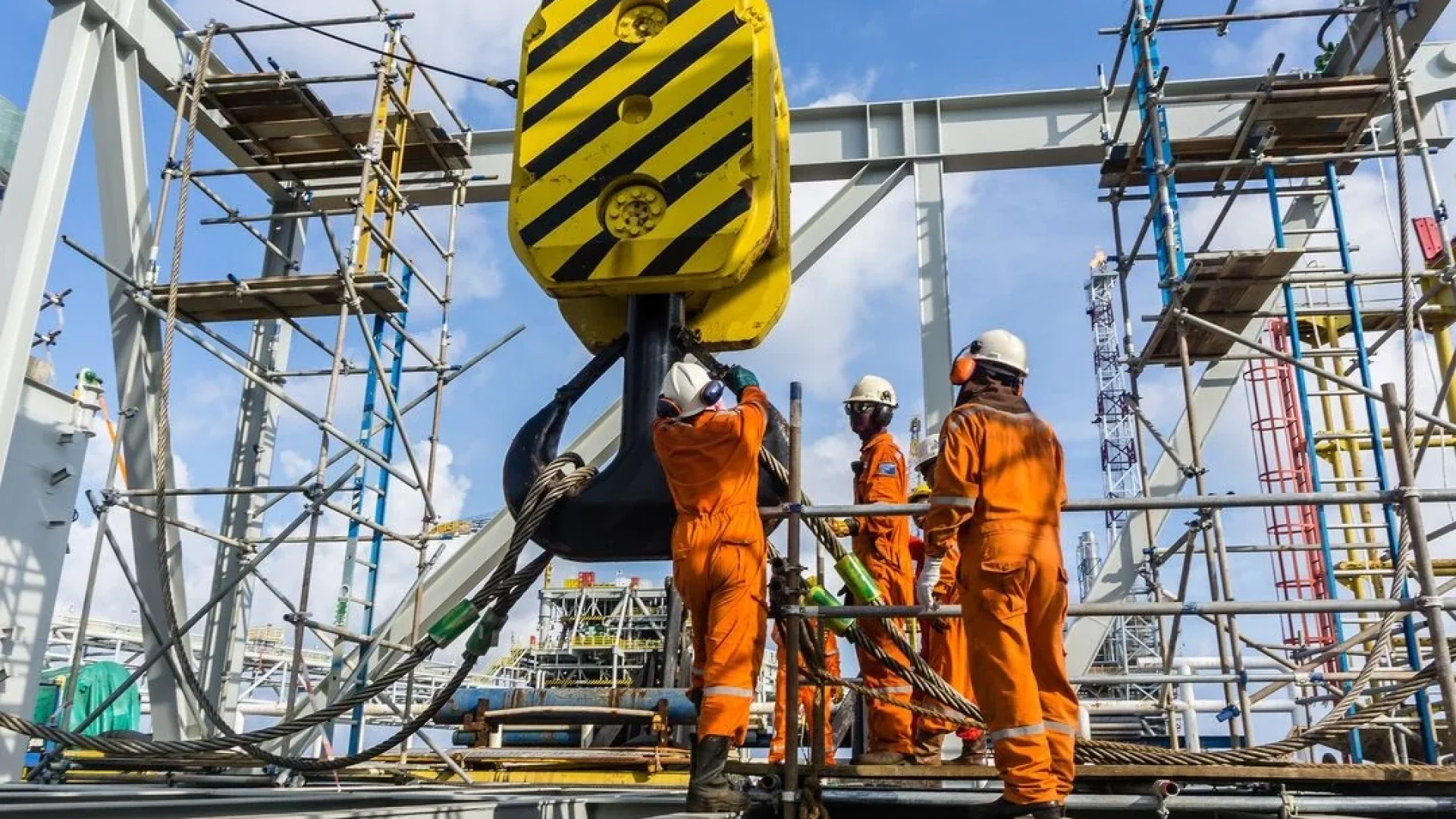
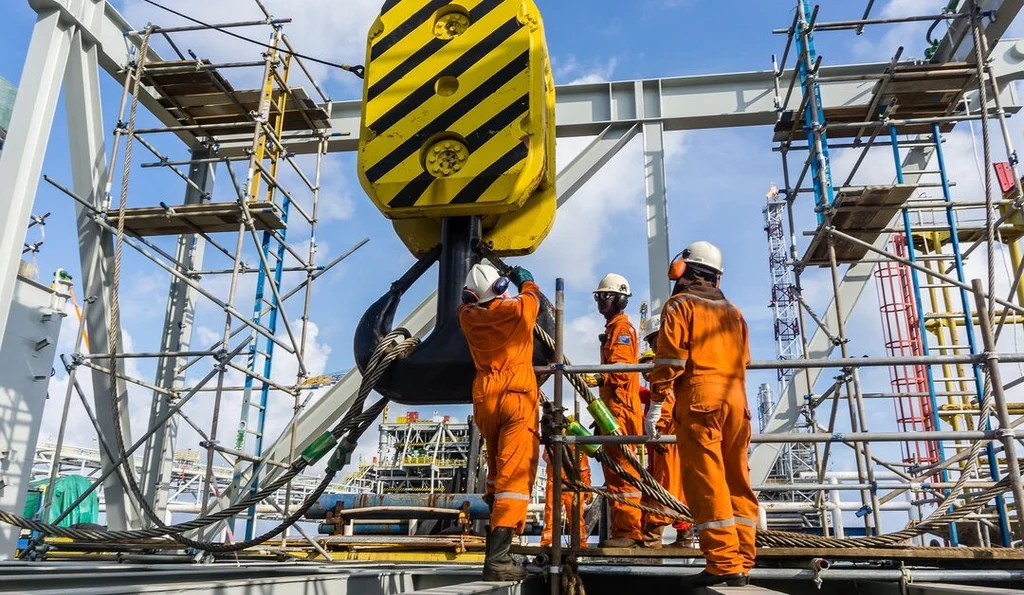
The rigging that fails an Alberta inspection is almost never the rigging in the air. It is the sling coiled in the gang box with a frayed edge nobody wrote up, the hook with a throat that has opened a little, the shackle that came off another job and never had a tag. An officer can pick those up and act on them without watching a single lift.
That matters to concrete crews more than most people assume. We are not erecting steel, but we hoist constantly: gang forms, rebar bundles and prefabricated cages, embed assemblies, screed rails, and concrete by the bucket where a pump cannot reach. Every one of those picks sits under two different parts of the OHS Code, and the two parts ask for different things from different people. This article sets out what each one requires, who carries it, and where Alberta has put the enforcement teeth.
Two parts of the Code land on every concrete pick
Alberta splits hoisting across Part 6 and Part 21, and the split is clean once you see it.
Part 21, Rigging, governs the hardware between the hook and the load — slings, shackles, spreader bars, wire rope, hooks, cable clips, ferrules. It is about condition, ratings and inspection, and it runs across nineteen sections, 292 to 309.
Part 6, Cranes, Hoists and Lifting Devices, governs the lift itself — the device, its load charts, the weight calculation, the signals, the people under the load.
A crew can be flawless on one and exposed on the other. A certified operator on a current load chart does not cure a sling that should have been destroyed last month, and a perfectly tagged rack does not cure a pick nobody calculated.
What Part 21 actually sets, in numbers
Part 21 is unusually specific, which is good news: it can be turned into a gang-box standard rather than a policy statement.
Safety factors. Section 292 sets the safe working load as a fraction of ultimate breaking strength: 20 per cent for components that are not fatigue-rated, a 5:1 factor. Components fatigue-rated to EN 1677-1 and not used to raise or lower a worker may be rated at 25 per cent, a 4:1 factor, as may lifting chain the manufacturer has fatigue-tested. Section 292.1 then sets wire rope factors by use — 3.5:1 running lines, 5:1 non-rotating lines, 3:1 tugger lines for pulling only and 5:1 if they hoist, 3:1 pendant and guy lines, 2:1 winch lines.
Load ratings. Section 293 is blunt about a mistake we still see on site: “The maximum load rating is not the breaking strength of the piece of rigging.” Ratings may be stamped, etched, embossed, printed or tagged, and where a component cannot be marked, information about its maximum load has to be made available to the lifting supervisor and the operator. Synthetic web slings carry their working load limits permanently and legibly marked on the sling itself, and a spreader bar and its data sheet carry matching identification numbers.
Inspection. Section 294 requires rigging to be thoroughly inspected before each period of continuous use during the shift, by a competent worker. Beyond that, Table 21.1 sets frequencies by sling type — daily for wire rope and synthetic webbing, monthly for chain in normal service, and periodic inspections at least annually.
The rejection criteria are measurements, not opinions
This is the part worth printing and laminating. Sections 305 to 309 define when a component stops being equipment and becomes scrap.
| Component | Remove from service when |
|---|---|
| Wire rope | 10 randomly distributed broken wires in one rope lay, or 5 broken wires in one strand in one rope lay; kinking or birdcaging |
| Hooks | Throat opening increased more than 15 per cent of original; twisted more than 10 degrees out of plane; 10 per cent or more loss of cross-sectional area; cracked or otherwise defective |
| Metal mesh slings | 25 per cent reduction in wire diameter from abrasion, or 15 per cent from corrosion; 15 per cent loss of original cross-sectional area at a hook opening or end fitting |
| Synthetic rope | Diameter reduced by more than 10 per cent |
| Synthetic fibre slings | Damaged — and section 305 notes heat above 90°C, sunlight and moisture as causes |
| Anything arc-struck | Removed, unless a professional engineer certifies it safe to use |
Two mechanics inside those criteria catch people out. First, section 305 treats combined damage as cumulative: where several types of damage together have an effect roughly equal to a single type that would exceed the limit, the sling goes. Second, removal from service is not a decision to park something in the back of the trailer — the sling has to be permanently removed and physically altered so nobody can quietly return it to the rack.
Repairs are narrow. A repaired metal mesh sling has to be proof-tested to at least twice its vertical hitch rated load, repaired welded components need a professional engineer’s certification before they go back on the hook, and makeshift rigging is out entirely under section 304.
Alberta put its on-the-spot fines on exactly one thing
Here is the detail that should shape how you spend your safety time. Alberta’s schedule of ticketable OHS offences — the violations an officer can write immediately, without a prosecution — includes only five items from Part 21, and all five say the same thing in different materials:
- 305(1) and 305(2), synthetic fibre web sling — $500 each
- 306(2), running wire rope — $500
- 306(3), stationary wire rope — $500
- 307, metal mesh sling — $500
In each case the offence is the employer failing to remove the damaged or worn component from service.
Nothing about safety factors is ticketable. Nothing about matching components is ticketable. The ticket is for keeping bad rigging available — and every one of those tickets is written to the employer.
From Part 6, three more land on concrete work: $300 where a lifting device has no load capacity plate or label (section 62), $300 where an employer lets a worker ride a material hoist, and $500 where a mobile crane or boom truck works without its outriggers extended and supported.
After 38 years pouring concrete in this city, we have sat through enough inspections to know that the officer’s first move is not to watch a pick. It is to ask to see the slings.
Part 6: the numbers that decide whether a pick needs paper
Load weight comes first. Part 6’s guidance calls load weight the most critical piece of information needed to conduct a lift safely, and total weight means the load plus hook and block plus slings and attachments. Weights come from manufacturer information, engineering specifications, or a competent person’s calculation — not from a crew’s estimate of a rebar cage.
Net capacity, not rated capacity. Load chart values must never be exceeded, and they assume a crane in as-new condition set up to the manufacturer’s specifications. Net capacity is the rated capacity minus jibs, rigging, load blocks and headache balls, which is why the rating on the boom never governs your pick.
The 75 per cent line. A lift calculation is required once a load reaches or exceeds 75 per cent of the crane’s capacity, covering load information including centre of gravity, crane configuration and deductions, the resulting percentage of capacity, and a sketch showing crane placement and clearances to buildings and power lines. For a repetitive series of picks, the worst case can satisfy the requirement. Cross that line without the paper and you are not merely under-planned; you are non-compliant.
Loads over workers. Workers may not stand or pass under a suspended load, moving or stationary. Where there is no reasonably practicable alternative, workers must be warned and the operator must know where they are — and the guidance adds a dimension crews rarely hear: the bottom edge of the load should not travel higher than the shoulder height of the workers attending it.
Tag lines. Tag lines keep riggers back from the load and off a conductive path, so they are normally nylon or another non-conductive material, long enough to control the load and used so the rigger cannot be struck by it. The hoisting line sits over the load’s centre of gravity to keep swing down, and tag lines come off where they would make things worse, such as near live conductors.
Concrete buckets are covered gear. Section 74 requires containers used for hoisting to be strong enough to withstand hoisting forces and the forces exerted by the load. A bucket is lifting equipment, not a site-fabricated hopper.
Who has to be certified, and who has to be competent
The employer must ensure the operator is competent, and under the Apprenticeship and Industry Training Act a recognized trade certificate is required for tower cranes, mobile cranes with a lifting capacity of 15 tons or more, stiff boom trucks over 5 tons, articulating boom trucks over 5 tons with a winch or over 8 tons without one, and wellhead boom trucks. Below those thresholds the obligation does not disappear — it shifts entirely onto the employer to show qualifications, training and experience.
Competency under section 64(2) is demonstrable, not assumed: reading lift plans and load charts, keeping log books, selecting configurations, determining net capacity, inspecting the device, and using hand signals. Signallers are designated under section 191, and an unclear signal is not acted on. Section 66 gives the operator a stop: any doubt about the safety of a lift, and the lift stops until the condition is made safe.
On a multi-employer site those duties sit in three places at once. The employer owns the equipment, the inspections and the competency. The prime contractor owns coordination across trades, including who is under the load and when. The person in charge of the lift owns the pick in front of them, and complex picks may need a lift engineer or rigging specialist. We cover how those roles are assigned in our guide to prime contractor requirements in Alberta, and the reporting consequences when a pick goes wrong in serious incident reporting on a concrete site.
Four things to close before the crane is on site
- Name the competent inspector. Section 294’s shift inspection needs a person, not a role. Record it where you record the excavation and shoring sign-offs.
- Weigh the picks, do not estimate them. Get engineered weights for cages, gang forms and embed assemblies, and add the rigging before comparing against the chart.
- Check every pick against 75 per cent. If any pick crosses it, the calculation and sketch are produced before mobilization, not on the morning of.
- Purge the rack. Measure hooks and ropes against the rejection criteria, destroy what fails, and document the maximum load of anything that cannot be marked. This is the one place Alberta writes tickets.
Talk to us before the crane is booked
Most of the rigging problems we are asked to look at were decided weeks before the lift, when a pick that needed engineered weights got a guess. Bring us in while the pour sequence and the crane window are still being drawn, and the lifting plan comes out of the same conversation as the formwork plan.
Reach our commercial concrete contractors in Calgary to set it up, or see our foundations work in Calgary for the cage and form picks that drive most foundation hoisting.
Frequently asked questions
Does Part 21 apply if we only lift with a telehandler, not a crane? Yes. Part 21 governs the rigging between the lifting device and the load, whatever the device is. The same inspection, rating and rejection requirements apply.
How often does rigging actually have to be inspected? Before each period of continuous use during the shift, by a competent worker. On top of that, Table 21.1 sets frequent inspections — daily for wire rope and synthetic webbing, monthly for chain in normal service — and periodic inspections at least once a year.
What makes a lift a “critical” lift in Alberta? The Code does not use that label as its trigger. The trigger is numerical: at or above 75 per cent of the crane’s capacity, a lift calculation is required, with load and crane information and a sketch of placement and clearances.
Who gets the ticket if an inspector finds a worn sling on our site? The employer. All five ticketable Part 21 offences are written to the employer at $500 each, for failing to remove damaged or worn rigging from service.
Is a concrete bucket treated as rigging? It is treated as a container for hoisting under Part 6, section 74, and must be strong enough to withstand hoisting forces and the forces exerted by the load — a rated, inspected bucket rather than anything fabricated on site.
Sources
- Government of Alberta, OHS Code Part 21 Rigging — Explanation Guide
- Government of Alberta, OHS Code Part 6 Cranes, Hoists and Lifting Devices — Explanation Guide
- Government of Alberta, Ticketable offences — Occupational Health and Safety
- Government of Alberta, OHS Code Part 21 — Rigging, section list
Section numbers and thresholds above are taken from the Government of Alberta’s published explanation guides and the ticketable offences schedule. The guides are the Government’s commentary on the Code rather than the legislative text itself; confirm against the current Code for your project.