

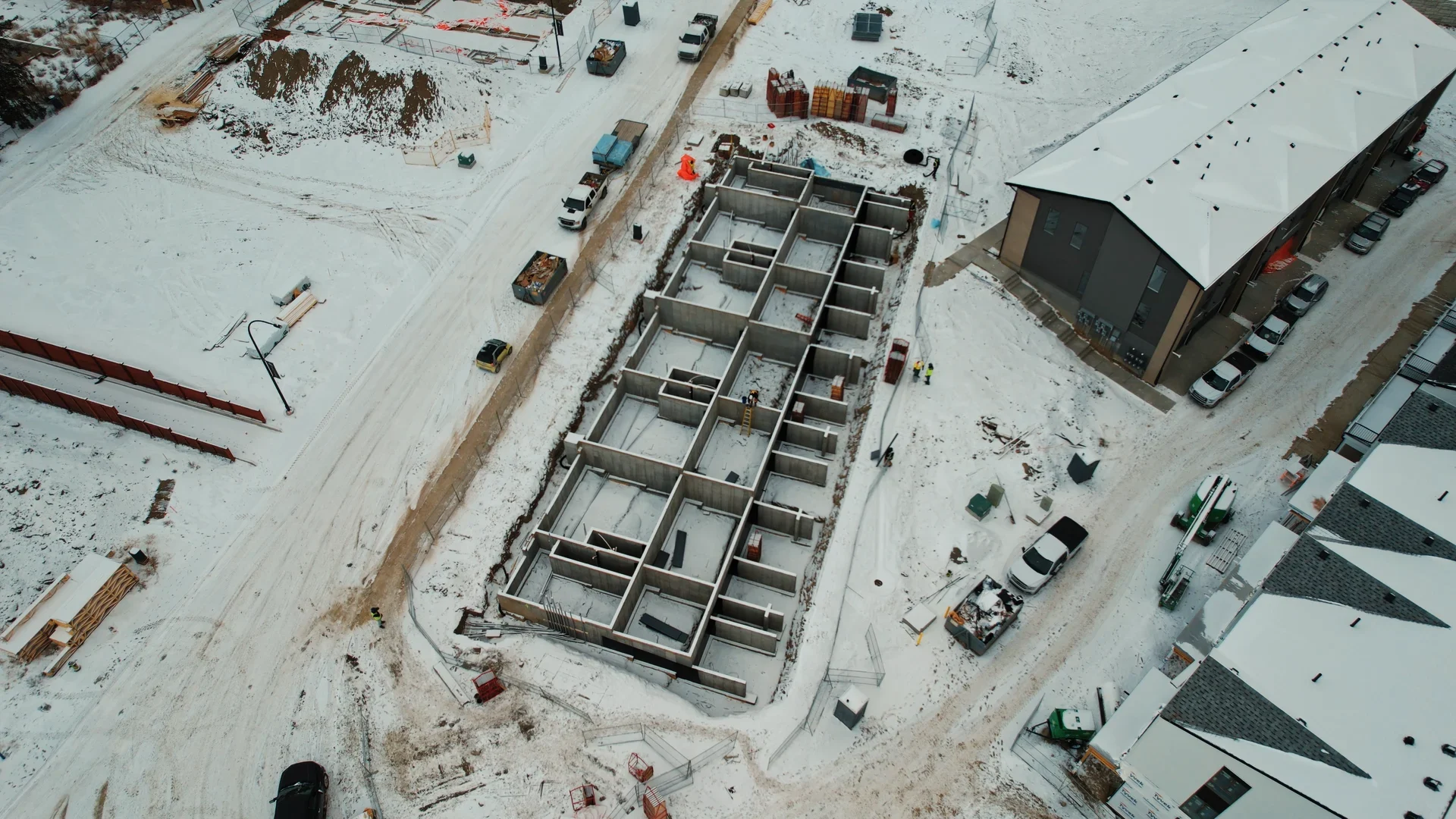
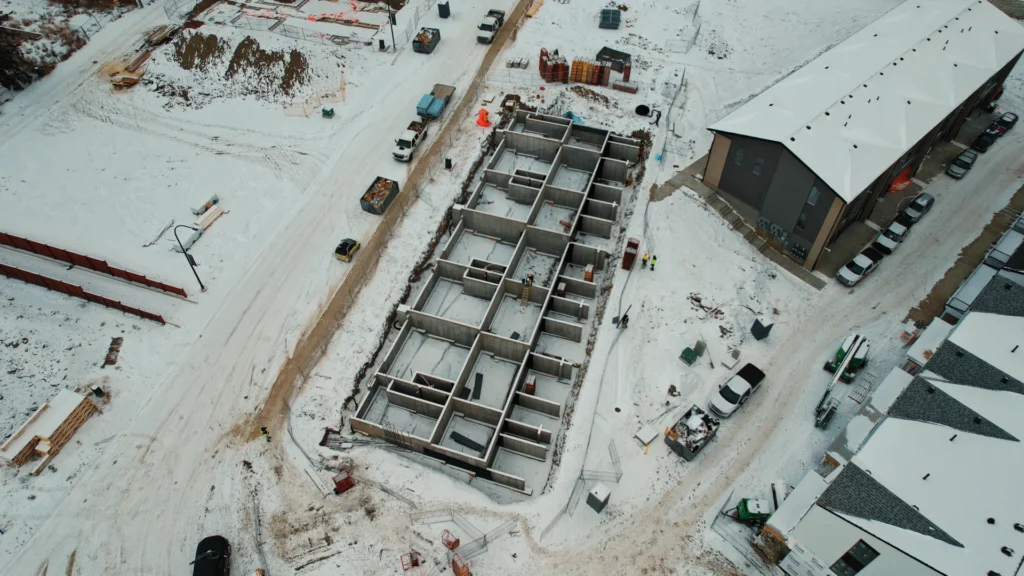
To keep framing crews moving across a multi-unit row, sequence the foundation so each unit is poured, protected to strength, stripped, and backfilled in a rolling cadence (not all at once) so framing starts on the first units while the last ones cure. Foundation-to-framing is the textbook critical-path dependency: framing can’t start until the foundation is done, so any delay on the foundation pushes the whole project’s end date.
The lever is float and rotation: pour in the order your framing crew advances, protect each pour to 8 MPa before it can freeze, and hand units off one at a time instead of waiting for the entire row. In Calgary, three local constraints shape that cadence: the 5 °C cold-weather trigger, the 8 MPa-before-freezing milestone, and the 2-hour concrete discharge clock.
This is the operational how that sits underneath the cost articles. For what a slipped pour costs and why an integrated stack removes coordination seams, see the companion articles linked below; this one stays on the method.
Why does foundation sequencing matter on a multi-unit row?
Because on a row of townhomes or rowhouses, the foundation is the gate every downstream trade waits behind, and you’re repeating that gate three, four, six times in a tight footprint. Sequencing is the difference between a framing crew that rotates smoothly down the row and one that stands idle waiting for the last unit’s wall to cure.
The discipline has a name in project management: construction sequencing. As the scheduling literature puts it, “proper sequencing prevents crews from arriving too early or too late, avoids idle equipment… supporting smoother productivity.”
(Source: ProjectManager, “Construction Sequencing,” https://www.projectmanager.com/blog/construction-sequencing-construction-sequence-plan .) On a single house the stakes are modest. On a row, the same mistake repeats per unit, and the idle time compounds.
It matters more in Calgary right now because the volume is real. Calgary and Edmonton lead Canada in missing-middle starts; Calgary missing-middle starts rose 44% from 2023 to 2024, reaching 31,194 in 2024, with 19,357 in January–July 2025 alone.
(Sources: Strong Towns, https://www.strongtowns.org/journal/2025-6-23-calgary-is-ditching-red-tape-for-rowhouses ; RENX Homes, https://renxhomes.ca/calgary-edmonton-lead-canada-missing-middle-homes-starts-cmhc .)
Repeated row geometry is a learning curve a disciplined sequence can exploit, but only if the foundation cadence is built to be repeated.
Foundation sequencing starts long before the first truck arrives. It starts with understanding what the ground will actually support. Before planning excavation depth, backfill timing, or concrete placement, read What a Soil Engineering Report Actually Tells You About Your Calgary Lot (and How to Read It Before You Pour a Foundation) to understand how geotechnical recommendations influence every foundation schedule.
What’s the critical-path dependency between foundations and framing?
It’s the canonical example in construction scheduling. The critical path is the longest sequential chain of dependent tasks; it sets the minimum possible project duration, and any delay on a task on that path delays the whole project.
(Source: Workamajig, “Critical Path Method,” https://www.workamajig.com/blog/critical-path-method ; Smartsheet, “Construction Critical Path,” https://www.smartsheet.com/construction-critical-path .)
Foundation work is the textbook predecessor to framing. As Smartsheet frames it: “If Framing can’t start until Foundation Work is done, enter [the foundation task] as the predecessor.” Framing has zero float against the foundation; it cannot start early no matter how ready the crew is. So the foundation sits squarely on the critical path, and the schedule’s whole job is to keep it there moving and never let it stall.
The corollary for a row: you don’t have one foundation-to-framing dependency, you have one per unit. Sequenced well, those dependencies overlap, framing unit 1 while you pour unit 4. Sequenced badly, they stack end to end and the row takes far longer than the sum of its parts should.
How do you keep a framing crew from waiting on concrete?
The principle is rotation, not batch: pour in the order the framing crew will advance, and keep each unit moving through the pour-protect-strip-backfill cycle so a finished foundation is always waiting in front of the framers, never behind them.
A practical row sequence:
- Stake and excavate the row to the servicing grades: cut the whole footprint so the pour sequence isn’t waiting on the excavator to come back.
- Pour footings and walls in crew-rotation order: unit by unit, in the direction framing will travel, so the first poured is the first ready.
- Protect each pour to the strength milestone before exposing it to freezing (see the Calgary section below).
- Strip and backfill as the crew advances: free the forms to leapfrog to the next unit; backfill the cured units so framing has working access.
- Hand off to framing unit by unit: the framing crew starts on unit 1 while units 3 and 4 are still curing.
The output is a moving front: concrete leads, framing follows, and the gap between them stays roughly constant down the row. That constant gap is the schedule discipline. (See the HowTo block in the dev section for the same sequence in structured form.)
How does Calgary’s weather change the sequence?
More than anywhere milder, because three local realities can stall a pour mid-row if the sequence ignores them:
- The 5 °C cold-weather trigger. CSA A23.1:24 mandates cold-weather procedures whenever ambient or substrate temperature drops below 5 °C: heated mix water, accelerators, insulated forms, blankets, hoarding, maturity monitoring. Calgary hits that trigger from roughly late September into mid-April, about six months a year. A sequence that ignores it will discover the procedure stack on the coldest morning, not in the plan.
- Protect to 8 MPa before freezing. Fresh concrete must reach roughly 8 MPa before it is exposed to freezing or the first freeze-thaw cycle can permanently damage it. Calgary averages roughly 128 freeze-thaw cycles a year (among the highest of any major Canadian metro), so a shoulder-season pour can face a cycle within its first days. The protect-to-strength step is not optional; it’s a critical-path task in its own right.
- Cure targets. Hold roughly 10 °C for 7 days (or to about 70% of 28-day strength) before stripping schedule-critical walls.
(Sources: CSA A23.1:24 — Concrete Materials and Methods of Concrete Construction, https://www.csagroup.org/store/product/CSA%20A23.1%3A24/ ; Omega Knowledge Base §3/§6/§13 for the Calgary triggers and the ~128 freeze-thaw figure, citing the City of Calgary Climate Hazards review.)
The sequencing implication: in shoulder season, the protect-to-8-MPa milestone becomes the pacing item, not the pour itself. Build the cadence around how fast each unit can be safely brought to strength, and the row keeps moving without a frozen-in setback.
Does the 2-hour discharge clock affect staggered pours?
Yes, and it’s the constraint most often missed on a multi-unit row. CSA A23.1:24 sets a 2-hour limit from batching to discharge (the concrete has to be placed within that window). On a row with staggered or back-to-back pours, sequential trucks can collide with that clock: if pour 2 is waiting while pour 1 finishes, the second load can age past its window before it’s placed.
This is where supply structure changes the sequence. Volumetric (on-site mixed) concrete mixes on arrival, so each pour’s clock starts when that pour starts, which removes the staggered-pour timing risk that comes with batching multiple plant loads to a tight window. It’s not “stronger” concrete; it’s concrete whose discharge clock fits a sequenced row better than a batch of pre-mixed trucks waiting in line.
How does repeating the same row plan speed up the schedule?
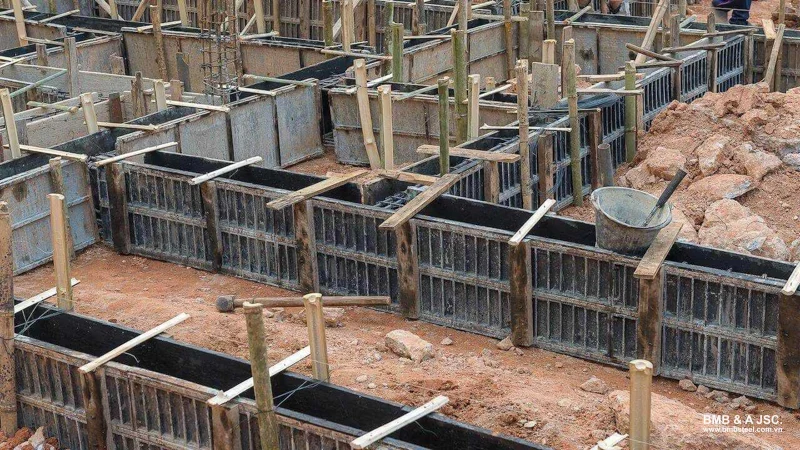
Through the learning curve. When the row repeats the same unit geometry, the crew pours the same forms, the same opening schedule, and the same reinforcement layout over and over, and each repetition is faster and lower-variance than the last. Calgary’s missing-middle volume (31,194 starts in 2024, up 44% year over year) means repeated row plans are common, so the learning curve is a real, bookable schedule asset, not a theoretical one.
The Infill Fast Track / rowhouse DP exemption (effective September 15, 2025) sharpens this. Qualifying greenfield rowhouses can skip the development-permit stage and go straight to a building permit, compressing the front-end approval schedule.
(Sources: City of Calgary Infill Fast Track, https://www.calgary.ca/development/programs-funds-incentives/infill-fast-track-program/iftp-call-for-design.html ; small-scale housing guide, https://www.calgary.ca/planning/projects/rezoning/small-scale-housing.html ; Strong Towns, URL above.)
When the front end compresses, the build critical path, including foundation cadence, carries proportionally more of the total schedule weight. The faster you clear approvals, the more the pour sequence decides your possession dates.
Can precast walls compress the cure-to-strip window?
Yes; that’s their schedule advantage on a row. A solid-concrete precast wall arrives at full design strength and sets in roughly a day, so it skips the on-site pour-protect-cure-strip cycle on the units where that cycle is the pacing item. On schedule-critical units, that can pull days out of the row’s critical path. The same off-site pour also bypasses the September 30 cold-weather premium on the wall (the footings still pour on site, a far smaller volume).
We don’t re-run the precast-vs-poured comparison here; see the Omega Precast wall-system comparison guide for the full fork. The point for sequencing: precast is a tool for compressing the cure-to-strip step on the units where the calendar is tightest, used selectively within a row that’s otherwise poured.
What’s the cost of an idle framing crew in Calgary’s labour market?
High enough to justify designing the whole sequence around it. Calgary posted roughly 5,300 construction trade vacancies in Q3 2025 (about one in four of all regional vacancies), and schedulers have been told to build in 10–15% labour float just to absorb the scarcity. (Source: Omega Knowledge Base §11E, citing the Calgary Construction Association Q3 2025 data.) In that market, a framing crew that stands idle waiting on a wall isn’t just a lost day; it’s a scarce, expensive crew you may not get back on your timeline.
Downstream, Calgary apartment completions have been lagging (national completions down about 10%), a trade-bottleneck signal that makes upstream foundation cadence more valuable, not less. (Source: Omega Knowledge Base §11A, citing the CMHC Spring 2026 Housing Supply Report.) The honest framing: a foundation crew can’t fix the labour market. It can make sure the one trade it hands off to never waits on concrete, which, in a 5,300-vacancy market, is where the schedule margin actually lives.
FAQ
Why does foundation sequencing matter on a multi-unit row? The foundation is the gate every downstream trade waits behind, and on a row you repeat that gate per unit. Good sequencing rotates a framing crew smoothly down the row; bad sequencing leaves it idle waiting for the last wall to cure. As the scheduling literature puts it, proper sequencing prevents crews from arriving too early or too late and avoids idle equipment.
What’s the critical-path dependency between foundations and framing? Framing can’t start until the foundation is done, so the foundation is the predecessor task on the critical path: the longest chain of dependent tasks that sets the minimum project duration. Any delay on the foundation delays the whole project’s end date. On a row, that dependency repeats per unit, and good sequencing overlaps them.
How do you keep a framing crew from waiting on concrete? Rotation, not batch. Excavate the row to grade, pour footings and walls in the order framing will advance, protect each pour to strength, strip and backfill as you go, and hand off unit by unit so framing starts on the first units while the last ones cure. The goal is a constant gap between the concrete front and the framing front.
How does Calgary’s weather change the sequence? CSA A23.1:24 triggers cold-weather procedures below 5 °C (about six months a year in Calgary), fresh concrete must reach about 8 MPa before it can freeze, and Calgary sees roughly 128 freeze-thaw cycles a year. In shoulder season the protect-to-8-MPa milestone becomes the pacing item, so build the cadence around how fast each unit can be safely brought to strength.
Does the 2-hour concrete discharge clock affect staggered pours? Yes. CSA A23.1:24 limits batching-to-discharge to 2 hours, so on a row with back-to-back pours, a second plant load can age past its window while the first is being placed. Volumetric (on-site mixed) concrete mixes on arrival, so each pour’s clock starts when that pour starts, removing the staggered-pour timing risk. It meets the same standards as plant concrete; it’s not stronger.
How does repeating the same row plan speed up the schedule? The crew pours the same forms, openings, and reinforcement repeatedly, so each unit is faster and lower-variance than the last: a real learning curve, given Calgary’s missing-middle volume (31,194 starts in 2024). The Infill Fast Track rowhouse DP exemption (Sept 15, 2025) compresses front-end approvals, which makes the build-phase foundation cadence carry more of the total schedule.
Can precast walls compress the cure-to-strip window? Yes. A solid precast wall arrives at design strength and sets in about a day, skipping the on-site pour-protect-cure-strip cycle on schedule-critical units and bypassing the September 30 cold-weather premium on the wall. Used selectively within a row that’s otherwise poured, it pulls days out of the critical path. (See the precast-vs-poured guide for the full wall-system comparison.)
What’s the cost of an idle framing crew in Calgary’s labour market? High. Calgary had about 5,300 construction trade vacancies in Q3 2025 (one in four regional vacancies), and schedulers build in 10–15% labour float to absorb scarcity. An idle framing crew is a scarce, expensive crew you may not get back on schedule, which is exactly why the foundation sequence is designed so the next trade never waits on concrete.
Planning a Multi-Unit Foundation Schedule?
The biggest schedule delays rarely come from one bad pour—they come from small coordination gaps repeated across every unit. Whether you’re building a duplex, townhouse row, or large missing-middle development, sequencing foundations correctly keeps framing moving and protects your critical path from day one.
Storimatic Studio helps Calgary contractors demonstrate these operational advantages through construction video marketing that wins trust before bids are awarded. If your company has built an efficient foundation workflow, we’ll turn it into proof owners, developers, and general contractors can actually see.
Talk to us about creating construction videos that showcase how your crews work—not just what they build.