

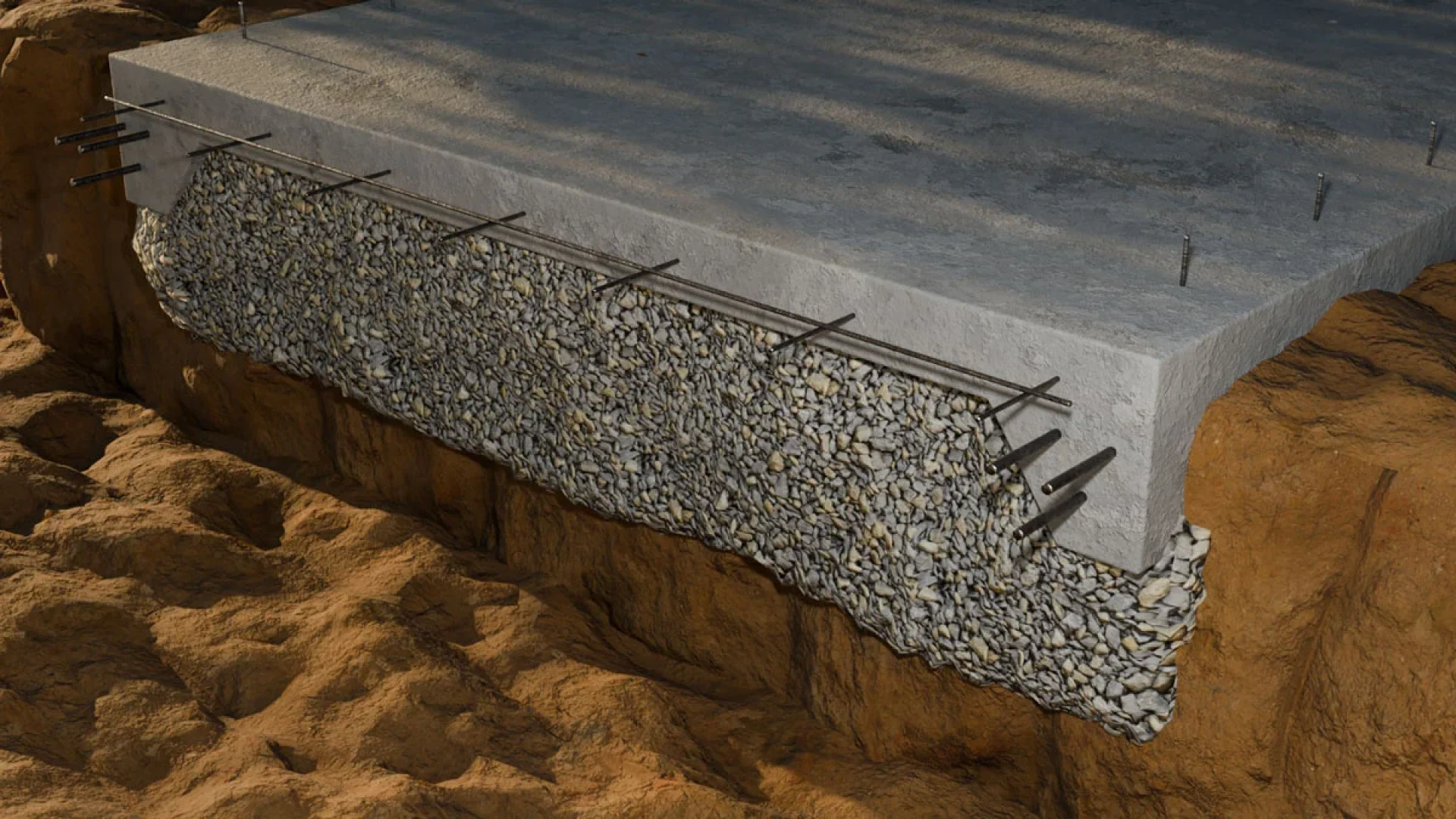
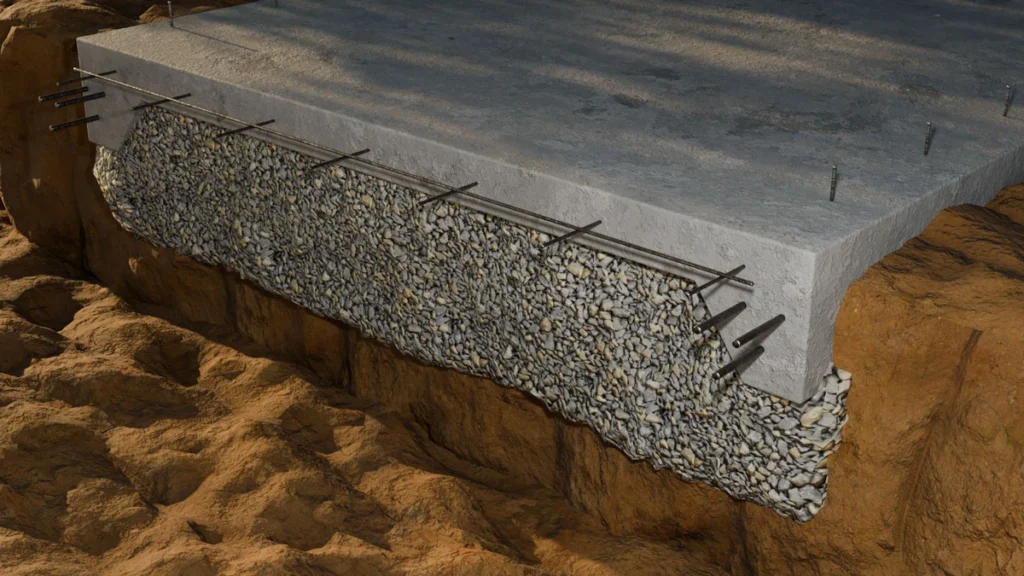
For a Calgary-area home or outbuilding there are three plain-language foundation families: a slab-on-grade (a thickened concrete pad, cheapest, but only safe on good soil with proper frost protection); piles (steel or concrete posts taken below the ~1.2 m frost line to reach firm bearing); and a grade beam (a reinforced concrete beam that spans between the piles and carries the walls). Cost generally rises from slab to grade-beam-on-piles, and the soil’s bearing value plus Calgary’s frost and expansive clay decide which is right.
If you’ve been handed three quotes that each propose a different foundation, this guide is for you. We’ll define each system in plain English, say when each is actually the right tool, and rank them honestly on cost, without the anti-concrete or pro-pile spin you’ll find on most sites trying to sell you one of them.
The three families, at a glance
| Slab-on-grade | Piles | Grade beam (usually on piles) | |
|---|---|---|---|
| What it is | A thickened concrete pad poured on prepared ground | Steel or concrete posts driven/turned below frost to firm bearing | A reinforced concrete beam spanning between piles, carrying the walls |
| Best for | Garages, shops, suites on good, stable soil | Light structures on poor soil; winter installs; immediate load | Houses and structures on poor or expansive soil |
| Frost driver | Must be frost-protected (depth or engineered insulation) | Bearing plate must sit below ~1.2 m frost line | Carried by piles below frost; void form under the beam for clay |
| Rough cost | Lowest (~$5–$12/sq ft) | Highest (~$20–$60/linear ft) | Mid-to-high (the pile + beam system) |
| Engineer? | Sometimes | Yes: P.Eng. + CCMC number | Yes: P.Eng.-sealed |
All cost figures are external and point-in-time. Validate against current Calgary quotes. Sources cited inline below.
What is a slab-on-grade, and when does it work?
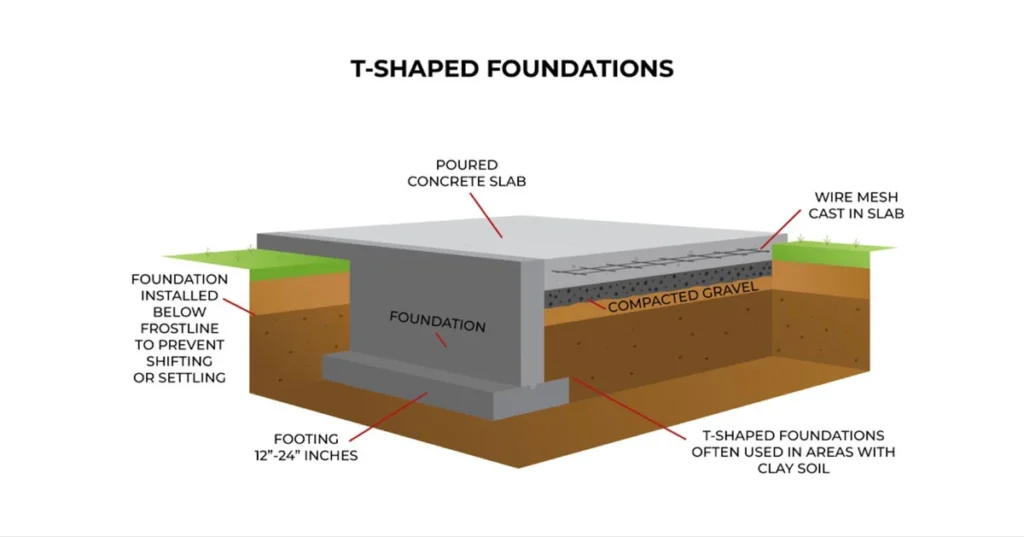
A slab-on-grade is a concrete pad poured directly on prepared ground: the least-expensive foundation, but in Calgary it only works on good soil with proper frost protection. It’s often thickened at the edges (sometimes with a grade-beam edge) to carry the walls.
Defined term, slab-on-grade: A concrete floor slab poured at ground level on a prepared, compacted base, with no basement or crawlspace beneath. Loads transfer straight into the soil under the slab.
A slab is “perfect for moderate/warm climates where frost-heave risk is minimal,” which is the whole catch in Calgary. Here, a slab must be frost-protected, either by carrying its edge thickening down toward the frost line or by an engineered frost-protected shallow foundation (FPSF) using specified insulation. And it’s only safe on stable, good-bearing soil, because its weakness is differential settlement when the ground below moves.
(Sources: Maestro’s, pier-and-beam vs slab-on-grade, https://maestrosfoundationrepair.com/pier-and-beam-vs-slab-on-grade-foundations/ ; Angi, slab-on-grade foundation, https://www.angi.com/articles/slab-on-grade-foundation.htm .)
Slab-on-grade is right when:
- You’re building a garage, shop, or garden suite (not a full basement) on good, stable, well-drained soil.
- The site has proper frost protection designed in.
- You don’t need access to buried plumbing later (a known slab drawback).
It is the cheapest path when the soil and frost cooperate, and the wrong tool when they don’t. On reactive Bearpaw-derived clay or poor bearing, a slab is exactly where you get the seasonal movement and cracking that piles-and-grade-beam exist to defeat.
What are piles, and when are they used?
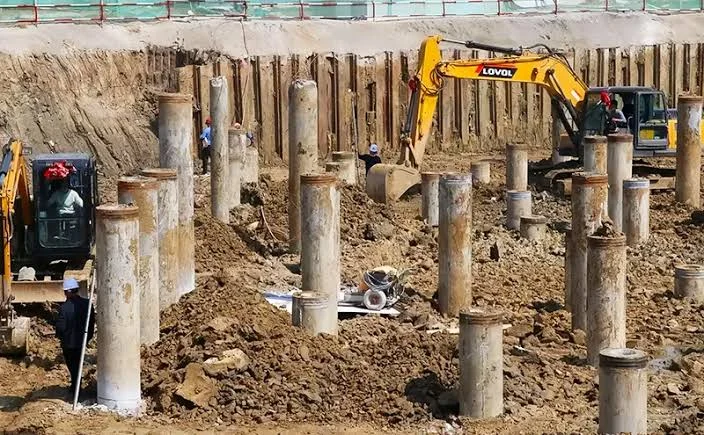
Piles are vertical steel or concrete posts installed to reach firm bearing below the frost line, used where surface soil bears poorly, for light structures, on tight sites, and in winter. The most common residential type around Calgary is the helical (screw) pile: a steel shaft with helical plates, turned into the ground like a giant screw.
Defined term, pile: A slender structural post (steel helical/screw, or driven/bored concrete) installed deep enough to carry the load on firm soil below weak surface layers, bypassing the poor ground near the surface.
In Calgary, piles must reach below the ~1.2 m frost line. Installers typically take the bearing plate 6–8 ft below it, since frost can reach roughly 7 ft in a hard winter. They must be CCMC-evaluated per Alberta code, and the shaft should be isolated so adfreeze (frost jacking) can’t lift them.
(Sources: Calgary Screw Pile Pros, do screw piles need to go below the frost line, https://screwpilescalgary.com/do-screw-piles-need-to-go-below-the-frost-line/ , and building-code-compliant helical pile, https://screwpilescalgary.com/building-code-compliant-helical-screw-pile/ .)
Piles tend to be right when:
- The surface soil bears poorly: low-bearing topsoil, soft clay, or a high water table where a conventional footing would have to be oversized or won’t perform.
- The structure is light: a deck, detached garage, sunroom, or addition.
- You need immediate load (no concrete cure window) or a winter install.
- Vibration must be minimal next to an existing structure.
They are generally not a standalone full-basement house foundation on their own; that stays with a poured or precast concrete foundation. We treat piles briefly here on purpose; for the full deep-dive comparison of cast-in-place vs precast vs helical pile (a more technical, specifier-oriented decision tree), see the Batch-02 article linked at the end.
Neutral anchor: Whatever a pile vendor’s brochure says, the due-diligence rule is the same: ask for the CCMC evaluation number (proof the product is evaluated to the National Building Code) and a P.Eng.-stamped design (proof it fits your soil and loads). In Calgary, that engineer must be registered with APEGA.
(Source: APEGA, https://www.apega.ca/ ; NRC Canadian Construction Materials Centre for CCMC.)
Planning a detached garage instead of a house? Read How to Get Garage Slab or Foundation Right in Calgary to understand when a simple slab works, when frost protection changes the design, and when a full foundation is the better investment.
What is a grade beam, in plain language?
A grade beam is a reinforced concrete beam that spans between piles (or pile caps) and carries the building’s walls, tying the foundation together and bridging over weak soil. It’s the term most homeowners have never heard, and it’s the partner to piles in the most common engineered solution for poor Calgary ground.
Defined term, grade beam: “A reinforced concrete beam that transmits the load from a bearing wall into spaced foundations such as pile caps or caissons,” spanning between piles and acting as a horizontal bond between footings to help control differential settlement.
A grade beam is used “where the surface soil’s load-bearing capacity is less than the design loads.” Instead of resting walls on the weak surface soil, the walls sit on the beam, the beam spans to the piles, and the piles carry everything down to firm material.
(Sources: Grade beam, Wikipedia, https://en.wikipedia.org/wiki/Grade_beam ; EngineerFix, what is a grade beam and how does it work, https://engineerfix.com/what-is-a-grade-beam-and-how-does-it-work/ .)
That’s why you’ll hear it as one phrase, “pile-and-grade-beam,” because the two work as a system.
Why put a void under a grade beam on Calgary clay?
So expansive clay can swell into a deliberate gap instead of lifting your foundation. This is the Calgary expansive-clay payoff that makes the whole system worth it. It’s the single most important detail in this article for anyone building on reactive Bearpaw-derived clay.
With grade beams on piles, “piers bypass poor soil and bear on suitable material below, allowing separation between the grade beam and expansive conditions below so soil can heave without damaging the foundation.” The mechanism: a void form (a sacrificial, cardboard-like form) is cast under the grade beam, leaving an empty gap. When the clay swells with moisture, it expands up into the void rather than pushing on the concrete.
(Sources: Maestro’s, pier-and-beam vs slab-on-grade, https://maestrosfoundationrepair.com/pier-and-beam-vs-slab-on-grade-foundations/ ; VoidForm, void forms for expansive and challenging soils, https://voidform.com/knowledge-base/common-types-of-void-forms-used-for-expansive-and-challenging-soil-conditions/ .)
Defined term, void form: A collapsible form (often waxed cardboard) cast beneath a grade beam or slab to leave a deliberate gap, so expansive clay swells into the void instead of pushing up on the concrete.
This is exactly why pile-and-grade-beam (with void form) is the go-to engineered system on Calgary’s worst clay: the piles get you below the frost line and onto firm bearing, and the void gives the reactive clay somewhere to go. (For the full heave mechanism of frost, clay, and chinooks, see our acreage-heave article linked below.)
Which foundation is cheapest, and how do they rank?
Cost generally rises slab → grade-beam-on-piles. Slab-on-grade is the least expensive; piles are usually the most. Here’s the plain ranking people actually search for (all figures external, validate against current Calgary quotes):
| System | External cost guide (validate locally) |
|---|---|
| Slab-on-grade | ~$5–$12/sq ft (the least expensive) |
| Pier/beam (mid) | ~$6–$12/sq ft |
| Piles | ~$20–$60/linear ft (often the highest total) |
(Source: Angi, how much does a concrete foundation cost, https://www.angi.com/articles/how-much-does-concrete-foundation-cost.htm ; Angi, slab-on-grade foundation, https://www.angi.com/articles/slab-on-grade-foundation.htm .)
But the honest point is that cheapest-on-paper isn’t cheapest-in-reality if the soil is wrong. Piles are chosen “when the soil isn’t fit to support a concrete foundation,” and a slab poured on reactive clay or poor bearing will cost you far more in cracking, re-levelling, and repair than the pile-and-grade-beam you “saved” on. The right comparison isn’t slab-vs-piles in the abstract; it’s the right system for your ground.
The honest triage: On good, firm, well-drained soil (say, dense till) with proper frost protection, a slab or a conventional footing is genuinely the economical, correct choice. You don’t need piles “to be safe.” You need piles when the geotechnical report says the surface soil won’t carry the load, or when you’ve got reactive clay that warrants the pile-and-grade-beam-plus-void approach. Don’t over-build a clean site; don’t under-build a poor one.
How do I choose? The soil and frost decision
Read your geotechnical bearing value first, then match the soil and frost to the system. The same code spine runs through every article in this series, and it’s the fork here too.
NBC(AE) 2023 Part 9 lets a prescriptive footing be sized from presumed bearing values: firm clay 75 kPa, till 200 kPa, and so on. That number is the fork:
- Good, firm-bearing soil + frost protection → a slab (for an outbuilding/suite) or a conventional concrete footing (for a house) can work.
- Poor / low-bearing or expansive soil, or a need to span over it → piles + a grade beam, with void form on reactive clay.
- Below the presumed bearing value, or on fill or sensitive clay → an engineered (Part 4) design is required, full stop.
(Source: presumed-bearing values from the NBC model table, mirrored at https://www.buildingcode.online/1253.html ; confirm against the BILD Alberta NBC(AE) 2023 Part 9 document.) For how to read the rest of that soil report, see our geotechnical-report decoder linked below.
Do I need an engineer, and does steel avoid Calgary’s sulphate problem?
Piles and grade beams need a P.Eng.-sealed design in Calgary, and steel piles do sidestep concrete’s sulphate problem, but add a corrosion consideration. Two practical points to close on.
The engineer + permit reality. In Calgary, pile-and-grade-beam foundation plans must be signed and sealed by a P.Eng. registered with APEGA. This is not an over-the-counter choice. (Sources: City of Calgary permit requirements, https://www.calgary.ca/development/permits/process-faq.html ; City of Calgary Additions, https://www.calgary.ca/development/home-building/additions.html .) A simple slab for a small outbuilding may not need an engineer; a pile-and-grade-beam system always does.
The concrete spec on every concrete option. Any concrete element (a slab, a grade beam, or a bored concrete pile) has to meet Calgary’s S-2 sulphate spec: Type HS/HSb cement, a minimum of 32 MPa at 56 days for S-2 (35 MPa is a market premium, not the code minimum), and 5–7% air entrainment. (Source: Concrete Alberta sulphate bulletin; CSA A23.1:24.
For the full chemistry, see our Type HS article linked below.) Steel helical piles sidestep sulphate attack on concrete entirely, because there’s little or no concrete in the load path, but they introduce a steel-corrosion consideration, which is why galvanizing and a P.Eng.’s durability assessment matter. So sulphate doesn’t pick a system by itself; it sets the concrete spec on the concrete options and reframes the durability question on steel.
FAQ
Slab-on-grade, piles, or grade beam: which foundation is right for my Calgary build? The soil’s bearing value and Calgary’s frost decide. Good, firm soil with frost protection can take a slab (for an outbuilding) or a conventional footing (for a house). Poor, low-bearing, or expansive soil points to piles with a grade beam. Below the code-presumed bearing, or on fill or sensitive clay, an engineered design is required.
What is a grade beam in plain language? A reinforced concrete beam that spans between piles and carries the building’s walls, tying the foundation together and bridging over weak soil. The walls sit on the beam, the beam spans to the piles, and the piles carry the load down to firm material, which is why it’s called “pile-and-grade-beam.”
Which foundation type is cheapest? Slab-on-grade is the least expensive (roughly $5–$12/sq ft), pier/beam is mid, and piles are usually the most expensive (roughly $20–$60/linear ft). Validate against current Calgary quotes. But the cheapest system on paper isn’t cheapest in reality if it’s poured on the wrong soil: a slab on reactive clay can cost far more in repairs.
When do I need piles instead of a slab? When the surface soil bears poorly (soft clay, high water table, low-bearing topsoil), when the structure is light (deck, garage, addition), when you need immediate load with no concrete cure, or for a winter install with minimal vibration. The geotechnical bearing value is what decides.
How deep do piles go in Calgary? Below the ~1.2 m frost line. Installers typically take the bearing plate 6–8 ft below it, since frost can reach roughly 7 ft in a hard winter. Piles must be CCMC-evaluated per Alberta code, and the shaft should be isolated so adfreeze (frost jacking) can’t lift them.
Why put a void under a grade beam? So expansive Bearpaw-derived clay can swell into a deliberate gap instead of lifting the foundation. A void form (a sacrificial cardboard-like form) is cast under the grade beam, leaving an empty space the clay expands into when it takes on moisture. It’s the key Calgary expansive-clay detail.
Do I need an engineer for piles and a grade beam? Yes. In Calgary, pile-and-grade-beam foundation plans must be signed and sealed by a P.Eng. registered with APEGA. A simple slab for a small outbuilding may not need an engineer, but a pile-and-grade-beam system always does.
Do steel screw piles avoid Calgary’s sulphate soil problem? They sidestep sulphate attack on concrete, because there’s little or no concrete in the load path. But they introduce a steel-corrosion consideration, which is why galvanizing and a P.Eng.’s durability assessment matter. Any concrete element (slab, grade beam, or bored concrete pile) still needs Type HS cement at 32 MPa minimum for S-2 soil.