

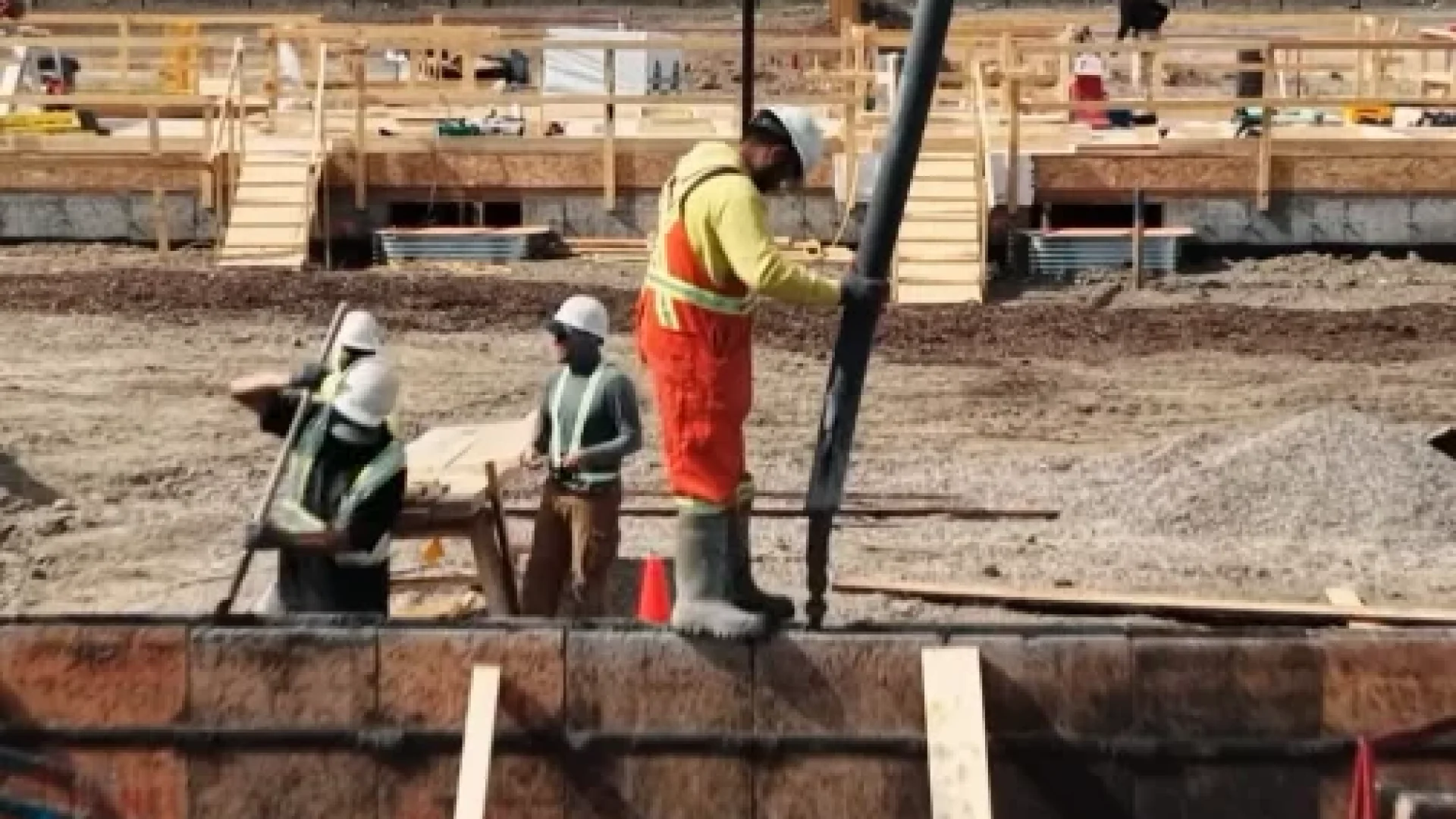
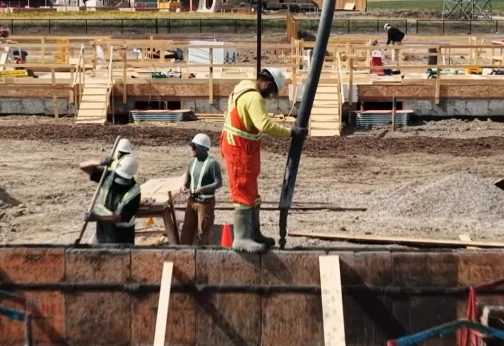
A 90 m³ footing pour is a coordination job before it is a concrete job. You need multiple mixer trucks arriving in timed rounds, a boom pump reaching the forms, a placing and finishing crew moving with the pour, engineer sign-off before the first truck discharges, and every load timed to the crew’s pace so no truck sits waiting.
We placed one of these in a recent ten-day stretch: a single 90 m³ footing for a major Calgary developer. Here is what goes into a day like that, and why one integrated team runs it in rhythm instead of stacking trucks and hoping.
1. It starts before a truck ever leaves the plant
Thirty-eight years placing concrete has taught us one thing: the pours that go wrong went wrong on paper. Before the first load, the forms are checked, the rebar is tied to the drawings, and the engineer signs off on what is in the ground. We respect that sign-off. If the reviewing engineer is not satisfied, nobody discharges. That is not a delay, that is the whole point of doing it right the first time.
We also plan the concrete itself. A footing of this size for a developer is not mystery mud. For most Calgary ground it is 32 MPa, Type 50 cement (sulphate-resistant, what current CSA nomenclature calls Type HS) at 5-8% air, built for our sulphate soils and freeze-thaw winters. On higher-load municipal and utility work we step up to 35 MPa Type 50 for thrust blocks. The spec is settled before anyone climbs into a truck.
Before a large footing can be scheduled, the excavation, reinforcing steel, and footing dimensions must already match the engineered drawings. If you’re planning a residential addition, our guide to How Deep Your Addition’s Footings Really Go in Calgary explains frost depth, footing sizing, bearing soil, and why engineer approval happens before concrete arrives.
2. Why 90 m³ is a rhythm problem, not a size problem
Ninety cubic metres is not one truck. It is a coordinated sequence of loads, each one batched, delivered, and placed while the load before it is still being worked. Get that sequence right and the pour flows like a single continuous placement. Get it wrong and you get cold joints, waiting trucks, and a crew standing around burning daylight.
The enemy is the gap. Too much space between loads and the concrete already down starts to set before the next truck arrives. Too little space and you stack trucks nose to tail with nowhere to go. The job is to keep concrete arriving at the pace the crew can place and finish it. That pace is the real spec of the day.
3. Fresh concrete is on a clock, and timing runs the whole show
Here is what governs everything: fresh concrete has to reach the forms and get worked while it is still fresh. Every load on a 90 m³ pour is moving against that window.
When the same group owns the plant, the trucks, and the placing crew, that timing is easy to manage. Omega Ready Mix batches a load from its own plant, it runs to site, it discharges inside the CSA window (generally about two hours from batching to placement), and the next load is timed to how fast our crew can place it. When those stages sit in three different companies, the timing turns into a blame game. Across the Omega Group it does not, because it is one group from silo to slab.
4. Getting the concrete into the forms: the boom pump
You do not tailgate 90 m³ of concrete into a deep footing across a tight site. You pump it. On this pour a boom pump reached over the excavation and placed concrete exactly where the crew needed it, load after load, without trucks having to fight for position at the edge of the hole.
The pump sets the tempo. Our boom- and line-pump operators work directly with the drivers and the placing crew so the boom is fed steadily, the forms fill evenly, and nobody is waiting on anybody. On a big footing that coordination between pump, truck, and crew is most of the game.
5. Placing and finishing move with the pour, not after it
A footing this size is worked continuously as it fills. Our placing crew moves concrete into the corners and along the forms while the finishing crew follows behind, consolidating and levelling. This is not a pour-then-finish job, it is a pour-and-finish-together job, and it only works when the placing crew, the finishing crew, and the pump are reading the same rhythm.
Footings in that recent stretch ran anywhere from 14 to 90 m³, and walls from 40 to 60 m³ on multi-truck coordinated rounds. The 90 m³ footing sat at the top of that range. Different size, same discipline: keep the concrete moving at the crew’s pace, and let the crew’s pace set how fast the trucks roll.
6. Testers on site, because someone will check the work
On a developer footing, the builder’s concrete tester is on site pulling samples: air content, slump, cylinders for the lab. We accommodate the testers on every pour like this. We want that check. It is the independent record that the concrete in the ground is the concrete on the spec sheet.
Thirty-eight years in, we have learned that the crews who resist testing are usually the ones with something to hide. We would rather the tester stand right there while the truck discharges.
7. Why one company makes the day run in rhythm
Stack up the moving parts on a 90 m³ day: the mix, the batch plant, five mixer trucks running timed rounds, the boom pump, the placing crew, the finishing crew, the engineer’s sign-off, the timing on every load, the tester. When those live in separate companies, every handoff is a phone call and every delay is somebody else’s fault.
The Omega Group runs all of it under one roof. Omega Ready Mix’s batch plant, with two cement silos and near-daily bulk cement deliveries, feeds a five-truck ready-mix fleet; that feeds our pump and our placing and finishing crews. One group means one schedule, one clock, and clear accountability from the silo to the finished footing. That is why a 90 m³ day runs in rhythm here instead of stacking trucks and hoping.
Proof from a recent ten-day stretch
In a recent ten-day stretch the Omega Group batched, delivered, and placed more than 1,100 m³ of concrete across roughly 80 separate pours, including Saturday work. That included single pours up to 90 m³ (the developer footing described here), fill-crete placements up to 70 m³, footings from 14 to 90 m³, and walls from 40 to 60 m³ on multi-truck rounds. Omega Ready Mix ran a five-truck fleet out of its own batch plant with two cement silos and near-daily 28-42 tonne bulker deliveries, with pours starting as early as 5:00 am and evening placements running to 5 pm, across residential, commercial, municipal, institutional, and industrial sites in the same week.
Large commercial concrete placements are governed by recognized engineering and construction standards rather than contractor preference. In Canada, structural concrete placement follows CSA A23.1 for materials and construction methods, while structural design is governed by CSA A23.3. Quality-control testing—including slump, air content, and compressive-strength cylinders—is performed using recognized ASTM procedures, and engineered footings are constructed according to the structural engineer’s sealed drawings and Alberta building requirements. These standards help ensure every placement meets the specified performance requirements before, during, and after the pour.
FAQ
How many mixer trucks does a 90 m³ pour need? It is not about a fixed number of trucks, it is about keeping trucks arriving in timed rounds so concrete lands at the pace the crew can place and finish it. On a pour this size the ready-mix fleet runs in coordinated rounds, cycling trucks between the plant and the site so the pump is always fed and no load sits waiting.
Why does timing matter so much on a large pour? Fresh concrete has to reach the forms and be placed while it is still fresh. Every load on a large pour has to get there and be placed in time. Running the plant, trucks, and crew as one operation keeps every load moving on schedule instead of leaving it to chance across separate companies.
Do you need engineer sign-off before pouring a footing? Yes. On engineered footings the reviewing engineer signs off on the forms and rebar before any concrete is discharged. We respect that sign-off completely. If the engineer is not satisfied, nobody pours until it is corrected.
What concrete mix goes into a Calgary footing? For most Calgary ground the workhorse is 32 MPa, Type 50 cement (sulphate-resistant, called Type HS in current CSA nomenclature) at 5-8% air, chosen for our sulphate soils and freeze-thaw climate. Higher-load municipal and utility footings step up to 35 MPa Type 50. The engineer’s drawings set the final spec.
Why use a boom pump instead of pouring straight from the truck? On a large or deep footing, or a tight site, a boom pump places concrete exactly where the crew needs it without trucks fighting for position at the edge of the excavation. It also sets a steady tempo so the forms fill evenly and the placing and finishing crews can keep pace.
Who checks that the concrete meets spec? On developer and institutional work the builder’s independent concrete tester is on site pulling air, slump, and cylinder samples. We accommodate testers on every pour like this, because that independent record confirms the concrete in the ground matches the spec sheet.
Get a quote or schedule a pour
Planning a footing, wall, or full structural pour in Calgary or the surrounding towns, Cochrane, Chestermere, Strathmore, Okotoks, Crossfield, Priddis, and Foothills County? Talk to us early so we can plan the mix, the rounds, and the crew before the forms go up. We often schedule next-day or same-week.
Planning a Large Footing or Structural Concrete Pour?
Large concrete placements aren’t successful because they’re big—they’re successful because every part of the operation is coordinated before the first truck leaves the plant.
Omega Ready Mix manages the entire process, including:
- Engineer-approved scheduling before placement
- CSA-compliant ready-mix production
- Multi-truck delivery coordination
- Boom and line pumping
- Experienced placing and finishing crews
- Independent testing accommodation
- Commercial, municipal, residential, and industrial concrete pours
- Service throughout Calgary, Cochrane, Chestermere, Strathmore, Okotoks, Crossfield, Priddis, and Foothills County
Whether you’re pouring a residential foundation or a 90 m³ commercial footing, our team coordinates the mix, delivery schedule, pumping, and placement so the pour stays continuous from the first load to the last.
Contact Omega 2000 Cribbing today to schedule your footing pour or request a project-specific concrete placement plan.