

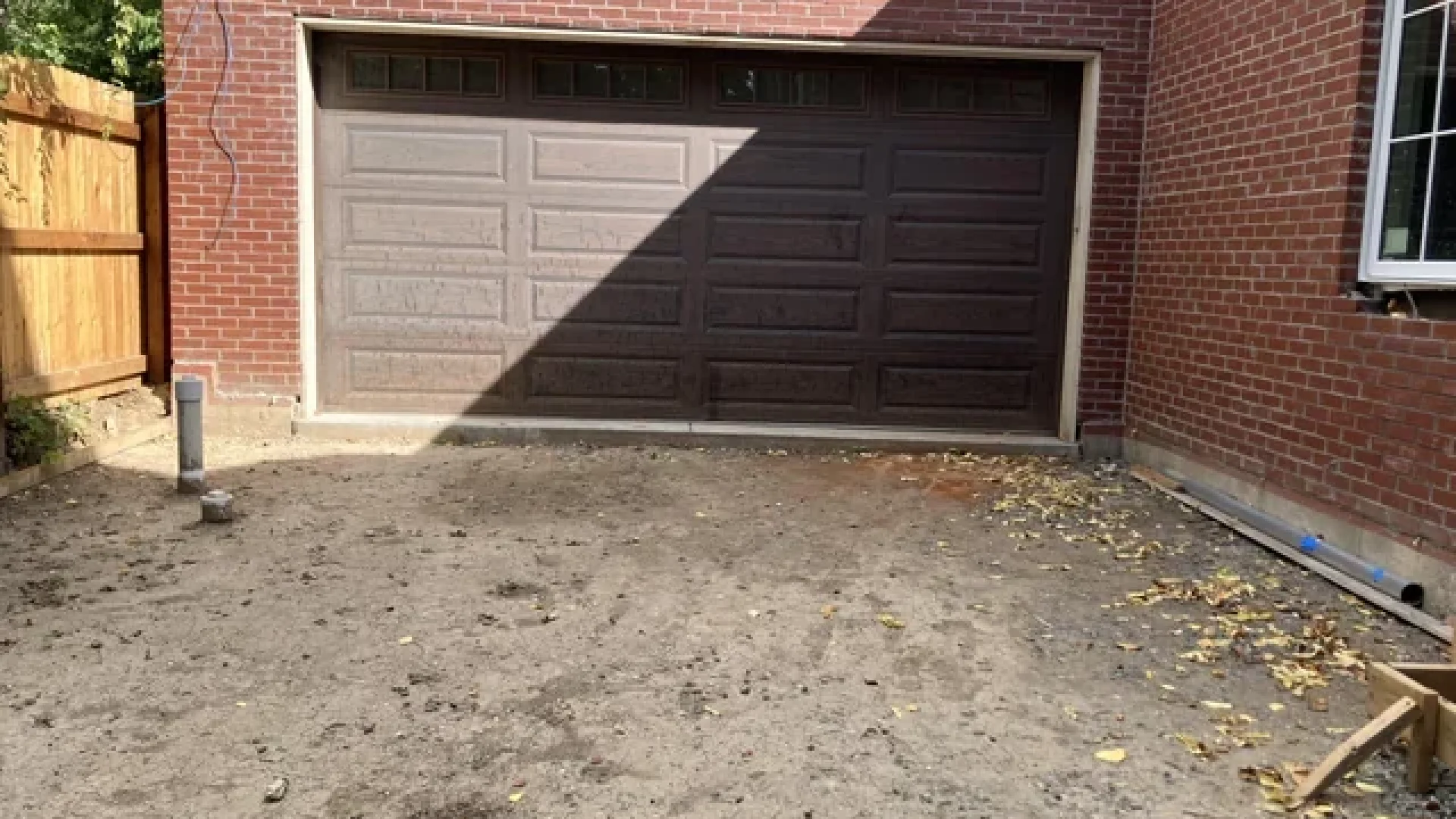
A detached garage slab heaves because all three ingredients of frost heave are present under it: frost-susceptible (silty or clay) soil, water, and freezing temperatures reaching that soil. A detached, unheated garage has no interior heat to hold the frost line back, so the ground freezes deeply and unevenly, ice lenses form, and they lift the slab. Remove any one of the three conditions (drain the water, swap the soil for non-frost-susceptible granular fill, or insulate the ground) and the heave stops. As the recognized design guidance puts it, “removing one of these factors will negate the possibility of frost damage.”
(Source: NRC / Home Innovation Research Labs, Revised Builder’s Guide to Frost-Protected Shallow Foundations.)
This is the cluster’s science article, the one the others point to. If you’re deciding whether your garage needs a slab or a foundation in the first place, start with the decision guide. Here we explain what’s actually happening under your floor, and how to fix the cause instead of re-leveling the symptom.
Before deciding how to repair recurring frost heave, determine whether your building should have been built on a slab or a full foundation in the first place. Our guide, Garage Slab or Foundation? How to Get It Right in Calgary, walks through the structural, soil, and budget considerations that determine the right system.
What is frost heave? (the three-condition rule)
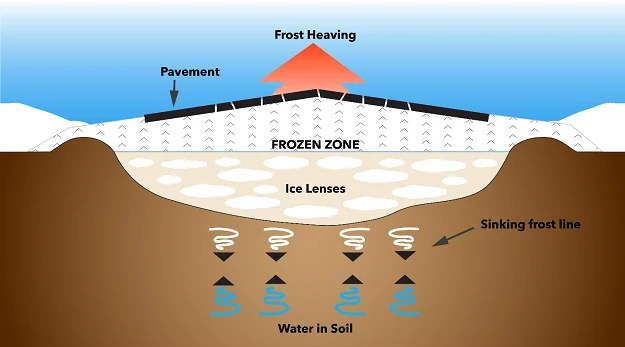
Frost heave happens only when three conditions occur together: a frost-susceptible soil, enough water, and freezing temperatures penetrating that soil. Take away any one and the heave can’t happen. (Source: NRC / Home Innovation, Revised Builder’s Guide to Frost-Protected Shallow Foundations, https://www.homeinnovation.com/documents/Reports/Revised-Builders-Guide-to-Frost-Protected-Shallow-Foundations.pdf ; InterNACHI, Frost Heave Caused by Ice Lens, https://www.nachi.org/frost-heave-ice-lens.htm .)
The three conditions are:
- Frost-susceptible soil: a soil with a large silt fraction (Calgary’s silty and clay soils qualify). Silt holds and wicks water by capillary action; clean gravel doesn’t.
- Water: soil moisture high enough (roughly above 80% saturation) to feed the freezing front. (Source: NRC / Home Innovation, URL above.)
- Freezing temperatures reaching the soil: a frost front penetrating below the slab.
That “any one” logic is the whole fix strategy. You don’t have to defeat winter. You just have to break one leg of the tripod. Each of the four fixes later in this article removes one of these conditions.
What’s physically lifting the slab? (ice lenses)
As the freezing front moves down through the soil, capillary action pulls liquid water up to the front, where it freezes into stacked, nearly pure horizontal “ice lenses.” Those lenses keep growing by drawing up more water, and they push the soil (and the slab on top of it) upward. (Source: InterNACHI, https://www.nachi.org/frost-heave-ice-lens.htm ; corroborated by Wikipedia, “Frost heaving,” https://en.wikipedia.org/wiki/Frost_heaving .)
It’s not the water already in the soil simply freezing in place. It’s a pump: the frost front acts like a wick, continuously pulling more water up from below into growing layers of ice. A single ice lens can be a fraction of a millimetre or several centimetres thick, and several can stack. That’s why heave is so uneven: the lenses form wherever the soil is wettest and most silty, so one corner of a slab can lift while another barely moves. Uneven lift is what cracks concrete.
Why won’t it just settle back in spring?
Because frost heave is a one-way jack, not a seasonal bounce. Water expands in volume by about 9% when it freezes, and the components a heave lifts are, in the words of one forensic engineering source, “unlikely to return to their original positions” after thaw. (Source: Alpine Intel, Frost Heave: Cause, Consequences and Prevention, https://alpineintel.com/resource/frost-heave-cause-consequences-and-prevention/ .)
When the ice lenses melt, the soil structure they created doesn’t perfectly collapse back. Voids, redistributed soil, and shifted slab sections stay shifted. So the damage accumulates: each freeze lifts a little, each thaw doesn’t fully reverse it, and over a few winters a hairline becomes a step crack and a flat floor develops a slope toward the door. Anyone who tells you “it’ll settle in spring” is describing a different process than the one cracking your garage.
Why does MY detached garage heave when the attached one doesn’t?
Because an attached or heated garage borrows heat from the house, and a detached, unheated garage borrows nothing, so the ground under it freezes deeper and more uniformly. A detached garage floor can “freeze and heave without the moderating influence of adjacent heated space,” so the soil beneath “can freeze deeply and uniformly across the entire floor area.” (Source: JLC, Q&A: Frostproof Slab-on-Grade, https://www.jlconline.com/how-to/foundations/q-a-frostproof-slab-on-grade_o ; Alair Homes Calgary, Avoiding Frost Heaves in your Detached Garage, https://alairhomes.com/calgary/articles/avoiding-frost-heaves-detached-garage/ .)
This is the core of the problem and the reason generic frost-heave content misses it. A heated structure keeps the soil at its perimeter and beneath it from freezing: the building itself is part of the frost protection. A detached, unheated garage on a shallow slab gives the frost front nothing to fight. The same soil and the same water that sit harmlessly under a heated house will lift a detached garage slab. That’s why “it’s detached and unheated” is the single biggest risk flag for a Calgary garage floor.
Why is it worse in Calgary specifically?
Because Calgary’s chinook-driven freeze-thaw whipsaw cycles the ice-lens engine far more often than a steady-cold climate does. Calgary sees roughly 128 freeze-thaw cycles a year, with chinooks swinging temperatures 20–30 °C in a single day and a design frost depth of 1.2 m. (Source: Omega Knowledge Base §13; City of Calgary Climate Hazards Year in Review.)
A city that freezes hard in November and stays frozen until April runs the freeze-thaw cycle a handful of times. Calgary runs it scores of times: every chinook thaws the surface, every cold snap re-freezes it, and each cycle is another stroke of the jack. Add Calgary’s frost-susceptible silty and clay soils, and you have the exact recipe: the susceptible soil and the water are local givens, and the chinook climate pulls the freeze-thaw lever more often than almost anywhere. A Calgary garage slab heaves harder than the same slab would in a colder-but-steadier place.
How do I stop it? The four-lever fix (treat the cause, not the symptom)
Each fix removes one leg of the three-condition tripod (and the fourth bears below it entirely). You don’t always need all four. But you need at least one to genuinely hold, and on a structure you can’t risk, you stack them.
Lever 1. Drainage: remove the water (cheapest, do it first)
If the ground under the slab can’t hold water, it can’t freeze, and if it can’t freeze, it can’t heave. (Source: JLC, URL above.) Slope the grade away from the garage: Calgary’s lot-grading rule calls for roughly 4% fall within 1.2 m of the foundation and downspouts discharging at least 1.8 m out. (Source: City of Calgary Lot Grading Bylaw 32M2004, https://www.calgary.ca/development/lot-grading.html ; Alpine Intel, URL above.) Pair that with a freely-draining granular base and, where needed, a perimeter drain to daylight. Keeping water away from the subgrade is the single highest-leverage, lowest-cost move.
Lever 2. Non-frost-susceptible subgrade: remove the susceptible soil
Excavate the frost-susceptible silt and clay and replace it with non-frost-susceptible granular fill (gravel or crushed stone) compacted in 150–200 mm (6–8 in) lifts. Clean granular fill doesn’t hold capillary water and gives any frost somewhere to expand without lifting the slab. (Source: GreenBuildingAdvisor / Ecohome synthesis, https://www.greenbuildingadvisor.com/article/frost-protected-shallow-foundations ; NRC / Home Innovation, URL above.) This is the lever a cribbing crew controls on a new pour: get the subgrade right once and you’ve removed a condition permanently.
Lever 3. Insulation / engineered FPSF: stop the freezing front
An engineered frost-protected shallow foundation (FPSF) uses continuous rigid insulation to keep the soil near 0 °C through cold snaps: it sits vertical at the slab edge plus a horizontal “wing” extending roughly 600–1,200 mm (24–48 in) out, over a granular drainage layer. For an unheated garage there’s no interior heat to borrow, so it needs more insulation and that horizontal wing. A properly engineered slab-on-grade or FPSF is as reliable at preventing heave as a footing foundation, and it should be modelled by a geotechnical engineer for the local climate.
(Source: NRC / Home Innovation, URL above; Ecohome, What Causes Frost Heave / How to Prevent and Fix It, https://www.ecohome.net/en/guides/3628/what-causes-frost-heave-read-here-how-to-prevent-and-fix-frost-heaving/ .) In Alberta this is the engineered alternative to digging to 1.2 m: designed and approved, never poured shallow on a guess.
Lever 4. Footings below the 1.2 m frost line: bear below the freeze
For a structure you simply can’t risk heaving, carry footings below Calgary’s 1.2 m frost depth to undisturbed bearing soil. Below the frost line, the ice-lens engine can’t reach the bearing surface.
(Source: Omega Knowledge Base §3; NBC (Alberta Edition) 2023 Part 9 §9.12 and §9.15, https://bildalberta.ca/wp-content/uploads/2024/03/National-Building-Code-2023-Alberta-Edition_Part-9-2.pdf .) This is the belt-and-suspenders option, and it ties directly to the slab-vs-foundation decision.
Why a re-level alone usually isn’t a fix
Mudjacking or polyurethane concrete leveling re-levels the slab, but it doesn’t touch the three conditions underneath. If the susceptible soil, the water, and the freeze cycle are still there, the slab heaves again. Concrete leveling is a legitimate tool to lift a settled or heaved pad back to grade. But on a frost-heaving garage it treats the symptom. Lift the slab without fixing the drainage and subgrade, and you’ve bought one season.
The honest read from a crew that does this work: fix the ground, not just the slab. That usually means correcting grade and drainage, and on a re-pour, excavating the susceptible subgrade for clean granular fill, sometimes with insulation or footings below frost. A re-level is the right call after the cause is handled, or as a stopgap; it’s the wrong call as a standalone “fix” for recurring frost heave. (If you’re weighing repair against replacement on a foundation, our underpinning guide covers that trade-off.)
When you do re-pour the floor, spec it for what it faces: a Calgary garage floor sees road salt and freeze-thaw, so it’s C-2 / F-2 exposure with 5–7% air entrainment per CSA A23.1:24. (Source: Omega Knowledge Base §3; CSA A23.1:24, https://www.csagroup.org/store/product/CSA%20A23.1%3A24/ .)
FAQ
Why does my detached garage floor crack and lift in winter? Frost heave. Three conditions are present under the slab: frost-susceptible silty/clay soil, water, and freezing temperatures reaching the soil. A detached, unheated garage has no interior heat to hold the frost line back. Ice lenses form and grow, pushing the slab up unevenly, which cracks it. Remove any one of the three conditions and the heave stops.
Why do detached garages heave when my attached garage doesn’t? An attached or heated garage borrows heat from the house, which keeps the soil beneath from freezing as deeply. A detached, unheated garage borrows no heat, so the ground under it freezes deeply and uniformly and the ice-lens engine runs unchecked. “Detached and unheated” is the single biggest risk flag for a heaving garage floor.
Will the heaved slab settle back in spring? No. Frost heave is a one-way jack, not a seasonal bounce. Water expands about 9% when it freezes, and the lifted soil and slab are unlikely to return to their original positions after thaw. Damage accumulates each winter: a hairline becomes a step crack, a flat floor develops a slope. “It’ll settle back” describes a different process than the one cracking your garage.
How do I stop my garage slab from heaving? Break one leg of the three-condition tripod, and stack fixes on a structure you can’t risk. Lever 1: drainage and grading to remove water (do this first). Lever 2: excavate susceptible silt/clay and replace with compacted granular fill. Lever 3: an engineered insulated FPSF to stop the freezing front. Lever 4: footings below the 1.2 m frost line. Treat the cause, not just the surface.
Is mudjacking or concrete leveling a real fix? It re-levels the symptom. Lifting a heaved pad back to grade is a legitimate tool, but if the susceptible soil, the water, and the freeze cycle remain, the slab heaves again. Fix the ground first: grade, drainage, and on a re-pour the granular subgrade (with insulation or footings below frost where needed). A re-level is right after the cause is handled, not as a standalone cure.
What soil under my garage causes heave? Frost-susceptible soil with a large silt fraction that holds and wicks water by capillary action, exactly the silty and clay soils common around Calgary. Clean gravel and crushed stone are non-frost-susceptible: they don’t hold capillary water, so swapping the subgrade to granular fill removes one of the three conditions.
Does an insulated slab really work in Calgary? Yes, when it’s an engineered frost-protected shallow foundation modelled for our climate. Continuous rigid insulation (vertical at the edge plus a horizontal wing over a drainage layer) keeps the soil near 0 °C through cold snaps. A properly engineered FPSF is as reliable as a footing foundation. In Alberta it must be designed and approved by an engineer, not poured shallow on a guess.
How many freeze-thaw cycles does Calgary get, and why does it matter? Roughly 128 a year, with chinooks swinging 20–30 °C in a single day. Each cycle is another stroke of the frost-heave jack, so Calgary cycles the ice-lens engine far more than a steady-cold climate. That is why a Calgary garage slab heaves harder than the same slab elsewhere, given the same soil and water.
Stop Repairing Frost Heave. Fix the Ground Beneath It.
A cracked garage floor is rarely the real problem. Frost heave starts below the concrete, where Calgary’s silty soils, moisture, and repeated freeze-thaw cycles combine to lift the slab year after year.
Omega 2000 Cribbing helps Calgary homeowners, builders, and developers determine whether a garage can be permanently repaired with improved drainage and subgrade preparation, upgraded to an engineered frost-protected slab, or rebuilt on frost footings below Calgary’s 1.2 m design frost depth. With Omega Ready Mix and Omega Precast under the same ownership group, foundation excavation, Type HS concrete supply, and precast foundation components can be coordinated through one experienced team.
Before you spend money on another concrete leveling or mudjacking repair, get a professional assessment of what’s actually causing the movement—and choose the solution that fixes the problem for good.