

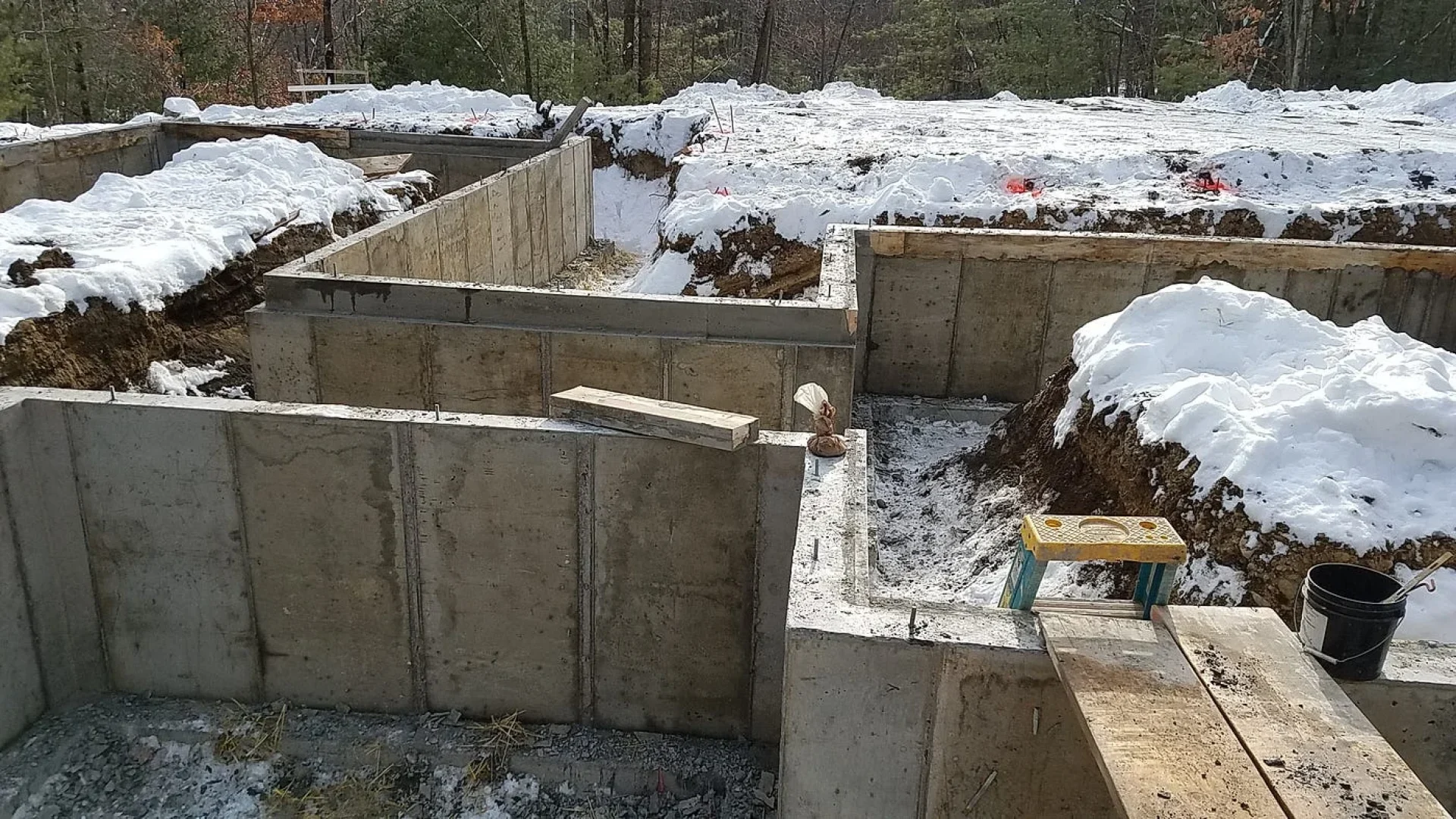
Your framing crew shows up March 1. Your foundation isn’t poured. Carrying cost on your $1.6M build runs $11,400 a month. A January pour saves $34,200 and shaves 8 weeks off your IRR — IF you have the 4 site conditions that make winter pouring work. Here are the 6 reasons builders do it, and the 4 that mean you shouldn’t.
The internet will tell you “never pour concrete in winter.” Concrete Alberta’s cold-weather guide will tell you that pour-window discipline — temperature, mix design, and protection — is the whole answer. Both are oversimplifications. After 38 years of forming and pouring Calgary foundations from October through April, we can reconcile them: winter pouring is an economic decision constrained by four site conditions. Get the conditions right and the calendar follows the money. Get them wrong and a re-pour erases every dollar you saved. Here are the six reasons Calgary builders pour through the cold, then the four conditions under which we tell a builder to wait.
1. Carrying cost on a $1.6M custom build is $11,400/month — winter delays compound fast
A Discovery Ridge owner-builder sits down in November 2025 to do the arithmetic on what waiting until spring actually costs him. His $1.4M construction loan at 6.85% runs about $7,994 a month in interest. Add roughly $2,200 in soft costs — builder’s-risk insurance, interim utilities, financing fees — and about $1,200 in property tax, and he is carrying $11,394 every month the build sits. A three-month wait for the spring thaw is not a pause. It is a $34,182 cheque.
Those are real Calgary numbers, not a worked example pulled from thin air. Owner-builder and custom construction-loan rates in late 2025 and early 2026 ran roughly 5.85% to 7.5%, and soft costs on a $1.4M to $1.8M build typically added $2,000 to $3,500 a month on top of interest. Treat these as industry-survey ranges and validate them against your own lender’s current rate sheet and your own insurance and tax bills — the structure of the math holds even as the inputs move.
Now set that carrying cost against the cost of pouring in the cold. A compliant Calgary winter pour — hoarding, heated water and aggregate, an accelerating admixture where the reinforcement allows it, insulated blankets, and extended cure monitoring — typically adds 15% to 25% to the foundation cost, on the order of $8,000 to $15,000 on a custom home. A 12-week delay on a $1.6M build burns $30,000 to $45,000 in pure carry. When the carry exceeds the cold-weather premium, the math favours pouring now.
Why it matters to you specifically: the breakeven is closer than most owners assume. On a $1.6M build carrying $11,400 a month, roughly five to seven weeks of delay costs more than the entire winter-pour premium. If the spring slot pushes you past that, waiting is the expensive option, not the safe one.
Carrying cost is the math. The next reason is the labour-supply pressure that pushed Calgary builders into the winter window over the last five years.
Saving six weeks only matters if everyone is working from the same assumptions. An experienced contractor should explain the schedule, technical risks, and mitigation plan clearly to both the engineer and the client. Read How a Foundation Crew Should Talk to Your Engineer (and Your Client).
2. Framing-crew lock-in: skilled crews are booked 3–6 months ahead
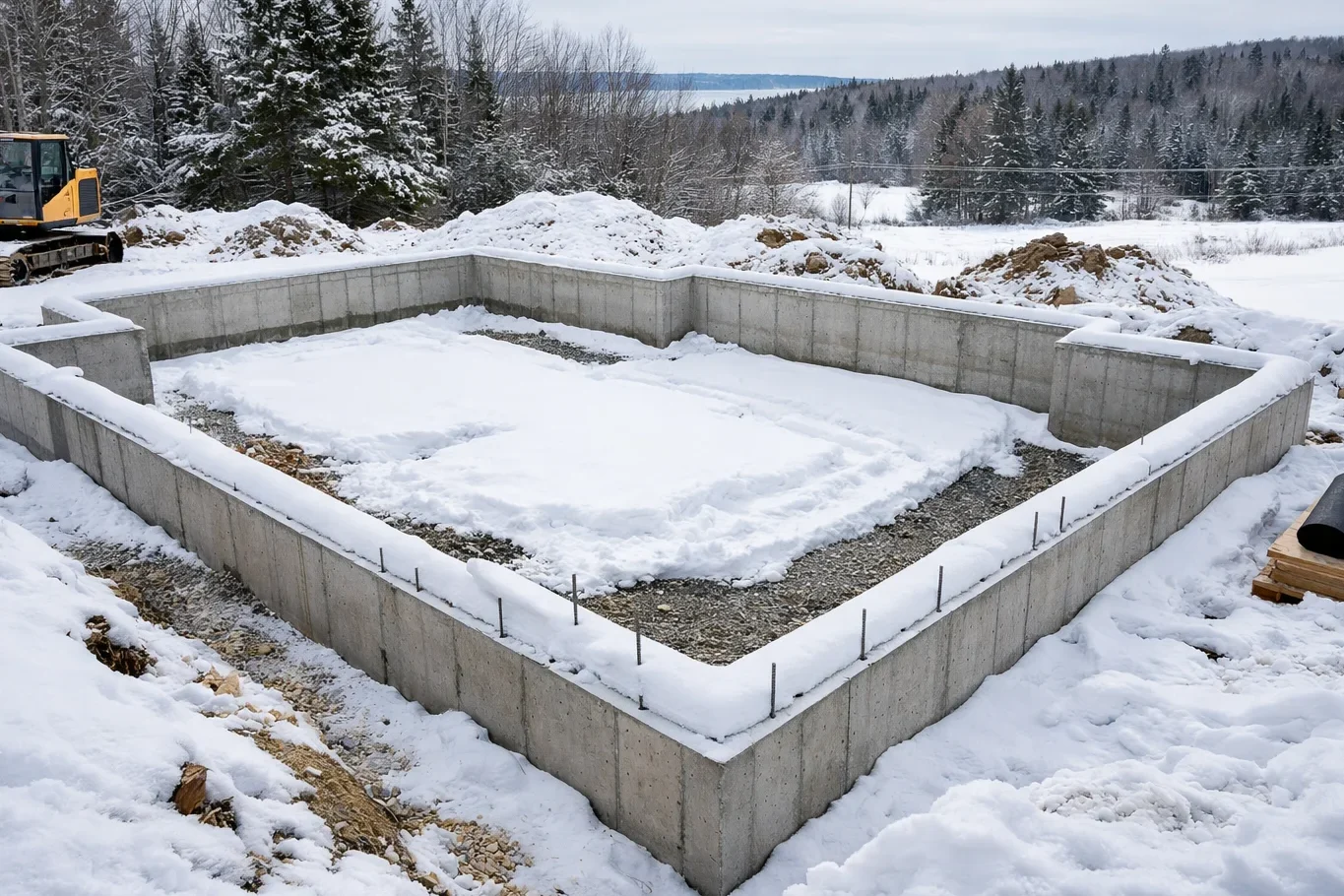
A McKenzie Towne spec builder has his framing crew locked for a March 1, 2026 start. The crew moves to the next builder’s site on March 8 — that is the entire window. If his foundation is not poured, cured to strength, and backfilled by March 1, he does not get a one-week grace period. He loses the slot and waits 7 to 10 weeks for the crew’s next opening, with his loan still running the whole time.
This is the downstream effect of a labour market that has tightened for a decade. BuildForce Alberta’s 2025–2034 forecast projects 59,000 total hires required against 43,400 retirements, leaving a 15,400 net gap the province has to recruit from outside the existing workforce. The Calgary Construction Association’s Q3 2025 data counted 5,300 vacancies in Trades and Transport — 23.8% of all local vacancies. When good framing crews are this scarce, they book three to six months out and they do not move their start dates for a foundation that ran late.
There is a useful nuance here that cuts against the panic. Job Bank’s December 2025 outlook rates concrete finishers (NOC 6481) as “Balanced” in Alberta, not a designated shortage — so the bottleneck is rarely the concrete trade itself. It is the framing, mechanical, and finishing crews stacked behind the pour, each with a locked calendar. The foundation is simply the first domino, and if it tips late, every crew behind it slips.
Why it matters to you: a missed framing slot is not a scheduling inconvenience, it is a second carrying-cost event layered on the first. The foundation has to meet the crew, and if the only date the crew has is in February, the foundation moves into the winter window to hold it.
Framing-crew lock-in is the labour driver. The next is a financing-side driver that hits multi-family developers hardest.
3. The MLI Select interest-rate window pushes multi-family developers to winter pours
A Mahogany developer has seven rental units under one title in a single building, financed through CMHC’s MLI Select program, with an October 2026 occupancy target and a rate-locked commitment that does not wait forever. To hold the commitment and hit occupancy, foundations need to be in the ground by mid-February. For this builder, the question is not “is winter pouring ideal” — it is “winter pour, or lose the financing structure the whole pro forma is built on.”
MLI Select rewards purpose-built rental that hits affordability, energy-efficiency, or accessibility thresholds with materially better terms — higher loan-to-value, longer amortization, and lower debt-coverage requirements than conventional financing. Under the program rules in effect since the February 2025 update, the points-based tiers apply to projects of five or more units held under a single title in one building, which is exactly the small-multi-family profile driving a lot of Calgary infill. The preferential terms are tied to commitment timelines; they do not survive indefinite delay, and re-applying in a different rate environment can change the entire deal economics.
Calgary multi-family permit-to-occupancy timelines run 11 to 14 months in good conditions, which leaves very little slack. A winter pour can preserve a rate-locked commitment that a spring delay would let expire. Confirm the exact program parameters and your commitment dates with CMHC and your lender before you build a schedule on them, because the underwriting rules are updated periodically and the numbers in your specific commitment letter are the ones that govern.
Why it matters to you: for an MLI Select project, the winter-pour premium is a rounding error next to the cost of losing program-grade financing. The 15% to 25% you spend protecting a cold-weather pour is trivial against the spread between MLI Select terms and conventional terms over a 40- or 50-year amortization.
MLI Select is one financing pressure. The next is the inventory pressure that drives spec builders specifically.
4. Lot inventory turnover: spec builders need to keep moving
An Auburn Bay spec builder is holding three serviced lots, and every month they sit undeveloped is a month of carry with no revenue against it. He pours in February so he can frame and finish through the summer and close in the fall. The alternative — an April pour — pushes his closings into the slow December–January resale market, where his finished homes sit longer and his pricing power erodes.
Calgary’s resale market has a pronounced seasonal rhythm: absorption is materially slower in the November-to-February window than in the May-to-September window. A spec builder managing three to six active lots times the pour to land the closing in the fast-absorption season, because the close date is the date that matters to his return — and the close date is downstream of the pour date by roughly eight to ten months. Pour in February, close in October into a moving market. Pour in April, close in December into a slow one.
This is a sequencing decision, not a concrete decision. The spec builder is not pouring in winter because winter concrete is better. He is pouring in winter because the only way to hit a fall closing is to start the clock in the cold, and the carrying cost on idle serviced lots makes “wait for spring” the more expensive path.
Why it matters to you: inventory turnover is the spec builder’s entire business model, and the pour window is one of the few levers that moves the closing window. Winter pouring is a tool for landing closings when buyers are actually shopping.
Inventory drives spec-builder timing. The next reason is a warranty-administration driver that catches builders who pre-sell.
5. ANHWP enrolment and permit-window alignment
A Killarney infill builder has pre-sold two of his units with contractual delivery dates, and his Alberta New Home Warranty Program enrolment has to line up with his permit and his pour so the structural-defect coverage clock starts in the year his sales contracts promised. A pour that slips out of the window does not just cost carry — it risks a delivery date he has already signed his name to.
Mandatory home-warranty coverage in Alberta is the legal backdrop here: under the New Home Buyer Protection Act, new homes must carry warranty coverage, and coverage commencement is tied to defined construction and possession milestones documented at enrolment. When the permit, the pour, and the enrolment fall out of alignment, a builder can create a coverage-timing problem on top of a schedule problem — and pre-sold homes carry penalty clauses, deposit-refund exposure, and reputational risk if the promised possession date slips.
Winter pouring is sometimes the only way to keep all three calendars synchronized: the permit clock, the warranty enrolment, and the contractual possession date. A foundation poured in January, in compliance with the standard, enters warranty coverage exactly like a July pour — the program does not penalize a winter pour, it simply requires it to meet the same code as any other pour.
Why it matters to you: if you have pre-sold, your build calendar is a contract, not a preference. The warranty and the possession date can both push the foundation into the winter window, and the cost of missing them dwarfs the cost of pouring in the cold.
Warranty timing is the regulatory driver. The last positive reason is the supply-side one: when concrete and crews are actually available.
6. Concrete supplier availability is highest in November–March
A Cochrane custom builder calls his concrete supplier in mid-February and gets a same-week delivery slot with room to choose his pour time. He makes the same call in mid-June and is quoted a multi-day lead time, a tight delivery window, and a premium for an off-peak pour. The difference is not the supplier’s mood. It is capacity.
Calgary’s climate gives builders only about 59 to 65 ideal pour days a year — days when ambient conditions allow a standard mix design without supplemental heat or hoarding — and those days cluster from May through September. The entire industry chases that same narrow window, which means ready-mix capacity, pump availability, and finishing crews are heavily booked in summer and comparatively open in winter. The scarce resource in July is the truck and the crew; in February, it is the pour-day weather, and weather is something a hoarding-and-heat plan can control.
That inversion is a real, underrated advantage. A winter pour often buys faster scheduling, more crew attention, and a pour time of your choosing rather than whatever slot is left. Faster scheduling means faster pour means faster site progression — provided the protection plan is in place to carry the concrete to strength.
Why it matters to you: in summer you are competing with every other builder in the city for the same trucks and crews. In winter you are competing with the weather, and unlike a fully booked supplier, the weather is a problem you can engineer around.
Those are the six reasons builders pour through a Calgary winter. Now the harder half of the article: the four conditions under which we tell a builder to wait — because the carrying-cost savings vanish the instant a wall has to be re-poured.
7. The 4 disqualifiers — when your winter pour should wait
Everything above is the economic case for pouring. None of it survives contact with a site that cannot protect the concrete. CSA A23.1:24 §7.6 is the governing cold-weather concreting standard in Canada — ACI 306R is a US document that practitioners reference for supplemental guidance only, not the rule we build to here.
The standard sets the non-negotiables: concrete placed at a minimum temperature near 10°C, maintained at 10°C for the first several days of cure, and protected from freezing until it reaches a minimum strength of 7 MPa before any exposure to a freeze-thaw cycle. That 7 MPa figure is the Canadian early-frost threshold; the “8 MPa” and the US “3,500 psi” numbers that circulate online are not the CSA value and should not be on your spec. If any one of the following four conditions applies, defer the pour.
Disqualifier 1 — A high water table at the excavation base. Pouring a foundation over groundwater in frozen ground is a frost-lens lottery. Saturated soil that freezes expands and lifts, and a footing placed on it can be heaved before the concrete ever reaches strength. If your geotechnical report shows the water table within roughly two metres of footing elevation during the November-to-March window, the winter math no longer applies — the risk of a heaved, cracked footing is the kind of failure that turns a $34,000 carrying-cost saving into a six-figure repair. Wait for the table to drop or change the foundation approach.
Disqualifier 2 — A wind-exposed site with no hoarding plan. CSA A23.1:24 requires the concrete to be held at its cure temperature through the critical early days, and on an exposed Springbank or Bearspaw acreage that is genuinely hard to achieve. Wind strips heat off hoarding faster than propane can replace it, and below roughly -5°C ambient, holding cure temperature requires full enclosure and active heat, not a tarp and good intentions. If the site is wind-exposed and there is no engineered hoarding-and-heat plan, you cannot reliably hit the temperature the standard demands, and the pour should not go.
Disqualifier 3 — No temperature-controlled cure plan documented in writing. The 7 MPa frost threshold is not reached by hoping. It requires a curing plan with real temperature monitoring — maturity sensors or in-place thermocouples — so you know the concrete has reached strength before the protection comes off. Without a documented, engineered cure plan, you are guessing, and in a Calgary January the wall will very often hit freeze before it hits 7 MPa. A pour with no written cure-and-monitoring plan is a pour waiting to fail; defer it until the plan exists.
Disqualifier 4 — A late-season pour with no supplier-confirmed cold-weather mix design. A Calgary winter mix is not the summer mix poured colder. It is a deliberately different design: adjusted water-to-cement ratio, heated materials, an accelerating admixture (a non-chloride accelerator where the wall is steel-reinforced or post-tensioned), and often elevated cement content to drive early strength. The 7 MPa-before-freezing target and the 10°C placing minimum are the supplier’s job to engineer toward — and if they have not confirmed the cold-weather mix in writing, you do not have a winter-ready pour, you have a summer pour exposed to winter. Do not let the truck roll without the mix design on paper.
If even one of these four applies, defer. The honest version of the winter-pour decision is this: the six reasons above are real and they are about money, but they only hold when the concrete can be protected to 7 MPa before it freezes. The moment a site cannot guarantee that, the carrying-cost savings are an illusion, because the cost of re-pouring a frost-damaged foundation dwarfs every month of carry you were trying to save.
FAQ
Q1: Can you pour a concrete foundation in winter in Calgary? Yes — Calgary builders pour foundations through winter routinely, and CSA A23.1:24 §7.6 sets out exactly how. It requires placing the concrete near 10°C, holding it at cure temperature for the first several days, and protecting it from freezing until it reaches 7 MPa. Below roughly -5°C ambient that means hoarding and active heat. A winter pour done to the standard is sound; a winter pour without temperature protection is not.
Q2: What does cold-weather concrete cost extra in Calgary? A compliant Calgary winter pour typically adds 15% to 25% to the foundation cost — on the order of $8,000 to $15,000 on a custom home — to cover hoarding, heated water and aggregate, an accelerating admixture where reinforcement allows, insulated blankets, and extended cure monitoring. Treat that as an industry-survey range and validate it against current Calgary quotes for your specific site and foundation size.
Q3: When should you NOT pour a foundation in winter? Defer the pour if any of four conditions applies: a high water table within about two metres of footing elevation; a wind-exposed site with no hoarding plan; no written, temperature-monitored cure plan; or no supplier-confirmed cold-weather mix design. Any one of these means the concrete may freeze before it reaches the 7 MPa frost threshold, and a re-pour erases every dollar of carrying cost a winter pour was meant to save.
Q4: What is the carrying cost of a delayed Calgary custom build? On a typical $1.6M custom build, carrying cost runs roughly $11,400 a month — about $7,994 in interest on a $1.4M loan at 6.85%, plus $2,000 to $3,500 in soft costs and around $1,200 in property tax. A three-month winter delay therefore costs about $34,200 in pure carry. The breakeven against a winter-pour premium is roughly five to seven weeks of delay; validate the inputs against your own lender and insurer.
Q5: Does winter concrete reach full strength? Yes — properly protected cold-weather concrete reaches its full design strength. CSA A23.1:24 requires the concrete to be kept at cure temperature and protected from freezing until it reaches 7 MPa, after which it continues to gain strength normally. The risk is never the cold itself; it is concrete freezing before it reaches that 7 MPa threshold, which is what hoarding, heat, the right mix design, and temperature monitoring exist to prevent.
Q6: How many days a year can you pour concrete in Calgary without special measures? Calgary averages roughly 59 to 65 ideal pour days a year — days when ambient conditions allow a standard mix design without supplemental heat or hoarding — concentrated from May through September. Outside that window, pours are entirely achievable but require cold-weather measures under CSA A23.1:24. That scarcity of ideal days is one reason summer ready-mix capacity is so heavily booked and winter slots are often easier to get.
Sources
- CSA A23.1:24, §7.6 (cold-weather concreting requirements) — https://www.csagroup.org
- Concrete Alberta — Cold Weather Concreting Best Practices — https://www.concretealberta.com
- CMHC MLI Select Underwriting Guide (multi-unit affordable-housing program) — https://www.cmhc-schl.gc.ca
- Alberta New Home Warranty Program (ANHWP) — enrolment and coverage commencement — https://anhwp.com
- National Building Code — 2023 Alberta Edition (NBC(AE) 2023) — https://www.alberta.ca
- BuildForce Alberta — Construction & Maintenance Looking Forward, Alberta 2025–2034 — https://www.buildforce.ca
- Calgary Construction Association — Q3 2025 local labour-market data — https://www.calgaryconstruction.com
All dollar figures are industry-survey ranges. Construction-loan rates, soft costs, and cold-weather premiums move with the market — validate every number against current Calgary quotes and your own lender, insurer, and supplier before relying on it for a budget. ACI 306R is referenced by practitioners as US supplemental guidance only; CSA A23.1:24 §7.6 governs cold-weather concreting in Alberta.
Not Every Winter Foundation Should Be Poured—We’ll Tell You Which Ones Should.
A winter foundation can save weeks on your schedule and tens of thousands in carrying costs—but only if the site, weather protection, mix design, and curing plan all support it.
Omega 2000 Cribbing has been forming and pouring Calgary-area foundations since 1988. We’ll review your project schedule, site conditions, and engineering requirements, then give you a straightforward recommendation: pour now or wait until conditions improve.