
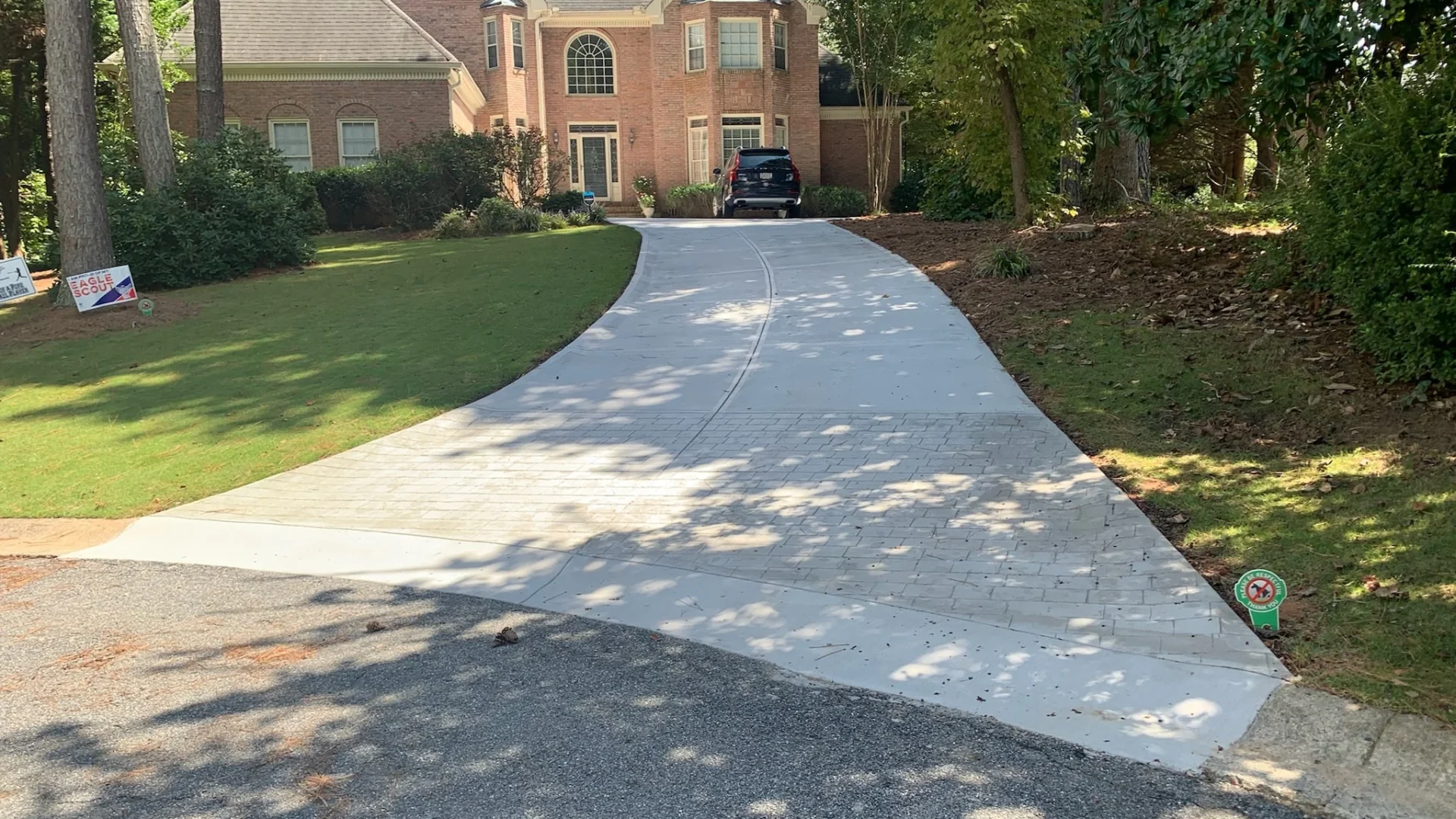
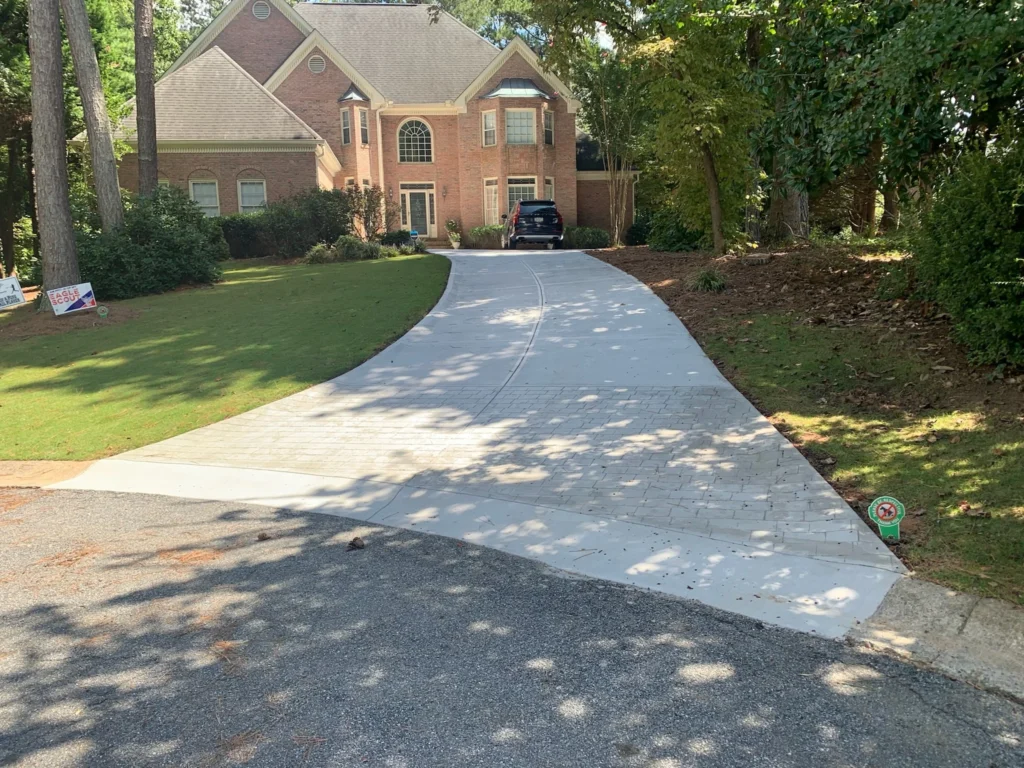
Most Calgary homeowners know what a driveway is. Fewer know about the driveway apron — the sloped transitional section between your driveway and the public road, and one of the most structurally important pieces of concrete on your property. When the apron fails, your vehicle scrapes bottom on every entry and exit, water pools at the curb, and the damage spreads up the driveway faster than you’d expect. A typical replacement runs $3,500–$5,500 CAD in Calgary (Angi, 2025), and the City has specific permit rules that catch homeowners off guard.
TL;DR: A driveway apron is the sloped concrete section bridging your driveway to the street. Calgary replacements run approximately $4,000 CAD for a standard 10’×20′ apron (Angi, 2025). Most replacements don’t need a permit — but non-conforming aprons require a $550 development permit and 10–12 weeks of processing time (City of Calgary, 2025).
What Is a Concrete Driveway Apron?
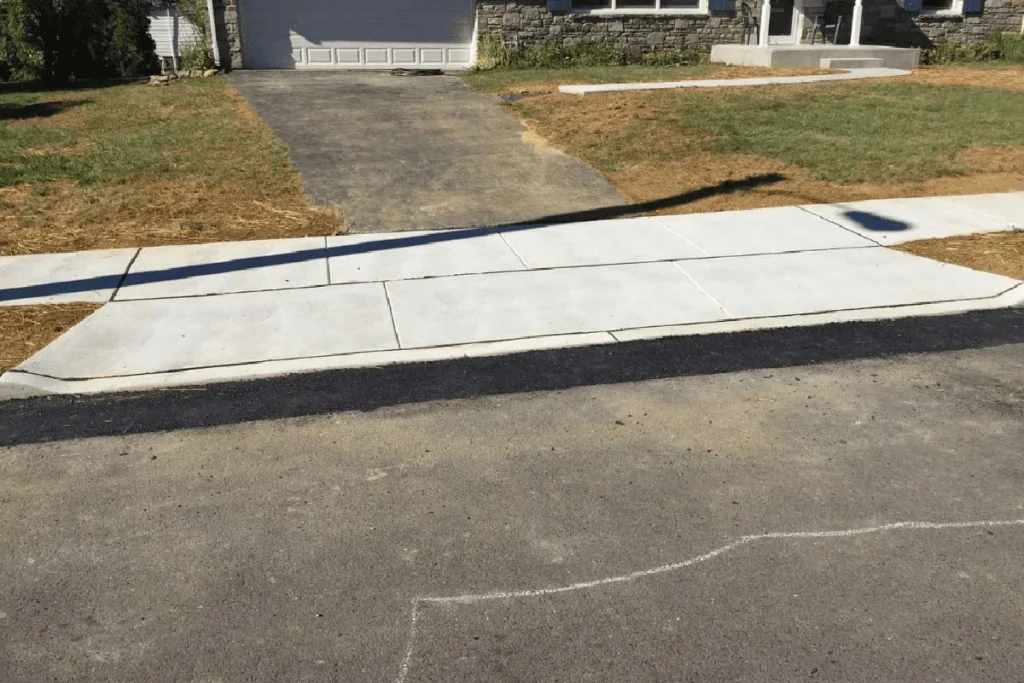
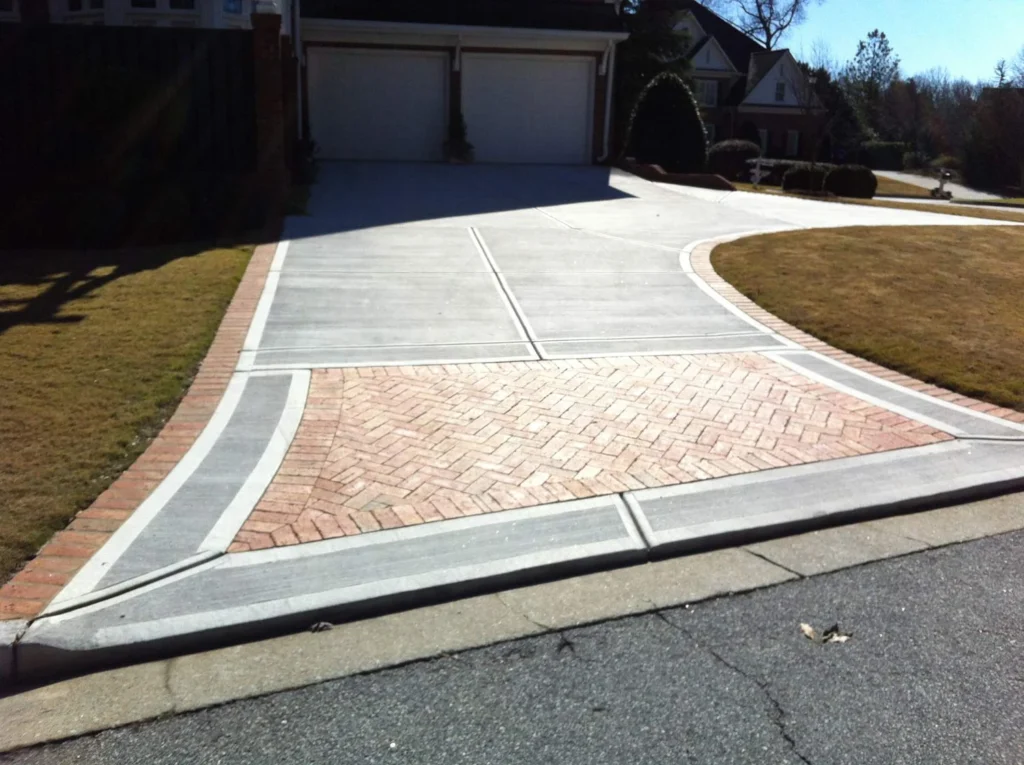
A concrete driveway apron is the sloped transitional slab between your private driveway and the public road or lane — spanning from the curb or edge of the road surface to where your main driveway begins (Angi, 2025). It’s the section your front wheels hit first when you pull in, and it handles more stress per square metre than the rest of your driveway because it bears load at an angle — vehicles transferring weight from road grade to driveway grade with every entry and exit.
The apron serves three functions that the flat driveway slab doesn’t:
- Grade transition: It smooths the elevation change between the street surface and your driveway, preventing vehicles from bottoming out at the connection point.
- Water drainage: A properly sloped apron directs runoff away from the foundation and toward the street, rather than letting it pool at the curb or flow back toward the house.
- Load distribution: At the point where vehicles decelerate and turn into the driveway, the apron distributes that concentrated load across the sub-base before transferring it to the main slab.
In Calgary, aprons connect driveways to either front streets or rear lanes. Properties with rear-lane garages have an alley apron — often the first section to deteriorate because the lane surface itself is typically lower-quality asphalt that moves more than a paved street.
The apron is also the boundary between your responsibility and the City’s. The road surface and curb are City property. Everything from the property line inward — including the apron — is the homeowner’s responsibility to maintain. When an apron heaves or cracks, the City won’t repair it; that repair bill is yours.
Many homeowners underestimate how driveway aprons protect the edge of your driveway, especially where heavy vehicles transition from the road to the driveway surface.
Why Do Calgary Driveway Aprons Fail Faster Than the Rest of the Driveway?
Calgary aprons deteriorate faster than main driveways because they sit at the intersection of two different structural systems — your sub-base and the City’s road base — which move independently with freeze-thaw cycles (ACL Masonry, 2024). Calgary experiences approximately 65–70 freeze-thaw cycles per year. At the joint between the apron and the road, differential movement is constant: the road heaves at a different rate than your sub-base, and every cycle stresses the connection point.
Additional failure factors specific to Calgary aprons:
- City road salt runoff: Sand and salt from snow-clearing operations on the street wash directly onto the apron, concentrating chloride exposure at the section most vulnerable to freeze-thaw damage.
- Vehicle load concentration: Delivery trucks, moving vans, and heavy vehicles that wouldn’t turn onto a residential driveway still frequently drive over the apron — the transitional section takes more heavy-load passes than the private driveway.
- Edge exposure: The apron edges (sides of the slope) are fully exposed to the elements on three sides rather than two, accelerating drying, carbonation, and de-icer infiltration.
- Grade stress: The continuous angle means water never fully drains from the surface — there’s always a low point that holds moisture longer than a flat slab.
Because Calgary experiences more than 60 freeze-thaw cycles each year, regular sealing and maintenance are essential. Our guide on how to prepare your driveway for Calgary winters explains how sealing, crack repair, and proper snow removal help extend the life of your concrete.
How Much Does a Concrete Driveway Apron Cost in Calgary?
A concrete driveway apron replacement costs $1,530–$4,320 USD in the US market (Angi, 2025), which translates to approximately $3,500–$5,500 CAD in Calgary when accounting for Alberta labour rates and local material costs. For a standard 10-foot by 20-foot apron — the typical size for a single-car driveway — budget approximately $4,000 CAD all-in, including excavation, forming, pouring, and surface finishing.
Here’s how that budget typically breaks down:
| Cost Component | Approximate Cost (CAD) | Notes |
|---|---|---|
| Excavation and removal | $400–$800 | Saw-cut, break up, haul existing concrete |
| Sub-base preparation | $300–$600 | Gravel compaction, grade adjustment |
| Forming and rebar | $200–$400 | Wood forms, steel mesh or rebar, stakes |
| Concrete materials | $600–$1,000 | Ready-mix with air entrainment for Calgary climate |
| Labour — pour and finish | $800–$1,500 | Crew, finishing tools, curing compounds |
| Sealing (first application) | $150–$300 | Penetrating silane-siloxane sealer |
| Total (typical) | $2,450–$4,600 | Standard 10’×20′ single-car apron |
A double-car apron (typical for side-by-side garage driveways, approximately 20’×20′) runs $5,500–$8,500 CAD. Lane aprons tend to cost slightly less — the City of Calgary lane surface is typically at a gentler grade than a front street, reducing the slope angle and forming complexity.
Our finding: In our experience pricing Calgary apron replacements, homeowners who delay replacement by 2–3 years after first noticing cracking typically end up paying 40–60% more than the original repair quote — because the failing apron damages the adjacent main driveway slab through differential movement, expanding the scope from apron-only to apron-plus-section repair.
If your apron failure has spread damage into the main slab, replacement may require a full driveway installation. Before deciding, review our comparison of DIY vs professional driveway installation in Calgary to understand the real costs and risks.
Do You Need a Permit for a Driveway Apron in Calgary?
Most standard driveway apron replacements in Calgary do not require a development permit — as long as the replacement conforms to the existing approved dimensions and setback rules (City of Calgary, 2025). You’re replacing like-for-like on your own property, which falls under routine maintenance rather than development. However, there’s an important exception that catches many Calgary homeowners off guard.
A development permit is required if your apron is — or will be — non-conforming. The City of Calgary’s Land Use Bylaw specifies that a garage apron must maintain at least 0.6 metres of clearance from the lane-side property line. If your current apron doesn’t meet that requirement, or if you’re widening the apron beyond the garage opening width, you’ll need a development permit before any work begins.
Calgary development permit details for non-conforming aprons:
- Cost: $550 application fee (City of Calgary, 2025)
- Processing time: 10–12 weeks
- Pre-application meeting: Recommended before submitting — the City’s planning department offers a free pre-application meeting to confirm whether your project needs a permit
- Survey requirement: You may need a Real Property Report (RPR) showing current setbacks, which adds $800–$1,500 CAD to the project cost
Our finding: Based on permit applications we’ve been involved with in Calgary, the most common trigger for a required development permit is a rear-lane apron that was originally poured too close to the property line — often without anyone realizing it didn’t conform. A quick pre-application meeting with the City typically costs nothing and can save the 10–12 week permit wait if the apron turns out to conform after all.
If you’re replacing an apron that accesses a public sidewalk rather than a lane, you may also need a curb crossing permit from the City’s roads department. This is separate from a development permit and typically costs $150–$300 CAD. Your concrete contractor should be familiar with which permits apply to your specific situation.
[INTERNAL-LINK: Calgary concrete permits guide → complete guide to development permits, curb crossing permits, and timelines for concrete work in Calgary]
What Are the Signs Your Calgary Driveway Apron Needs Replacing?
Replace your driveway apron when any of these conditions are present — delaying typically doubles the repair cost within two to three Calgary winters (Concrete Alberta, 2025):
- Vehicle bottoming out: If your car scrapes when entering or exiting, the apron has heaved, settled, or lost its slope alignment with the road. This is the most immediate functional failure signal.
- Cracks wider than 10mm: Surface cracks under 3mm can be sealed. Cracks 3–10mm warrant monitoring and filling. Anything wider than 10mm, or with vertical displacement between crack edges, means the structural integrity is compromised.
- Spalling over more than 25% of the surface: Surface scaling and spalling that covers more than a quarter of the apron isn’t patchable economically — the sub-surface damage is too widespread.
- Water pooling at the curb connection: If water pools at the joint between the apron and the road rather than draining away, the grade has shifted enough that a new pour is needed to restore proper drainage slope.
- Visible sub-base exposure: If you can see gravel or dirt through the concrete, the surface layer has eroded to the point where the structural base is exposed to weather and freeze-thaw cycles.
Cracks and surface scaling that appear before the apron is 10 years old typically indicate a mix or installation problem — either inadequate air entrainment for Calgary’s climate, too-thin a pour (minimum 100mm for residential aprons), or finishing while bleed water was still present. These failures warrant a warranty conversation with the original contractor if the work is recent.
Frequently Asked Questions
What is a concrete driveway apron?
A concrete driveway apron is the sloped transitional slab between your private driveway and the public road or lane. It spans from the curb or road edge to where your main driveway begins, handling vehicle weight at the angle where driveway grade meets road grade. It also channels water away from your property and defines the boundary between your maintenance responsibility and the City’s.
How much does a concrete driveway apron cost in Calgary?
A concrete driveway apron costs $1,530–$4,320 USD (Angi, 2025), which translates to approximately $3,500–$5,500 CAD in Calgary with Alberta labour rates. A typical 10-foot by 20-foot single-car apron runs close to $4,000 CAD all-in, including excavation, sub-base prep, forming, concrete pour, finishing, and first sealing application.
Do I need a permit for a driveway apron in Calgary?
Most standard apron replacements in Calgary don’t require a development permit if the apron conforms to current setback rules. Non-conforming aprons — those wider than the garage opening or within 0.6 metres of the lane-side property line — require a development permit ($550, 10–12 weeks). Always confirm requirements with the City of Calgary before starting work.
How long does a concrete driveway apron last?
A properly installed concrete driveway apron lasts 25–40 years with regular sealing and careful de-icer use. Calgary’s 65–70 annual freeze-thaw cycles accelerate wear, particularly at the joint between the apron and the road where differential movement is greatest. Re-sealing every 2–3 years with a penetrating silane-siloxane product is the most effective way to extend apron lifespan.
Can I replace just the driveway apron or does the whole driveway need replacing?
You can replace just the driveway apron independently of the rest of the driveway. The apron is a separate concrete slab at the street connection. If the main driveway is structurally sound, replacing only the apron is cost-effective. A contractor will saw-cut the joint, remove the damaged section, and pour a new apron properly connected to the existing slab with rebar or dowels.
Protecting Your Driveway Apron Through Calgary Winters
Your driveway apron is working harder than the rest of your driveway — it takes vehicle loads at an angle, sits at the junction of two different sub-bases, and is the first surface hit by salt and sand from city snow clearing. Give it the maintenance attention it deserves: seal it every 2–3 years with a penetrating sealer, keep rock salt off it, and replace it before cracks widen to the point where the main driveway slab starts taking damage from differential movement.
Key takeaways:
- A driveway apron is the sloped concrete slab connecting your driveway to the road — it’s your responsibility to maintain, not the City’s.
- Calgary aprons fail faster than the main driveway because they sit at the junction of two independent sub-bases and receive concentrated city road salt exposure.
- Replacement costs approximately $4,000 CAD for a standard single-car apron in Calgary — budget $5,500–$8,500 CAD for a double-car apron.
- Most replacements don’t need a development permit. Non-conforming aprons require a $550 permit with a 10–12 week wait.
- Replace when cracks exceed 10mm, when the vehicle bottoms out, or when spalling covers more than 25% of the surface.
Not Sure If Your Driveway Apron Needs Repair or Replacement?
Cracks, spalling, or vehicle scraping at the curb connection are signs your apron may be failing. A quick inspection can determine whether simple repairs will work or if a full replacement is the better long-term solution.
Contact us to cchedule a free Calgary driveway inspection and get a professional recommendation before winter damage spreads.