

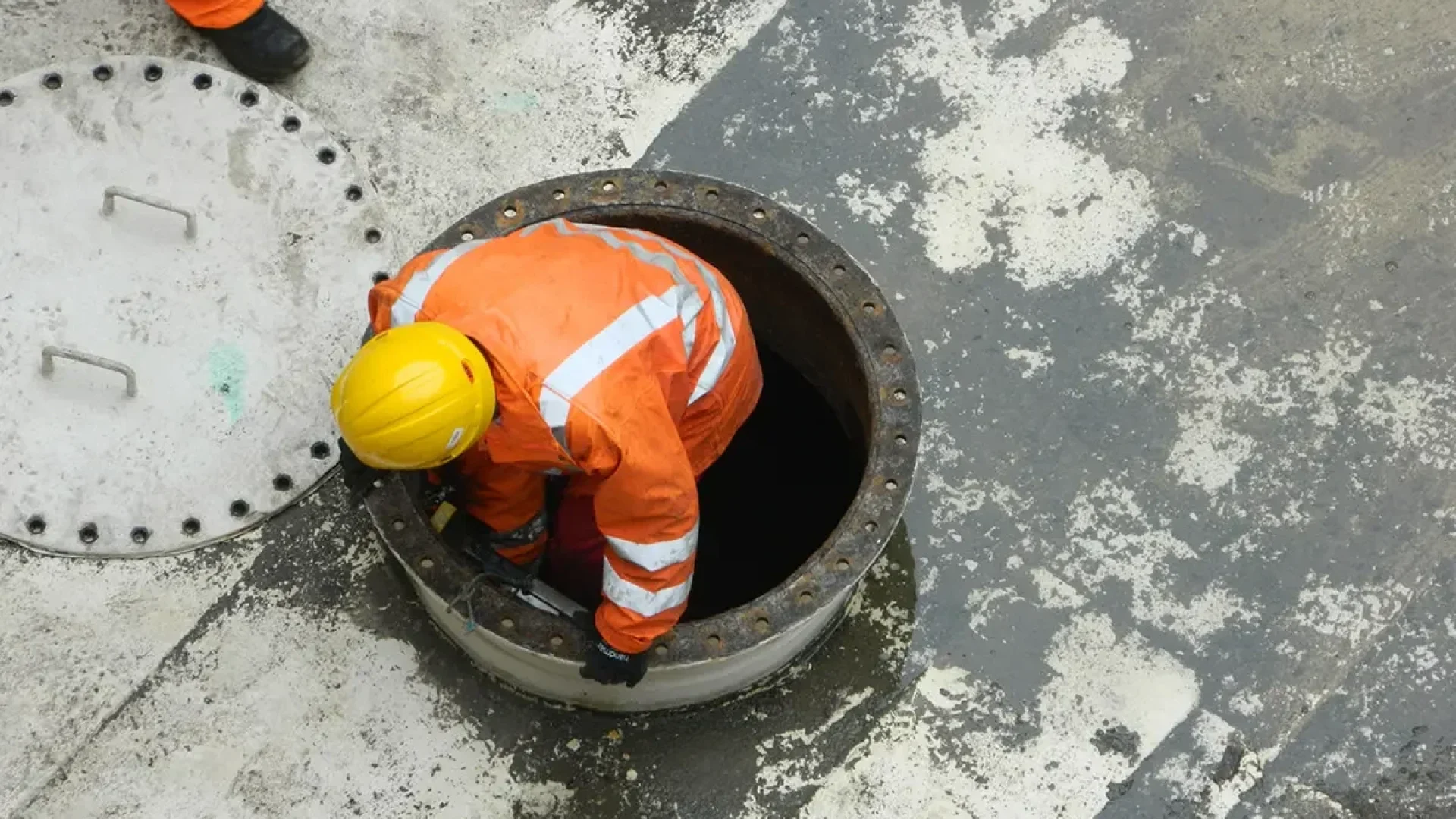
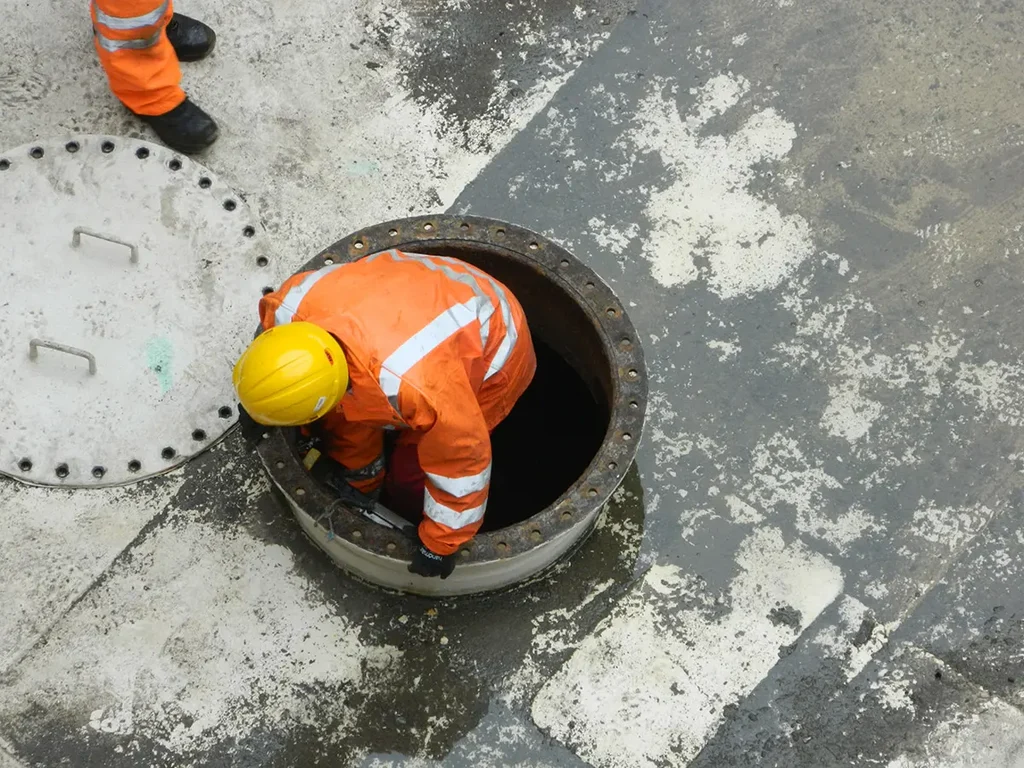
Most confined space violations we see on concrete work are not refusals to follow the rules. They are structures nobody classified. A wet well gets poured, a lid goes on, and three weeks later a finisher drops into it with a grinder to fix a honeycomb — no permit, no gas test, no tending worker, because on the schedule that line item reads “patch wet well interior.” Alberta’s Occupational Health and Safety Code does not care what the schedule calls it. It cares whether a worker’s breathing zone crossed the plane of a confined space access.
This is a guide for the builder, the prime contractor and the superintendent who have to decide, before the crew arrives, whether a structure on their site is a restricted space, a confined space, or neither — and what each answer costs in paperwork, equipment and time.
A confined space is a restricted space plus a hazard
Alberta uses two definitions, stacked. Get them in the right order and most of the classification work does itself.
A restricted space is “an enclosed or partially enclosed space, not designed or intended for continuous human occupancy” that “has a restricted, limited or impeded means of entry or exit because of its construction.” That is a geometry test. A manhole barrel, a sump, a valve chamber, an elevator pit, a crawl space under a suspended slab, the inside of a formed tank — all of them fail the geometry test the moment the lid or the deck goes on.
A confined space is narrower: “a restricted space which may become hazardous to a worker entering it because of” its atmosphere, the conditions or changing circumstances within it, or the nature of the activity performed in it. That is a hazard test, and the third branch is the one concrete crews keep walking into. A dry, ventilated, clean precast chamber may be a restricted space and nothing more. Send a worker into that same chamber with a gas-powered cut-off saw and the activity has made it a confined space. Nothing about the structure changed. The work changed.
The definition of entry matters as much as the definition of space. Alberta’s guidance is explicit that a worker has entered when “his or her breathing zone crosses the plane of the confined space access.” Reaching in with an arm is not entry. Leaning in with your head is.
After 38 years pouring concrete in this city, we have sat through enough incident reviews to know which way the argument goes when a structure was never classified: the activity gets read against the worker, not the schedule.
The concrete structures that catch people out
The ones everyone classifies correctly are the ones with “tank” or “vault” in the name. These are the ones that get missed:
| Structure | Why it qualifies | What usually triggers it |
|---|---|---|
| Wet wells, sumps, lift station bases | Limited entry, poor natural ventilation, decomposing water | Interior patching, coring, coating |
| Formed tank and reservoir interiors | Partially enclosed once the deck is formed | Rubbing walls, stripping snap ties, waterstop repair |
| Elevator pits and stair cores | Deep, single access, low point of the building | Pit slab finishing, grouting rails |
| Crawl spaces under suspended slabs | Impeded entry by construction | Underslab repair, vapour barrier work |
| Trench and pipe chases with lids set | Restricted means of exit | Joint filling, grouting, cutting openings |
| Catch basins and inlet structures | Classic restricted geometry | Benching, invert repair |
| Shored excavations with limited egress | Impeded exit, atmosphere can change | Footing forming, tie-in work |
An excavation is its own conversation — depth, cut and shoring drive that analysis, and we cover it in our guide to excavation shoring requirements in Calgary. The point here is that a shaft you access by ladder through a single opening has stopped being an excavation problem and become a Part 5 problem.
What Part 5 actually requires
Part 5 of the OHS Code runs from section 44 to section 58, and the obligations are sequenced. The Part 5 section list reads as a project plan if you read it in order: code of practice (s.44), hazard assessment (s.45), training (s.46), entry permit system (s.47), general safety and protection (s.48), hazardous substances and energy (s.49), unauthorized entry (s.50), traffic hazards (s.51), testing the atmosphere (s.52), ventilation and purging (s.53), inerting (s.54), emergency response (s.55), tending worker (s.56), entry and exit (s.57), retaining records (s.58).
Four of those deserve attention before you price the work.
The code of practice is a document, not a decision made on site. Alberta’s guideline for developing one lists what it has to cover: a description of the confined spaces at the work site, the reasons for entry, the hazards present, worker training requirements, the entry permit system, procedures for each type of entry, atmospheric testing, ventilation, purging and inerting, isolation of hazardous substances and energy, emergency response, the roles of the tending worker, and recordkeeping. It must be in writing and available to affected workers. If your project has a confined space and nobody has written that document, the first entry is already non-compliant regardless of how carefully the crew works.
The permit is per entry, and it is signed. At a minimum it names each worker who enters and the reason for their entry, the location, the period it is valid for, the work being done, the required safety precautions, the entry, working and exit requirements, and the signature of a competent person. A generic format may be used for similar spaces, but a separate permit is required for each entry. “We did one at the start of the week” is not a permit system.
Rescue has to be real before anyone goes in. The Code requires that a worker not enter a confined space unless an effective rescue can be carried out, and Alberta’s guidance puts the next sentence beyond argument: “Using a 9-1-1 service by itself is not enough to meet this requirement.” On a concrete site that usually means a tripod and retrieval winch at the opening, a trained attendant, and a rescue procedure the crew has practised — Part 7 requires that rescue training include simulated emergencies. Budget it as equipment and labour, not as a form.
Records outlive the pour. Alberta’s bulletin on restricted and confined spaces sets the retention period at one year where no incident or unplanned event occurred during the entry, and two years where one did. That is a document control obligation for the general contractor, not a note on the superintendent’s phone.
The numbers are in your code of practice, not in the Code
This is where contractors expecting a clean table get frustrated. Alberta sets the atmospheric criteria for your site through your own code of practice rather than publishing one threshold for everyone. The guideline says the code must state who may test the atmosphere before entry and how, what substances are tested for, when continuous monitoring is needed, which instruments are used, how they are calibrated, and how often measurements are taken.
Two anchors are consistent across Alberta practice. The oxygen window is 19.5 percent to 23.0 percent by volume: below 19.5 percent the atmosphere is oxygen deficient, above 23.0 percent it is oxygen enriched, and either condition is an evacuation trigger. Flammable gas is expressed as a percentage of the lower explosive limit, and the number your program picks is the number you are held to — CCOHS notes that British Columbia and Yukon tie continuous monitoring to more than 20 percent of the LEL, while many Alberta employer programs set their action level at 10 percent. CCOHS is also clear on timing: testing happens before entry, during entry, and continuously throughout entry depending on the hazards present.
For concrete work, the two atmospheric hazards worth naming in your own document are combustion exhaust and displacement. Gas and propane equipment — cut-off saws, power trowels, generators, heaters — produces carbon monoxide, and inside a chamber with one opening the exhaust has nowhere to go. Ventilation is the control, and the guideline requires your code of practice to describe how workers will be alerted should the ventilation system fail. The second hazard is cutting and grinding in a space you cannot clear; respirable crystalline silica behaves very differently in an enclosed vault than it does on open flatwork, which is why we treat silica dust control for concrete cutting as a separate pre-start item on any interior scope.
Who carries this on a multi-trade site
Three roles get confused on pour day, so settle them at the pre-construction meeting rather than at the opening.
The employer of the entering worker owes that worker the code of practice, the training, the permit and the equipment. If a concrete subcontractor is sending the finisher in, the subcontractor’s program governs that entry.
The prime contractor coordinates. Where multiple employers work at the same site, the designation decides who reconciles overlapping programs, controls access, and makes sure one trade’s grinding is not another trade’s atmosphere — we set out how that designation works in Alberta in our note on prime contractor requirements.
The tending worker is a position, not a spare hand. Their duties are to communicate with workers inside, stay outside at or near the entrance (or at a remote monitoring station) when hazardous conditions are present, have a suitable system for summoning assistance, and be trained in the evacuation procedures and emergency response plan. A tending worker who leaves to fetch a cord has ended the entry.
One practical consequence for schedules: a confined space entry needs two or more people for one person’s work. If your plan shows a single finisher patching a wet well interior on a Friday afternoon, the plan is short a body, a tripod and a permit.
Design the entry out where you can
The cheapest confined space is the one that never forms. On projects where we are involved early, several decisions remove entries entirely: coring and sleeving before the deck is placed rather than after, forming an access large enough that the opening stops being restricted, finishing interior walls before the lid goes on, and scheduling interior repairs in the window when the structure is still open to the sky. Where an opening genuinely has to be cut into a closed structure, concrete cutting and coring done from outside the space is almost always cheaper than the entry it replaces.
Talk to us before the lid goes on
The decision that sets your Part 5 exposure is a sequencing decision, and it is usually made weeks before anyone looks down a manhole. Bring us into the structure sequence while the forms are still being planned and we will tell you which entries we can design out, which ones are unavoidable, and what the unavoidable ones need in crew, equipment and permit time. Reach our commercial concrete contractors in Calgary to set that review up.
FAQ
Is every manhole on my site a confined space? Every manhole with a lid on it is at least a restricted space, because the geometry fails the test for continuous occupancy and unimpeded exit. It becomes a confined space when its atmosphere, its internal conditions, or the activity performed in it may make it hazardous. Running a gas-powered saw inside one makes the activity branch apply.
Does leaning into an opening count as entry? Yes, once your breathing zone crosses the plane of the access. Alberta’s guidance uses that line specifically so the question does not turn on how much of the body went in.
Can we rely on 9-1-1 for rescue? No. The Code requires that an effective rescue can be carried out before entry, and Alberta’s guidance states directly that using a 9-1-1 service by itself does not meet that requirement. You need rescue capability at the opening and workers trained for it, including simulated emergencies.
How long do we keep the entry paperwork? One year where no incident or unplanned event occurred during the entry, and two years where one did.
Does the Code give me the oxygen and gas numbers? It requires your code of practice to specify the testing regime, substances, instruments, calibration and frequency. In Alberta practice the oxygen window is 19.5 to 23.0 percent by volume, and flammable gas is managed against a percentage of the lower explosive limit that your own program sets and your crew is then held to.
Who is responsible when two trades share the space? The employer of the entering worker owes that worker the program, training, permit and equipment. The prime contractor coordinates between employers so that overlapping work does not create the hazard.
Sources
- Government of Alberta, Guideline for Developing a Code of Practice for Confined Space Entry — https://open.alberta.ca/dataset/eb357dda-9700-4ef2-a084-221edded8c9a/resource/f5ea3828-5bb4-4238-b430-4bbd081a7e31/download/whs-pub-cs001.pdf
- Alberta OHS Code, Part 5 — Confined Spaces (sections 44–58) — https://search-ohs-laws.alberta.ca/legislation/occupational-health-and-safety-code/part-5-confined-spaces/
- Alberta OHS Resource Portal, Working in restricted or confined spaces — https://ohs-pubstore.labour.alberta.ca/download/sample/154
- CCOHS, Confined Space — Atmospheric Testing — https://www.ccohs.ca/oshanswers/hsprograms/confinedspace/confinedspace_atmospheric.html