

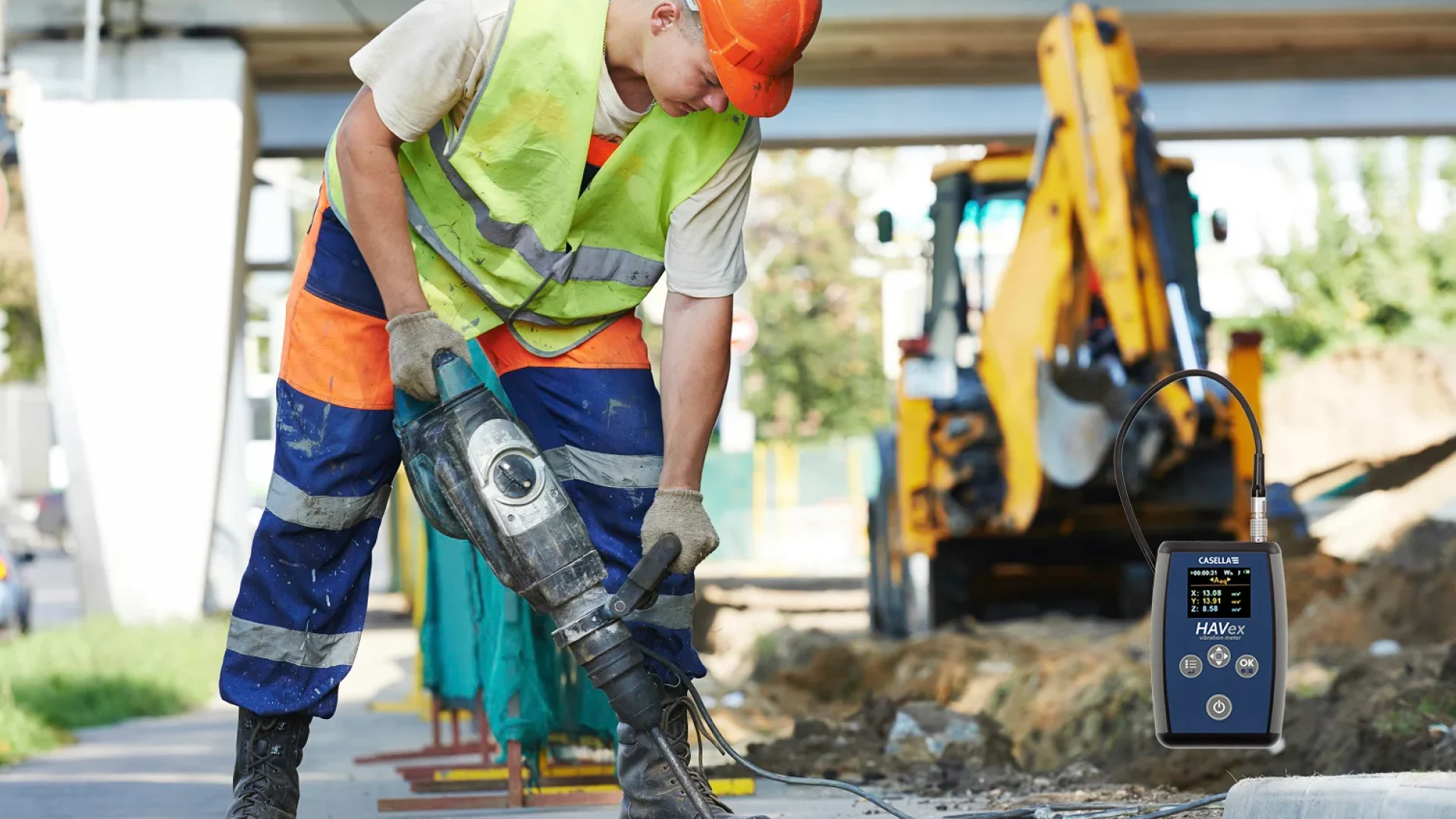
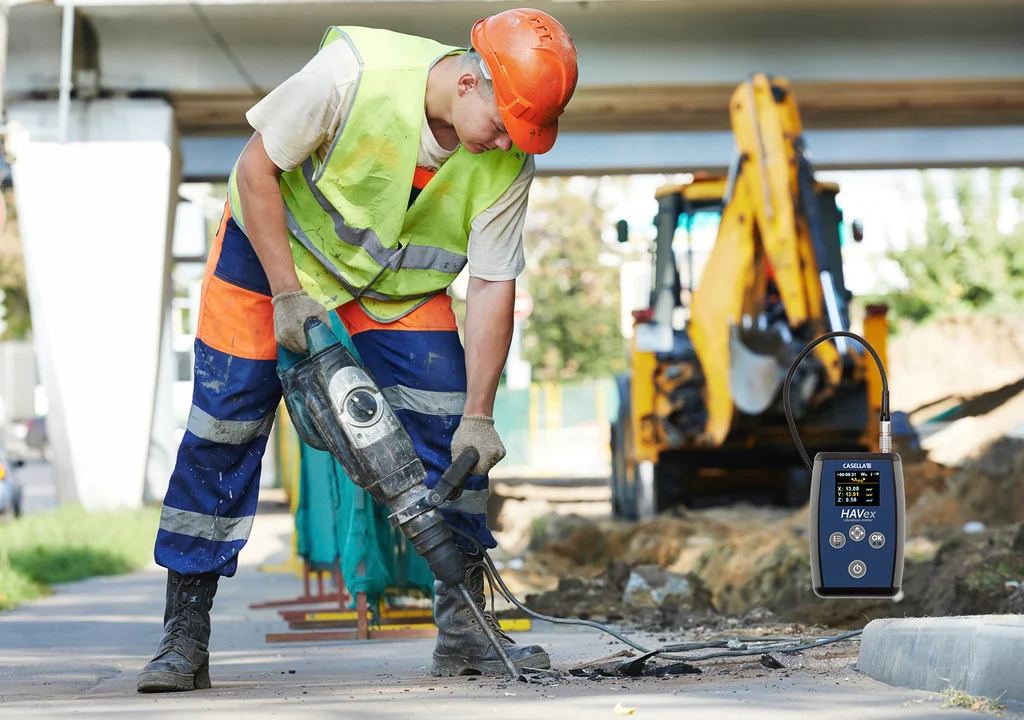
Alberta’s Occupational Health and Safety Code contains no numeric exposure limit for hand-arm vibration. There is no number in the Code the way there is for noise or for an airborne contaminant. That fact surprises most people who go looking for it, and it is the single most important thing to understand before you plan a week of breaking out a slab. The absence of a number does not mean the absence of a duty. It means the duty sits in Part 2 of the Code — hazard assessment and control — and the numbers you will be quoted in a meeting come from guidelines, not from law.
We have spent 38 years pouring, cutting and removing concrete in Calgary, and the crews who get hurt by vibration are almost never hurt on the day it happens. The injury shows up years later, in a man in his forties who cannot feel a nail between his fingers in February. This page sets out the numbers that actually exist, where each one comes from, and how to build a demolition day around them.
Where the duty actually lives
Alberta’s OHS Code handles vibration through the general machinery of Part 2, Hazard Assessment, Elimination and Control. Part 2 is short and it is broad:
- Section 7 — Hazard assessment. You identify the hazards at the work site.
- Section 8 — Worker participation. Workers are involved in that assessment.
- Section 9 — Hazard elimination and control. You eliminate the hazard, or if you cannot, you control it.
- Section 10 — Emergency control of hazard.
Nothing in that list requires a measured figure in metres per second squared. What it requires is that you recognise hand-arm vibration as a hazard when your crew spends a shift on a breaker, write it into the assessment, and show a control. An inspector who finds a hazard assessment with no mention of vibration, on a job where two men have been on hammers since seven in the morning, is looking at a Part 2 problem — not a missing number.
A contractor’s safety record and certification tell you how the paperwork is handled, but the hazard assessment for this job is written fresh, for this scope. Our note on how builders should read a foundation crew’s safety credentials covers the vetting side; this page covers what belongs in the assessment once the crew is hired.
The numbers that do exist, and who publishes them
Two sets of guideline figures circulate in Canada, and they do not agree. Knowing which one you are being handed matters.
Alberta’s own published guidance. The province’s Best Practices – Vibration at the Work Site reproduces an ACGIH table that scales the allowable magnitude to how long the tool is actually in the worker’s hands:
| Daily exposure duration | Maximum frequency-weighted acceleration |
|---|---|
| 4 to 8 hours | 4 m/s² |
| 2 to 4 hours | 6 m/s² |
| 1 to 2 hours | 8 m/s² |
| Less than 1 hour | 12 m/s² |
CCOHS. The Canadian Centre for Occupational Health and Safety describes the ACGIH recommendation as a single daily value instead: a daily vibration exposure, expressed as an eight-hour equivalent, of 5 m/s², with the advice that once exposure reaches 2.5 m/s² you should be putting controls in place. CCOHS also states plainly that many Canadian jurisdictions have no regulation specifically addressing vibration exposure, and that agencies here generally adopt the ACGIH values or another external guideline.
Both are honest representations of ACGIH guidance at different points in its life. So if one consultant tells you 4 m/s² and another tells you 5 m/s², neither is wrong and neither is quoting Alberta law. Write the table into the hazard assessment and name the source beside it. Then the number has a provenance, and nobody argues about it on a Tuesday morning.
One more figure worth knowing: the weighting applied to those measurements comes from ISO 5349, which accounts for the hand being most sensitive to vibration in the range of roughly 8 to 16 Hz. That is why a raw accelerometer reading and a frequency-weighted reading are different animals, and why a tool’s published figure has to say which one it is.
What the tools on a concrete job actually put out
Guideline numbers only become useful next to tool numbers. Alberta’s guidance puts the range for jackhammers at roughly 5 to 20 m/s², with an average around 12 m/s² for manual use.
Set that beside the table above. At 12 m/s², the Alberta table gives you under one hour of trigger time in a day. Not under one hour on site — under one hour of hand actually on a running tool. On a normal slab removal, a man who works steadily from 7:00 to 11:30 is nowhere near that.
Trigger time is not shift length. The rest of the day is walking, positioning, loading and waiting on the bin, and the first honest thing a crew can do is measure the difference once with a stopwatch rather than guess at it.
Trigger time is a schedule problem, not a PPE problem
There is no glove that solves this. Anti-vibration gloves are a control of last resort and their benefit is modest and frequency-dependent. The controls that move the number are all decisions made before the tool comes out of the truck:
- Change the method. Saw-cutting a slab into liftable panels and removing them mechanically trades breaker hours for a machine. On most Calgary residential and light-commercial removals this is faster anyway, which is the argument that actually wins with a client. Our page on cutting openings in an existing slab walks through when sawing beats breaking.
- Rotate the work. Two workers alternating on a hammer halve each man’s trigger time without adding a day to the schedule.
- Use bigger iron. A hydraulic breaker on a carrier removes the hand from the equation entirely. On anything over a modest area, this is the control.
- Reposition the tool often. Alberta’s guidance records a training case in which crews were taught to move the cutting tool every 8 to 10 seconds, on the observation that the amount of concrete broken after ten seconds is about the same as after a full minute. Exposure dropped and productivity went up. It is the rare control that costs nothing.
- Keep hands warm. Cold is not a footnote here; it is the local aggravating factor. See below.
- Maintain the tools. Worn bits and dull chisels raise magnitude and lengthen the job at the same time.
Why Calgary’s climate makes this worse
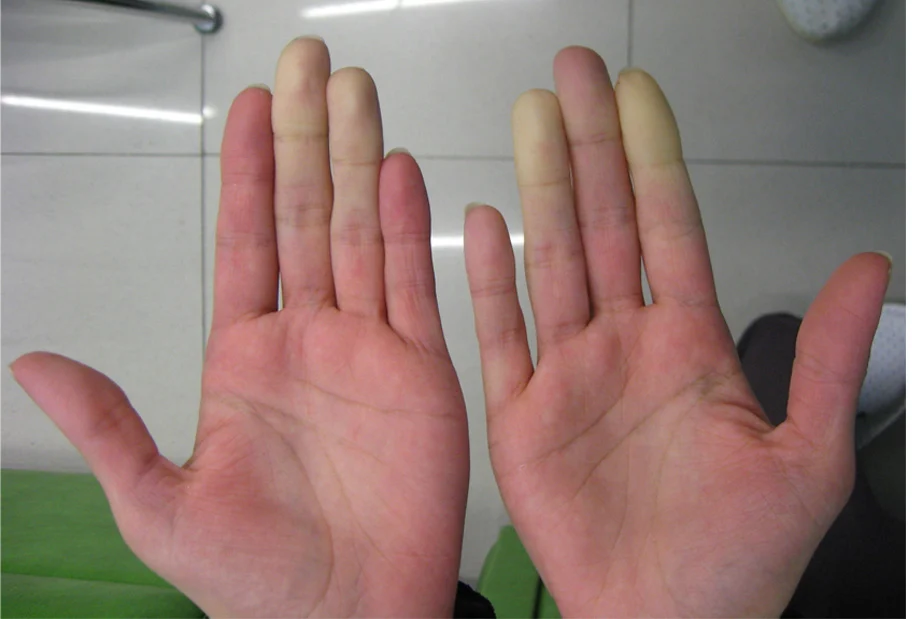
CCOHS is explicit that hand-arm vibration symptoms are aggravated when the hands are exposed to cold. Vibration constricts the small vessels in the fingers; cold does the same thing. Stack them and you get the classic presentation much faster.
Calgary gives you that stack for a large part of the working year, and concrete removal does not stop for it. A crew breaking out a driveway apron in late October, bare-handed for grip, with a metal chisel pulling heat out of the palm, is running two hazards at once. The controls are unglamorous and they work: insulated gloves that still allow grip, a genuinely warm break area, hot drinks, and rotation planned around the cold rather than around lunch.
If you are planning removal work into the shoulder season, the sequencing in our guide to concrete removal and disposal in Calgary applies to the crew’s hands as much as to the bin schedule.
What the damage looks like, in the clinic’s own language
Hand-arm vibration syndrome is graded on the Stockholm Workshop scale, and it is graded twice — once for the blood vessels, once for the nerves.
Vascular (vibration-induced white finger):
| Stage | Description |
|---|---|
| 0 | No attacks |
| 1 (mild) | Occasional attacks affecting only the tips of one or more fingers |
| 2 (moderate) | Occasional attacks affecting the fingertips and middle of the finger |
| 3 (severe) | Frequent attacks affecting all parts of most fingers |
| 4 (very severe) | As stage 3, with skin changes in the fingertips |
Sensorineural:
| Stage | Description |
|---|---|
| 0SN | Exposed to vibration but no symptoms |
| 1SN | Intermittent numbness, with or without tingling |
| 2SN | Intermittent or persistent numbness, reduced sensory perception |
| 3SN | Intermittent or persistent numbness, reduced tactile discrimination |
CCOHS notes that it may take a few months to several years for symptoms to become clinically noticeable. That lag is the whole management problem. Nothing on the job tells you it is happening. By the time a worker reports stage 2 numbness, the exposure that caused it is years in the past and cannot be undone by a change in method today.
It is also why the ACGIH figure is framed as the level at which most workers should not progress beyond stage 1. The guideline is a line drawn through a population, not a safety line — people vary in susceptibility, and CCOHS says so directly.
A workable standard of care for a Calgary concrete crew
Put together, the defensible position looks like this:
- Name hand-arm vibration in the Part 2 hazard assessment for any scope involving breakers, hand-held saws, grinders or plate compactors.
- Record the guideline figures you are working to, and cite the source beside them.
- Estimate trigger time per worker per day — measured once, not assumed.
- Choose the method that lowers trigger time before you choose PPE.
- Build cold-weather hand warmth into the plan from October onward.
- Give workers a way to report numbness and tingling that does not cost them the job, and act on the first report.
Across 52,000+ projects, the pattern we see is that the crews with the least vibration exposure are not the ones with the best gloves. They are the ones who cut instead of break, who rotate, and who own the right machine for the area.
Where this page stops
This page is about hand-arm vibration: the magnitude figures, trigger time, and the Part 2 obligation. It is not about whole-body vibration from operating equipment, which is assessed differently. It is not about respirable dust from cutting or breaking concrete, which is a separate hazard with its own Alberta requirements. It is not about noise exposure or hearing protection, and it is not about the community noise rules that govern what hours a crew may work. Each of those is its own assessment, and none of them substitutes for this one.
Planning a removal or cutting scope in Calgary?
Method selection is where vibration exposure is won or lost, and it is a decision made at quoting, not on site. If you have a slab, driveway, apron or structural opening to deal with, talk to us about the approach before the schedule is fixed — see our concrete removal services in Calgary, or send the drawings and we will come back with a method, a sequence, and an honest estimate of how many hours anyone spends holding a running tool.
Frequently asked questions
Does Alberta have a legal hand-arm vibration exposure limit? No. The Alberta OHS Code contains no numeric exposure limit for hand-arm vibration. The obligation comes from Part 2 of the Code — identify the hazard, involve workers, eliminate or control it.
What number should we put in our hazard assessment then? Either the scaled ACGIH table published in Alberta’s own Best Practices – Vibration at the Work Site (4 m/s² for 4 to 8 hours, up to 12 m/s² for under an hour) or the CCOHS framing of 5 m/s² as an eight-hour equivalent with a 2.5 m/s² action level. Cite whichever you use.
How much vibration does a jackhammer produce? Alberta’s guidance puts jackhammers in the range of about 5 to 20 m/s², averaging around 12 m/s² in manual use. At that magnitude the Alberta table allows under one hour of trigger time per day.
Do anti-vibration gloves fix the problem? No. They are a supplementary control. The measures that materially reduce exposure are changing the method, rotating workers, using machine-mounted breakers, repositioning the tool every 8 to 10 seconds, and keeping hands warm.
Why does this matter more in winter here? CCOHS states that hand-arm vibration symptoms are aggravated by cold exposure. Calgary’s climate stacks cold hands on top of vibration for much of the concrete season, which is why hand warmth is treated as a control and not a comfort.
Sources
- Government of Alberta, Best Practices – Vibration at the Work Site — https://open.alberta.ca/dataset/e5df2d17-e381-4ab7-b238-eacfbdf548c6/resource/06781b84-b253-4ff1-aa09-fba132811e0e/download/whs-pub-gs007.pdf
- CCOHS, Vibration – Measurement, Control and Standards — https://www.ccohs.ca/oshanswers/phys_agents/vibration/vibration_measure.html
- CCOHS, Vibration – Health Effects — https://www.ccohs.ca/oshanswers/phys_agents/vibration/vibration_effects.html
- Alberta OHS Code, Part 2 — Hazard Assessment, Elimination and Control — https://search-ohs-laws.alberta.ca/legislation/occupational-health-and-safety-code/part-2-hazard-assessment-elimination-and-control/