

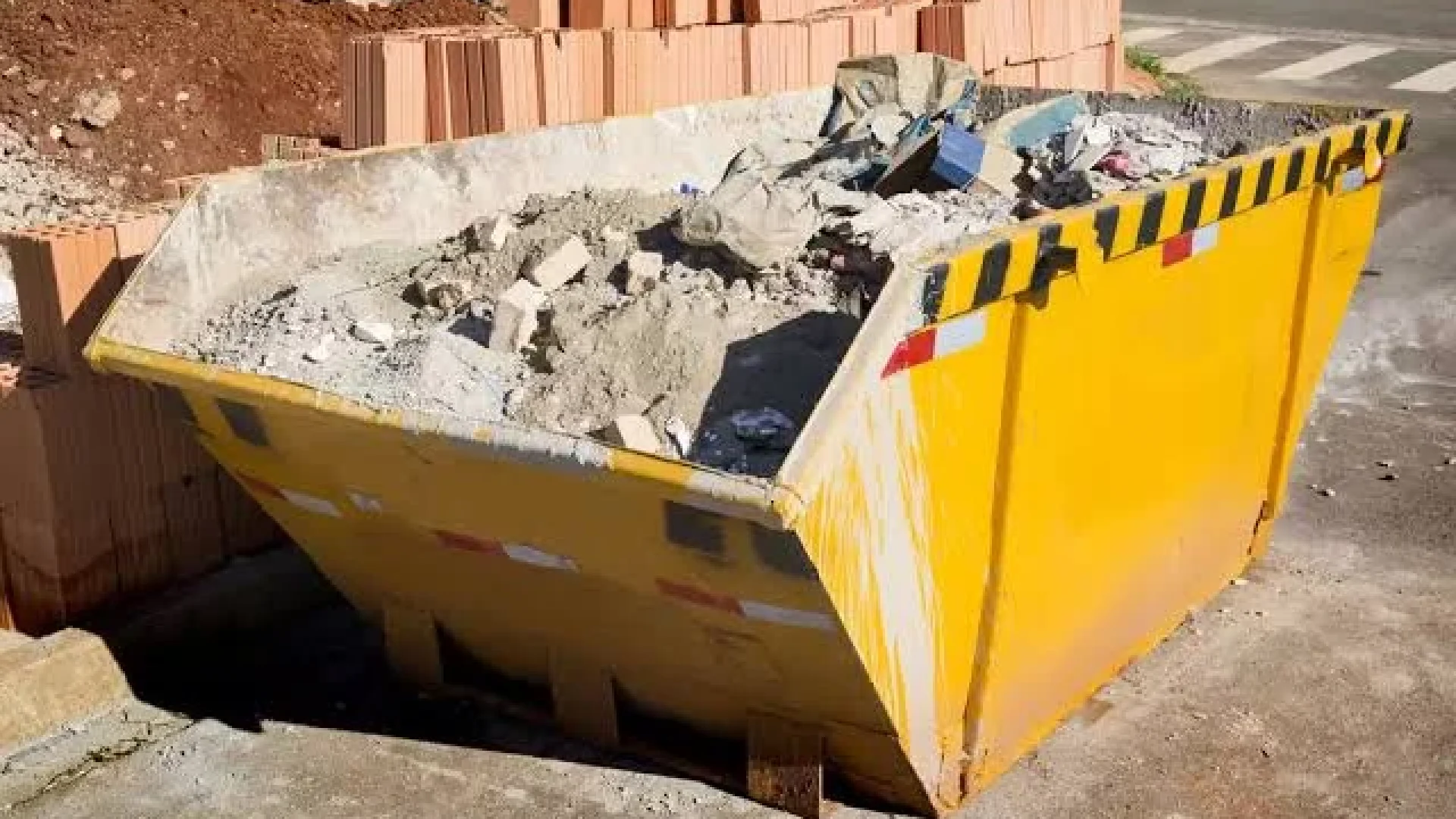
Most of the cost in a concrete removal job is not the breaking. It is the hauling and the gate fee at the other end. A crew can break a double garage pad in a morning; moving the twenty-odd tonnes that used to be a garage pad, and paying to put it somewhere, is the part that swings a quote by thousands of dollars.
Tear-out is usually priced last and thought about least. It arrives on the schedule as one line — “remove existing” — and nobody interrogates it until the bins are on site and the numbers stop matching. After 38 years of working in Calgary, we have found that the removal line is where a tight project most often goes soft.
Here is what actually drives it.
What concrete removal and disposal includes
Removal is four separate operations, and a quote that does not separate them is hiding something.
- Breaking. Hydraulic hammer on an excavator or skid steer for anything over a few square metres; handheld breakers for tight or interior work; saw cutting first where the break has to stop at a clean line.
- Separating. Pulling rebar, mesh and embedded steel out of the rubble, because steel changes where the material can go and what it costs to drop off.
- Hauling. Bins or tandem trucks, priced by weight far more than by volume.
- Disposal. The gate fee at a landfill or a recycler — the line most quotes bury.
Only the first one looks like demolition. The other three are logistics, and they are where the money is.
Where the material goes, and why that line moves the price most
Concrete does not belong in a City of Calgary landfill, and the City prices it accordingly.
The City states directly that “recycling of road asphalt, brick, masonry brick and concrete is not available at City landfills,” and that loads mixed with those materials are charged the Disposal Surcharge Rate — $180 per tonne, against a basic sanitary rate of $113 per tonne. The surcharge kicks in when a load contains 10 per cent or more of construction and demolition material, and commercial vehicles are subject to random inspection: staff can flag a truck to a designated area before it empties and make the call on the spot.
A dedicated concrete recycler charges a different order of magnitude. Calgary Aggregate Recycling lists $10 per tonne for concrete rubble, brick and mortar, paving stone and cinder block, $7 per tonne for asphalt rubble, and $60 per tonne for rebar taken separately, with a flat $50 plus GST for loads under four tonnes.
Ten dollars a tonne against a hundred and eighty. On twenty tonnes of slab, that single routing decision is the difference between roughly $200 and roughly $3,600 in gate fees. It is the cheapest decision on the job and the one most often made by whoever happens to be driving.
Two practical consequences follow:
- Keep the concrete clean. A bin of broken slab with form lumber, poly and drywall offcuts thrown on top is no longer a clean rubble load. It is a mixed C&D load, and it gets priced like one.
- Ask where your removal contractor tips. “Disposal included” is not an answer. The recycler’s name is an answer.
How much material are you actually moving?
Contractors price bins by the box; the gate prices by the scale. Concrete fills a weight limit long before it fills a volume.
Worked example, round numbers: normal-weight concrete runs about 2.4 tonnes per cubic metre. A 100 mm (4 in.) slab is 0.1 m³ per square metre, so roughly 240 kg for every square metre of slab.
| Slab | Approx. area | Approx. volume | Approx. weight |
|---|---|---|---|
| Single driveway, 100 mm | 40 m² (430 ft²) | 4.0 m³ | ~9.6 t |
| Double garage pad, 100 mm | 60 m² (650 ft²) | 6.0 m³ | ~14.4 t |
| Small commercial apron, 150 mm | 80 m² (860 ft²) | 12.0 m³ | ~29 t |
Those are arithmetic on a round density figure, not quoted prices — but they are the right order of magnitude, and they explain why a 20-yard bin that would swallow a house full of framing waste is full of concrete at a quarter of its volume. Price removal in tonnes. Bins are the container, not the unit.
Rebar, mesh and what makes a slab expensive to break
Two slabs of identical size can differ by half again in removal cost, and the difference is usually inside the concrete.
- Plain 100 mm flatwork breaks fast and loads clean.
- Mesh-reinforced flatwork holds together in mats. The hammer breaks it; the crew still has to cut the mesh to make pieces a machine can lift.
- Rebar-reinforced structural slabs, grade beams and footings are a different job. Steel has to be cut, and the rubble has to be sorted if you want the recycler’s clean-concrete rate.
- Post-tensioned slabs are not a demolition question at all until an engineer has looked at them. Cutting a live tendon is a safety event, not a cost overrun.
Thickness matters less than people expect and reinforcement matters more. If nobody knows what is in the slab, a few core holes or a saw cut at the edge will tell you before the bins are ordered rather than after. Where the removal is partial rather than total, the boundary between what stays and what goes needs to be cut, not broken — we walk through that in detail in our guide to cutting openings in an existing concrete slab.
Load bans: the six weeks that reshape your schedule
This is the Calgary-specific item that out-of-town estimators miss.
The City of Calgary applies seasonal load bans on restricted roadways, with spring bans running March 15 to May 15. Restricted roads are posted with signs showing the required axle weight reduction as a percentage of licensed axle weight — the City’s levels are 50 per cent, 75 per cent and 90 per cent. A load ban permit is required for a gross vehicle weight over 5,000 kg on restricted roads, and carriers remain responsible for obtaining every permit needed to move overweight loads.
Concrete debris is the densest material most construction trucks carry. During a 75 per cent ban, a hauler is not making the same number of trips with the same trucks — which means either more trips, smaller loads, or a start date after May 15.
If your tear-out lands in that window, decide deliberately. Sometimes the right answer is to break and stockpile on site in March and haul in late May. Sometimes the right answer is to pay for the extra trips because the pour date will not move. Either is fine. Discovering it in week two is not, and it is exactly the kind of sequencing gap we describe in eight concrete coordination failures that delay projects.
Access, stockpiling and the site conditions that stall a tear-out
- Machine access. A slab a machine can reach comes out in hours. A backyard pad behind a 900 mm gate comes out by hand, in buckets, and the labour line triples.
- Stockpile room. Space to pile broken concrete between the hammer and the truck decouples the two operations. On a tight infill lot with none, the excavator waits on the hauler all day.
- What is under the slab. Shallow services, weeping tile and the odd abandoned cistern all turn up under old flatwork. Locates are cheap. A hammered gas line is not.
- Adjacent structures. Breaking hard against a neighbouring foundation, garage wall or public sidewalk means saw cutting a relief line first and taking the last metre carefully.
- Reuse on site. Clean crushed concrete makes serviceable sub-base fill. Where the grading plan allows it, crushing on site removes both the haul and the gate fee — worth asking before the first bin is ordered.
What belongs on the removal line in a quote
A defensible concrete removal and disposal price in Calgary shows its work. Ask for:
- Estimated tonnage, not just square footage
- The disposal destination and the rate per tonne at that gate
- Whether rebar separation is included or extra
- Saw cutting where partial removal needs a clean edge
- Bin or trucking count and what happens if the tonnage runs over
- Load ban exposure if the work falls between March 15 and May 15
- Locates and site protection
- What happens to the sub-base — recompacted, replaced, or left for the next trade
That list is the removal equivalent of the thinking in our piece on the line items that should be on a Calgary foundation quote. A quote that answers all eight is usually from someone who has done it before. A single-line “demo and dispose” price is a number someone is planning to revisit.
Frequently asked questions
How much does concrete removal cost in Calgary? It is priced by tonnage, access and disposal routing rather than by a flat square-foot rate. The two biggest variables are reinforcement (plain flatwork versus rebar-reinforced structural concrete) and where the material is tipped — $10 per tonne at a concrete recycler versus a $180-per-tonne disposal surcharge at a City landfill for loads containing 10 per cent or more C&D material.
Can I put broken concrete in a regular bin with other demolition waste? You can, and it will cost you. The City of Calgary applies its disposal surcharge to loads containing 10 per cent or more construction and demolition material. Keeping concrete in its own clean load is what keeps it eligible for recycler pricing.
Does rebar have to come out? For clean-rubble recycler rates, yes — and rebar is accepted separately, at $60 per tonne at Calgary Aggregate Recycling. Steel left in the load either downgrades the load or gets handled at the gate at the operator’s discretion.
Do load bans really affect concrete hauling? Yes. Spring bans run March 15 to May 15 in Calgary, posted at 50, 75 or 90 per cent of licensed axle weight, with permits required above 5,000 kg GVW. Concrete is dense enough that axle limits bind before the box is full.
Can broken concrete be reused instead of hauled away? Sometimes. Crushed clean concrete works as sub-base on many sites, which removes both the haul and the gate fee. It depends on the grading plan, the geotechnical requirements and the space to crush. Ask early — it is one of the few decisions that can take an entire line off the budget.
Before you price the pour, price the tear-out
Removal is the first line on the schedule and the one most likely to be a guess. Across more than 52,000 projects in this city, the jobs that stayed on budget were almost always the ones where the tear-out was measured in tonnes, routed to the right gate, and scheduled around the load ban calendar before anyone talked about pour dates.
If you have an existing slab, foundation or commercial pad that has to come out, talk to our concrete removal team with your drawings or a few photos of the edge conditions. We will tell you what is in the slab, what it weighs, where it should go, and what that means for your start date — before it becomes a change order.
Sources
- City of Calgary — Landfill commercial materials and rates: https://www.calgary.ca/for-business/operations/landfill-commercial-rates.html
- City of Calgary — Disposal Surcharge Inspection Program: https://www.calgary.ca/for-business/operations/waste-disposal-surcharge-materials.html
- City of Calgary — Overweight and Load Ban permit: https://www.calgary.ca/roads/permits/overweight-load-bans.html
- Calgary Aggregate Recycling — Dispose and Recycle rates: https://calgaryaggregate.com/dispose-recycle/