

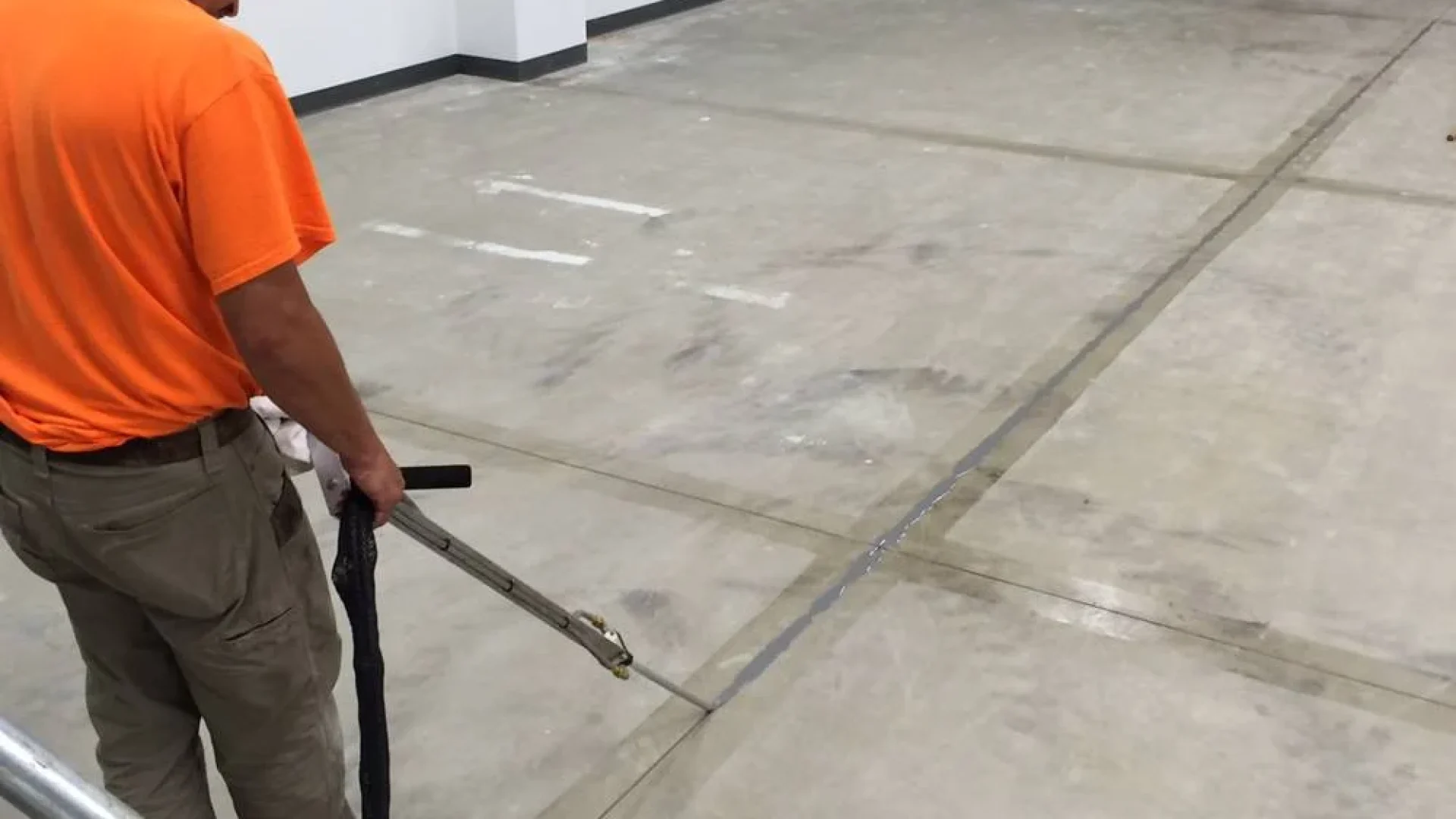
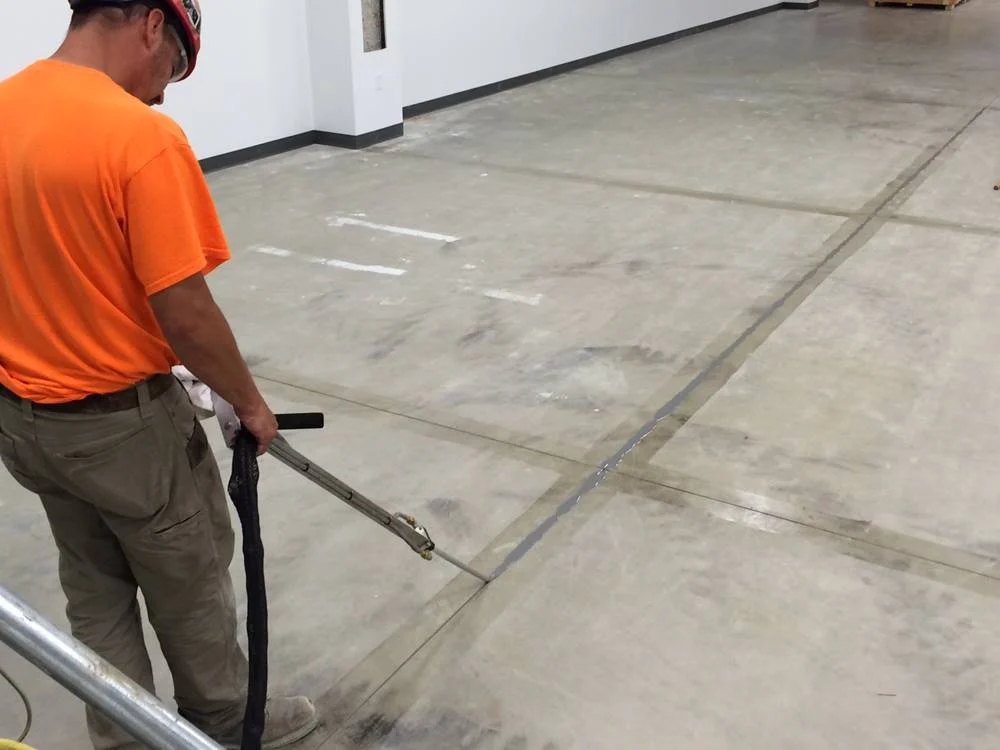
If a slab will carry forklifts, the joints need a semi-rigid filler — not a flexible sealant — and it should go in as late as the schedule allows, not as soon as the floor is walkable. Those two decisions, made months apart, account for most of the joint damage we get called back to look at in Calgary warehouses and shop floors.
The material itself is not complicated. What makes this expensive is that the right answer fights the construction schedule. Occupancy wants the floor finished. The slab wants another three months to shrink. Whoever resolves that tension decides whether the joint edges are intact in year five.
After 38 years pouring concrete in Calgary, we have watched this line item get value-engineered more often than almost anything else on a floor package.
A filler and a sealant are not the same product
A semi-rigid filler exists to support the joint edge. A sealant exists to keep water out. They are asked to do opposite things, and swapping one for the other is the single most common error on an industrial floor.
ACI 302.1R is direct about the distinction. Its guidance is that “contraction and construction joints in floor areas subject to the hard wheels of material-handling vehicle traffic should be filled with a semi-rigid filler to minimize wear and damage to joint edges.” Where the environment is wet or there are hygienic requirements, the same guide sends you the other way: “joints should be sealed with an elastomeric liquid sealant or a preformed elastomeric device.”
So the question is not “what do we caulk the joints with.” The question is what the joint has to survive:
| Condition | What the joint needs | Why |
|---|---|---|
| Forklifts, pallet jacks, hard polyurethane or steel wheels | Semi-rigid epoxy or polyurea filler | The filler carries the wheel across the gap so the edge is never struck |
| Wash-down bays, food handling, hygienic areas | Elastomeric sealant, often with backer rod | Movement and water exclusion matter more than edge support |
| Exterior slab, freeze-thaw exposure, no hard-wheel traffic | Elastomeric sealant | Water and ice are the enemy, not wheel impact |
| Isolation joints at columns and walls | Compressible filler, never a rigid product | These joints must be free to move |
A soft sealant in a forklift aisle compresses under the wheel, the wheel drops into the gap, and it strikes the far edge on the way out. That is what spalling is. It is not a concrete quality problem — it is a joint asked to do a job its material could not do.
We cover the general joint types and why they exist in our guide to expansion and control joints in concrete. This article picks up where that one stops: what goes into the joint once the traffic is hard-wheeled.
The hardness number worth putting in the specification
Specify Shore A hardness, tested to ASTM D2240, and make the number explicit. This is the clause that separates a filler that supports the edge from one that does not.
The long-standing recommendation, as summarised by joint filler specialists writing for the industry, is that joints “should be filled with a semi-rigid epoxy or polyurea joint filler having a Shore A hardness of A80 or higher per ASTM D 2240.” That same source notes the direction of travel: “current draft revisions of these documents revise this recommendation to an increased filler hardness of A85+.” Manufacturer guide specifications for heavy industrial floors are now commonly written at “90 or greater.”
The sources are not perfectly aligned — A80, A85 and A90 all appear in current industry documents, depending on vintage and on who wrote them. That disagreement is real and worth naming rather than papering over. The practical rule that resolves it is the one the same specialists give: the Shore A hardness of the joint filler should be equal to or greater than the Shore A hardness of the wheels crossing the joints.
That rule is useful because it is checkable. Ask the tenant what equipment is going on the floor, get the wheel durometer from the lift truck supplier, and specify at or above it. A tenant running small hard-wheeled electric pallet jacks is a harder service condition than an open shop floor with pneumatic-tired equipment, even though the second building looks heavier.
One more number belongs in the same conversation: joint deflection. The industry guidance is that “anything over .020 could lead to joint deterioration issues.” If the joints in an existing floor already deflect beyond that under load, filler alone is not the repair — the load transfer across the joint has failed, and that is a structural conversation, not a materials one.
Filling early is the most expensive shortcut on the floor package
Wait as long as the schedule can stand. Every day of delay is free performance.
Concrete keeps shrinking long after it is strong enough to walk on. A joint filled at 14 days is filled at a width the joint will not keep. As the slab shrinks further the joint opens, and the filler either tears or lets go of one face — leaving a gap with an unsupported edge, the exact condition the filler was bought to prevent.
The industry guidance clusters, with some spread:
- Technical guides recommend installing joint filler “as late as possible (60-90 days following new slab placement) to maximize shrinkage of the slab.”
- Manufacturer guide specifications are firmer at the low end and more ambitious at the high end: “at a minimum slab cure time should exceed 28 days per ACI 302,” with a recommended “90-120 day slab cure,” and installation deferred until after the building’s HVAC is running.
The HVAC condition matters more in Calgary than the calendar does. A slab in a building that has not yet been heated has not finished the drying shrinkage it will see once the makeup air units run through a first winter.
Here is the practical sequence for a Calgary project:
- Pour and saw the slab. Control joints go in on time; that timing is driven by the concrete, not by the filler.
- Leave the joints open through construction. They will collect debris, which is expected and cleaned out later.
- Get the building closed in and the heat on. Let the slab dry under something resembling service conditions.
- Fill at 90 days or later if the schedule permits, and not before 28. If occupancy forces an earlier fill, say so in writing and price the touch-up.
- Budget a re-fill pass. Even a well-timed fill will show some separation at joint faces in the first year.
That last point is worth negotiating up front. Some separation after the first heating season is normal behaviour, not a defect, and a project that has agreed on that in advance does not spend the winter arguing about it.
Depth, width and the backer rod mistake
Fill the full depth of the saw cut. Do not put compressible material underneath it.
This is where a lot of otherwise correct specifications get undone on site, because backer rod is cheap, it makes the joint take less material, and the crew may have done it that way on a sealant job last month.
The guidance is unambiguous. Technical guides state that “control joint fillers should be installed at full depth in the saw-cut control joints and a minimum of 2″ in joints greater than 2″ deep,” and warn plainly: “Do not use a compressible backer rod to reduce volume.” Manufacturer specifications say the same thing in stronger language — compressible foam backer rod is prohibited in saw-cut control joints less than 2 inches deep, and permitted only in through-slab construction joints at a minimum depth of 2 inches.
For reference, a typical guide specification describes cleaning saw-cut joints to their full original depth as “typically 1 ¼ – 1 ½” in a 6″ slab, 2″ in an 8″ slab.”
Width follows the same logic. ACI 302.1R’s guidance is that “joints should be as narrow as possible to minimize damage due to wheels loads while still being wide enough to be properly filled.” Narrow joints are better for the wheels and worse for the applicator, and the balance point is a conversation to have with whoever is doing the work — not a number to invent on a drawing.
For construction joints, ACI 302.1R also notes they “should be saw-cut 1 in. (25 mm) deep before filling,” giving the filler a clean, square reservoir rather than whatever profile the bulkhead left behind.
What Calgary adds to the problem
Two local conditions change the calculus, and neither appears in a manufacturer datasheet written for a milder climate.
Unheated and partially heated buildings. A cold storage building, an unheated equipment shop or a warehouse heated only to keep pipes from freezing puts the slab through a far wider annual temperature swing than a conditioned distribution centre. Joints in those floors open wider in January than the filler was installed to span. That argues for the harder end of the hardness range and the longest practical delay before filling.
Swing-season repair timing. When joints need remedial work, timing matters. The industry advice is that “repairs should optimally be performed midway through humidity and temperature cycles, typically spring or fall,” so the joint is caught near the middle of its range rather than at an extreme. In Calgary that maps to April–May and September–October, and it argues against scheduling joint remediation during a January shutdown just because the building is quiet.
Neither is a reason to specify something exotic. They are reasons to protect the schedule allowance and resist filling early.
Where this sits in the floor package
Joint filling is usually the last line on a floor scope and the first squeezed when the schedule slips. It is worth defending: spalled joint edges get ground and patched repeatedly, and each repair is wider than the last.
If you are specifying or pricing a floor where this matters, the neighbouring decisions are worth settling at the same time. We have written separately about comparing high-traffic flooring options, about floor flatness FF/FL numbers, and about sizing commercial concrete pads.
Across 52,000+ projects, the pattern on industrial floors has been consistent: the buildings where joints are still tight a decade later are the ones where somebody protected the fill date. It is a small line item with a long tail.
If you are planning a warehouse, shop or distribution floor in the Calgary area and want the joint detail sorted before it becomes a change order, talk to our commercial concrete team. We would rather have the conversation at the specification stage than at the callback.
Frequently asked questions
Can we just caulk the control joints in a warehouse floor? Not if forklifts or other hard-wheeled equipment will cross them. A flexible sealant compresses under the wheel and leaves the joint edge unsupported, which is the mechanism that causes spalling. Semi-rigid epoxy or polyurea fillers support the edge instead.
How long after pouring should joints be filled? Industry guidance ranges from a minimum of 28 days to a recommended 90–120 days, with technical guides commonly citing 60–90 days. Later is better because the slab is still shrinking. Where possible, fill after the building is closed in and heated.
What Shore A hardness should we specify? Current industry documents cite A80, A85 and A90 depending on vintage. The governing principle is that the filler should be at least as hard as the wheels crossing it, tested to ASTM D2240.
Is it normal for joint filler to separate after the first winter? Some separation at the joint face in the first year is common as the slab completes its shrinkage, particularly in buildings with wide temperature swings. It is usually addressed with a remedial pass rather than full replacement.
Do isolation joints get the same filler? No. Isolation joints at columns and walls are designed to move, so a semi-rigid filler is the wrong product there. Those joints take a compressible material.
What if the joints are already spalled? Repair the edges first, then fill. If the joints also deflect under load beyond roughly 0.020 in., load transfer has failed and filler will not fix it — that needs an engineering assessment.
Sources
- ACI 302.1R-15, Guide to Concrete Floor and Slab Construction, Chapter 5 — https://www.concrete.org/Portals/0/Files/PDF/302.1R-15_Chapter5.pdf
- “Understanding Spalled Concrete Joints,” Metzger McGuire via For Construction Pros — https://www.forconstructionpros.com/concrete/concrete-repair/article/22939848/metzgermcguire-understanding-spalled-concrete-joints
- Metzger McGuire guide specification, Section 07 92 16, Rigid Joint Sealants / Concrete Floor Joint Filling — https://metzgermcguire.com/wp-content/uploads/2020/05/07-92-16-Rigid-Joint-Sealants-Concrete-Floor-Joint-Filling-EDGE-PRO-90-2020.pdf
- “Mastering Control Joint Filling in Industrial Concrete Floors,” SpecChem — https://specchem.com/resources/mastering-control-joint-filling-in-industrial-concrete-floors-a-complete-guide/