

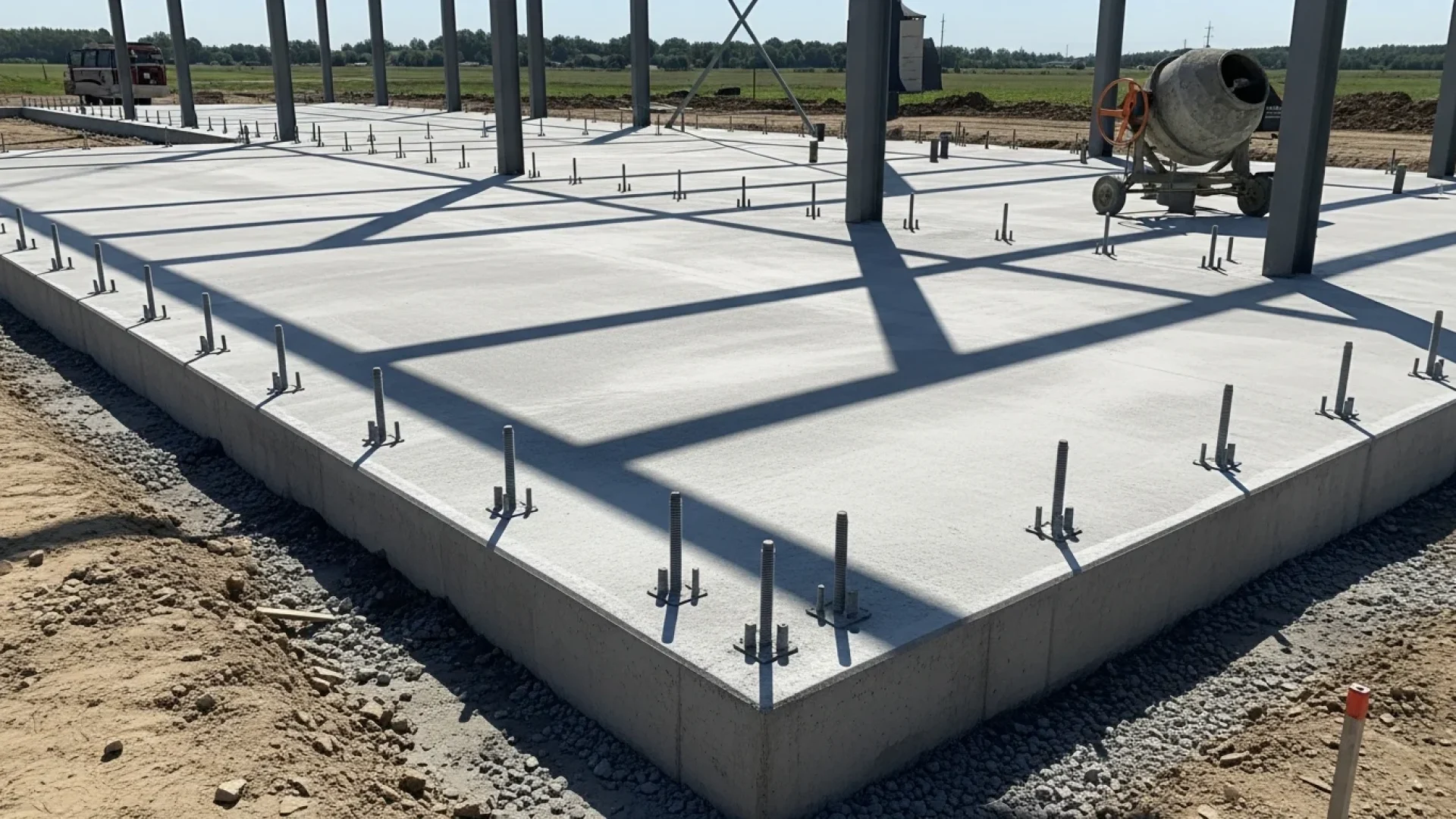
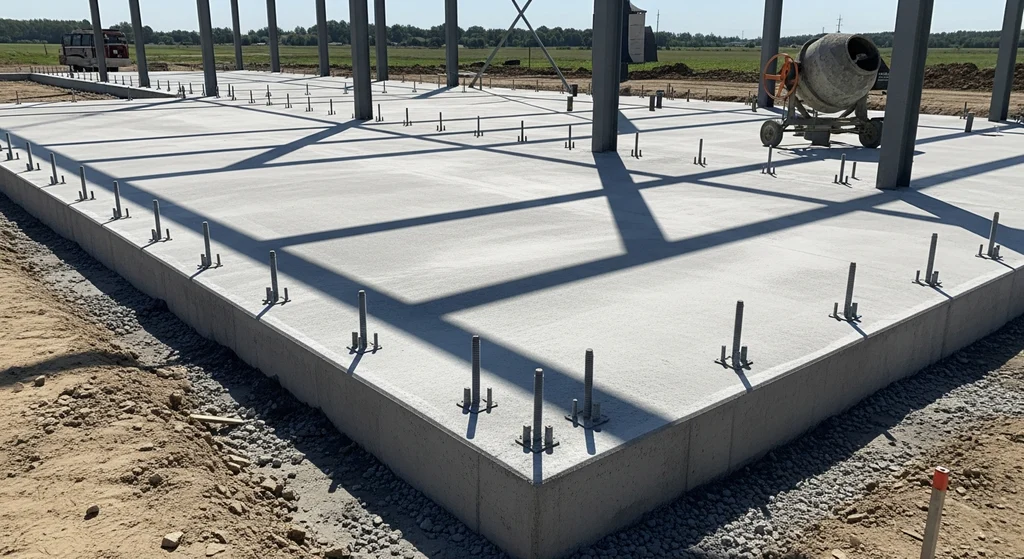
A commercial concrete pad in Calgary is not a bigger version of a garage pad. It is a small piece of pavement with a job description: carry a loaded truck, drain in every direction, and survive roughly sixteen freeze-thaw cycles a winter with de-icing salt sitting on it. Get the load and the subgrade right and the pad outlives the tenant. Get them wrong and you are saw-cutting and repouring inside five years, usually in the one corner where the truck turns.
After 38 years pouring concrete in Calgary, we have found that most pad failures are decided before anyone opens a bag of cement — in four choices: what the pad carries, what it sits on, how it drains, and when in the year it goes in. Here is how we work through those four before a number goes on a quote.
What counts as a commercial pad
A commercial pad is any slab-on-ground that carries wheel loads, stationary equipment, or a service vehicle rather than foot traffic and a parked car. In practice that covers:
- Waste and recycling enclosure pads and the approach apron in front of them
- Loading dock aprons and truck manoeuvring areas
- Equipment pads — generators, transformers, chillers, rooftop units at grade, compressors
- Bin, laydown and storage pads on industrial yards
- Shop and warehouse floor extensions poured outside the building line
- Fleet parking and wash pads
They look like flatwork. They behave like pavement. That distinction is the whole article — and it is why a pad priced like a patio comes back as a warranty call.
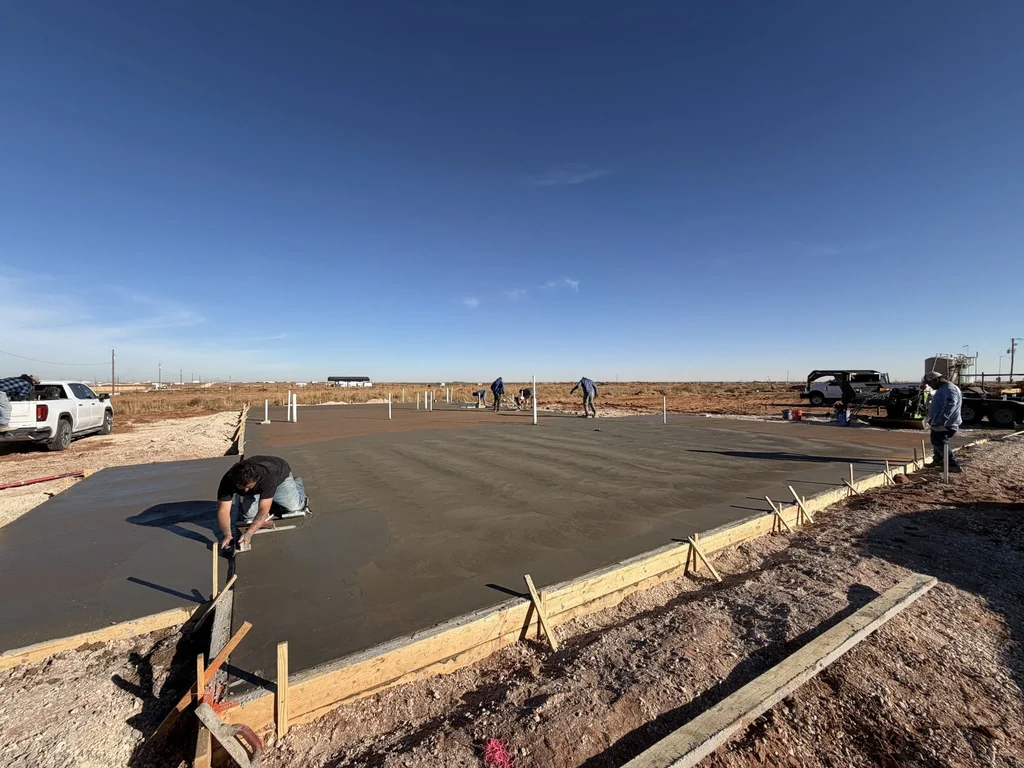
Decision 1: Start with the load, not the square footage
Price the pad from the heaviest thing that will ever sit or turn on it, not the average. A pad sized for a delivery van and then used by a three-axle collection truck does not fail gradually — it cracks at the edge on the first hard turn.
Calgary gives you a hard number to design against for waste areas. The City’s Design Standards for the Storage and Collection of Waste (DPS-STDRD-0002) requires that all concrete and asphalt pads, aprons, approach areas and parking structures serving collection support a minimum weight of 25,000 kg — the weight of a loaded collection vehicle. That requirement repeats through the multi-residential, commercial and mixed-use sections of the standard. If your site is getting City or contracted collection, that figure is not a target. It is a condition of service.
For everything else, we ask three questions:
- What is the heaviest axle, and how often? A loaded forklift drives far more load through a small, hard contact patch than a pickup does through four tires.
- Where does it turn? Turning and braking loads concentrate at slab edges and corners. ACI’s guide for commercial parking lots and site paving (PRC-330) is explicit that stresses are highest near a free edge, and that loads travelling near an edge need further design attention. Nearly every pad we are called back to look at has failed at an edge, not in the middle.
- Is anything stationary and heavy? A transformer or a bin sitting in one spot for ten years is a different problem than traffic. It is a bearing problem, and it belongs to the subgrade.
Decision 2: The subgrade decides more than the slab does
A pad is only as good as the ground and base underneath it. You can add concrete thickness all day and still get a broken pad if it is sitting on uncompacted fill or reactive clay.
Calgary’s soils are not uniform across a quarter section, let alone across the city. Much of the area sits on glacial till and lacustrine clay that swells when wet and shrinks when dry, and industrial sites are frequently built on engineered fill of unknown history. That is why we treat the geotechnical report as a construction document rather than a formality — what your soil report is actually telling your crew usually changes the base build-up before it changes the slab.
What we look for before pouring a commercial pad:
- Proof of compaction, not a promise of it. Density testing on the subgrade and on each lift of granular base. If nobody tested it, it is not compacted.
- A free-draining granular base. Well-graded crushed gravel, placed in lifts, compacted, and thick enough to break capillary rise from the clay below.
- Drainage out of the base, not just off the surface. Water trapped in the base under a Calgary winter is a frost lens waiting to lift a corner. This is the same mechanism that lifts detached garage slabs — we wrote up why garage slabs heave here, and the physics do not change because the slab got bigger.
- Where the pad meets a building. A pad butting a foundation wall needs to be free to move independently, or it will drag on the wall as it heaves. If the pad is tied into structure, the footing depth rules apply — see our note on how deep footings go in Calgary.
Decision 3: Thickness, reinforcement and joints are one decision, not three
Thickness, steel and joint spacing have to be chosen together, because each one changes what the others have to do.
Thickness follows the load and the support. Light-duty pads carrying passenger vehicles and foot traffic sit at the thin end of the range. Pads seeing loaded trucks, bins and equipment go substantially thicker, and pads at collection points and dock aprons are usually the thickest concrete on the site. ACI PRC-330 sets thickness by traffic category rather than by a single number, and that is the right way to think about it — a site can legitimately have three different pad thicknesses depending on where the trucks actually go.
Reinforcement does not stop concrete from cracking. It holds cracks tight, keeps load transferring across them, and stops a crack from becoming two slabs that rock under a wheel. On pads carrying repeated wheel loads, that load transfer is the point.
Joints are where you tell the pad where to crack. Cut them early, cut them deep enough, and lay them out so no panel ends up long and narrow and no joint dies into a re-entrant corner at a bollard or column. On a pad with bollards, drains and a bin enclosure, that layout takes ten minutes on paper and saves a random crack the building lives with forever.
Decision 4: Grade and drainage — the 2% that fails inspection
The City caps the grade where waste containers are stored, manoeuvred or collected at 2 per cent in all directions, and requires collection and staging areas to be flush with the adjacent alley, parking lot or roadway.
Those two requirements pull against each other on a sloped site, and that is where pads get designed badly. Two per cent is enough to drain if the pad is finished true, and not nearly enough to hide a low spot. Standing water on a pad in Calgary is not a nuisance — it is the ingredient that makes freeze-thaw damage possible. Add the chloride from de-icers and you have the exact combination that Dr. Muntasir Billah described to LiveWire Calgary when discussing the city’s aging concrete: salt water getting in and reacting with the chemistry of the concrete and the reinforcement.
The numbers behind that are worth knowing. The City of Calgary’s own climate projections put the historical baseline at 16.2 freeze-thaw cycles across December, January and February, rising to a projected 18.5 cycles by 2050. Every one of those cycles is a chance for water sitting in a low spot to expand inside the surface. A pad that drains completely gets far fewer of those chances than a pad that ponds.
Practical version: shoot the grades before the pour. Confirm the flush transition to the alley or lot. And if the site slope makes 2 per cent impossible where the drawings put the enclosure, move it now — not after the collection contractor refuses the site.
Sequencing: when the pad goes in changes what it costs
Commercial pads are usually the last concrete on a site and the first thing that gets squeezed when the schedule slips. That is how pads end up poured in late October with nothing budgeted for protection.
We schedule pads around three realities:
| Timing | What it means for the pad |
|---|---|
| Spring, on thawed and tested subgrade | Best case. Full curing window before the first freeze cycle. |
| Mid-summer | Watch evaporation and finishing windows on large open pours; plan crew size to the pour, not the other way around. |
| Late fall | Workable with protection, blankets and a placement plan. Costs more. Needs to be priced, not assumed. |
| Deep winter, unprotected subgrade | Avoid. You are pouring on ground that will move under the slab when it thaws. |
The other item people miss: a pad poured before the underground work is finished gets cut. Confirm conduit, drains, sleeves and bollard footings are in and inspected before anyone forms — the same discipline as our pre-backfill inspection checklist on the foundation side.
What belongs in the scope before you price it
If you are putting a commercial pad out for pricing, these are the lines that make quotes comparable:
- Design load — the heaviest vehicle or equipment, and whether it turns on the pad
- Whether the pad serves waste collection (and therefore the 25,000 kg standard)
- Subgrade condition, required compaction, and who tests it
- Granular base type and depth
- Slab thickness, reinforcement type and spacing
- Joint layout, including saw-cut timing
- Surface finish and slope, with the 2 per cent maximum called out where it applies
- Drainage: where the water goes, and what happens at the flush edge
- Bollards, curbs, thickened edges and any embedded items
- Cold or hot weather protection, priced rather than assumed
Quotes that answer all ten are pricing the same pad. Quotes that answer six are pricing risk you absorb later.
FAQ
How thick should a commercial concrete pad be in Calgary? It depends on the heaviest load and how well the subgrade is supported. Pads carrying only cars and foot traffic sit at the light end; pads carrying loaded trucks, bins or equipment are considerably thicker, and dock aprons and collection points are usually thickest. ACI PRC-330 sets thickness by traffic category rather than one universal number, which is why a single site often has two or three pad thicknesses.
What load does a garbage bin pad have to carry in Calgary? The City of Calgary’s Design Standards for the Storage and Collection of Waste require pads, aprons and approach areas to support a minimum of 25,000 kg, the weight of a loaded collection vehicle.
What is the maximum slope for a waste collection pad? Two per cent in all directions where containers are stored, manoeuvred or collected. Collection and staging areas also have to be flush with the adjacent alley, parking lot or roadway.
Can a commercial pad be poured in winter in Calgary? Yes, with planned protection and a tested subgrade — but the protection has to be priced into the job. What we avoid is pouring on frozen or untested ground, because the slab moves when that ground thaws.
Does a commercial pad need reinforcement? For anything carrying repeated wheel loads, yes. Reinforcement does not prevent cracking; it keeps cracks tight and keeps load transferring across them so the pad behaves as one slab.
Talk to a crew that has poured through 52,000+ projects
Most of what decides a pad’s life happens before the pour: the load you designed for, the base you compacted, the grades you shot, and the season you picked. Bring us the drawings and the geotechnical report and we will tell you which of the four is going to be your problem.
See our concrete pads work, or start with our commercial concrete contracting team if the pad is one line item in a larger site package.
Sources
- City of Calgary, Design Standards for the Storage and Collection of Waste (DPS-STDRD-0002): https://www.calgary.ca/content/dam/www/uep/wrs/documents/wrs-documents/development-reviews-design-standards-for-storage-and-collection-waste.pdf
- American Concrete Institute, ACI PRC-330: Commercial Concrete Parking Lots and Site Paving Design and Construction: https://www.concrete.org/store/productdetail.aspx?ItemID=33021&Language=English&Units=US_Units
- LiveWire Calgary, “Freeze-thaw and the long-term climate impacts on Calgary infrastructure,” reporting City of Calgary climate projections: https://livewirecalgary.com/2023/02/24/freeze-thaw-and-the-long-term-climate-impacts-on-calgary-infrastructure/