

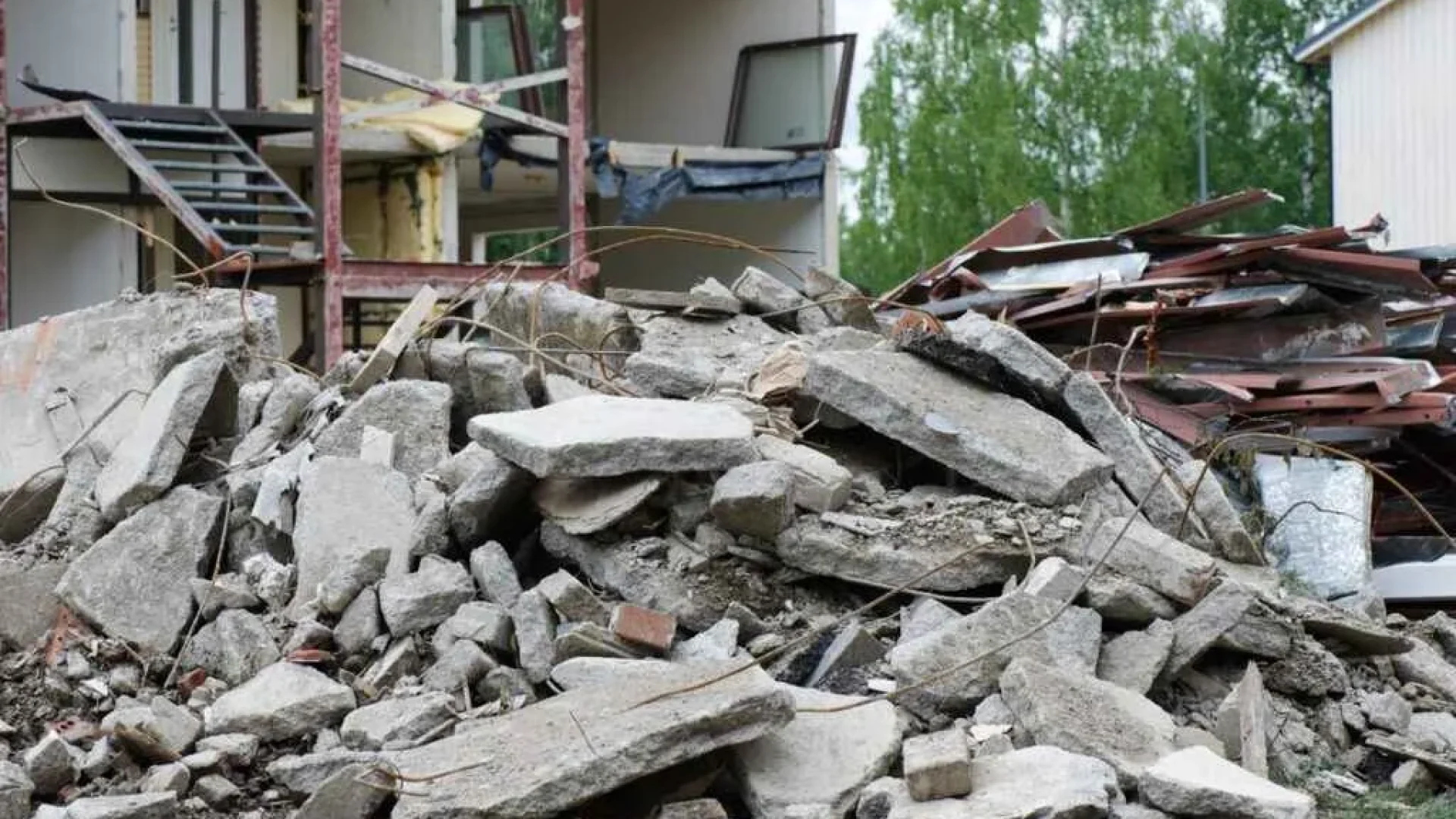
Three separate pieces of law govern a concrete demolition in this province. Alberta’s Occupational Health and Safety Code Part 30 governs how the work is done. The City of Calgary governs whether you may start. The National Fire Code – Alberta Edition governs a document most estimators have never heard of.
Tear-out gets priced as a line item and scheduled as a day. After 38 years of doing this work in Calgary, we have found the demolition line is where a tight schedule most often goes soft — and it is almost never the breaking that holds it up. It is a signature, a disconnection confirmation, or a report nobody budgeted for.
The short version: four things have to exist before anyone swings
Four documents need to be in hand before demolition begins on a concrete structure in Calgary, and each has a different author.
- A written hazard assessment by the employer, identifying chemical and biological hazards in the structure — and the hazardous material has to be removed before demolition, not managed during it.
- Written confirmation of service disconnection, available on site to workers and to an officer.
- A City of Calgary demolition permit, with a seven-day review target and a 180-day life.
- A customized fire safety plan, accepted in writing by the fire department and the authority having jurisdiction, before demolition operations commence.
Only the third one appears on most schedules.
Part 30 is eight sections long, and two of them set your sequence
The Code’s demolition part is short. Sections 415 through 422 cover the whole subject:
| Section | Subject |
|---|---|
| 415 | Worker in charge |
| 416 | Location of equipment |
| 417 | Hazardous substances |
| 418 | Use of explosives |
| 419 | Disconnecting services |
| 420 | Materials chute |
| 421 | Dismantling buildings |
| 422 | Building shaft demolitions |
Section 415 requires a competent worker designated by the employer to be in charge at all times while demolition work is in progress — a named person, not a crew. Section 416 keeps temporary offices and tool boxes out of reach of falling debris, which is a site-layout decision made before the trailer is dropped. Sections 417 and 419 are the two that move dates.
Hazardous substances: removal happens before demolition, not during
Section 417 obliges the employer to remove chemical and biological substances that could harm workers from the structure, or from the part being demolished, before demolition starts. The Part 30 Explanation Guide‘s examples are the ones you would expect on an older Calgary building: asbestos, lead paint, mercury, PCBs and mould.
Three points in that clause carry real cost.
First, a written hazard assessment is required before any demolition begins, covering both direct hazards — contact with lead paint, say — and indirect ones, such as dust. On a concrete structure the indirect hazard is the one that bites, and the controls are those we set out for silica dust control on concrete cutting.
Second, under Part 4, asbestos-containing material — one per cent or more asbestos by weight — has to be removed before demolition. Separately, a site becomes a restricted area if asbestos fibres may reach or exceed the occupational exposure limit, regardless of asbestos content. Two triggers, and the second does not care what the lab report says about percentage.
Third, the clause written for concrete: section 417(b) requires concrete with embedded facilities — conduits, pipelines — to be assessed, identified, located and marked under section 447. On a parkade deck, or any structure renovated twice, that is the difference between a controlled cut and a struck service. Same discipline as cutting openings in an existing concrete slab.
Disconnecting services: the confirmation has to be written, and on site
Section 419 requires electric, gas, water, steam, sewer and other service lines to be shut off, capped or otherwise controlled at or outside the structure before demolition begins. Utility companies should be notified in advance, and — the part crews miss — written confirmation of disconnection must be readily available at the site to workers and to an officer. Where a utility must stay live, it should be relocated or protected and every worker told where it runs.
The City’s permit process pushes the same requirement from the other direction: the application requires a signed service disconnection request form for water, electrical and gas, and the City is explicit that the time to obtain each utility’s signature depends on each utility provider. Which is to say, it is not a date you control.
This is the most common reason a demolition start slides in this city. The permit is not the bottleneck; the third signature is.
Tensioned cables and bars: the one case where the engineer stands on site
Section 421 runs demolition in reverse order of construction: consider whether a method could cause sudden collapse, whether a member supports something that is not coming down, and whether temporary struts, braces or shores are needed.
Then subsection 421(c) sets a different bar. Where tensioned cables or bars are involved, building design and construction information has to be obtained first, and the demolition procedures must be prepared and supervised by a professional engineer who is present at the work site.
Present. Not consulted, not retained, not available by phone.
That is why a post-tensioned slab is not a demolition question until an engineer has looked at it, and why it should never be priced as ordinary tear-out. We covered the cost side in what concrete removal and disposal actually costs in Calgary; 421(c) is the legal reason behind it. If post-tensioning is possible, the engineer’s attendance is a line item and a scheduling constraint, settled before the permit goes in.
Two rules close the part. Section 422 requires a free-standing scaffold where a shaft is demolished from the inside, because an anchored scaffold can be pulled down if the structure lets go. And section 420 — usually discovered after the chute is built — requires any materials chute steeper than 45 degrees from the horizontal to be totally enclosed, with workers kept out of the landing area by barricades or guardrails and warning signs posted nearby.
The Calgary demolition permit: what the application actually asks for
A demolition permit is required to demolish a building from a site, move a building, do a partial demolition, or reduce a building to its foundation and rebuild. It is generally not required for a detached residential garage — unless that garage is over 10 square metres and is independently serviced or carries the home’s primary utility meters.
What the application wants, beyond the obvious:
- A licensed demolition contractor named on the application
- Signed service disconnection request forms for water, electrical and gas
- An asbestos abatement form for houses built before 1990
- A public tree disclosure statement, required regardless of how close any public tree is, plus a tree protection plan if a public tree sits within six metres
- For buildings five storeys or greater, an advanced weather forecasting system and a public protection site safety plan
- A site plan, heritage planner review approved before issuance, a site contact sign on the fence, and professional stamps where the Building Code requires them
Review is targeted at seven days, which the City states is not a guarantee. The permit expires 180 days from issuance, with extensions available, and fees vary and are payable in full at application. One useful scoping detail: if services will only be shut off and nothing is demolished, no demolition permit is needed.
The fire safety plan nobody budgets for
This requirement surprises experienced contractors, because it comes from the Fire Code rather than from OHS.
Section 5.6 of the National Fire Code – Alberta Edition covers construction and demolition sites, and Article 5.6.1.3 requires a fire safety plan prior to the commencement of construction, alteration or demolition operations. It is prepared by the owner, developer or contractor responsible for the site, and must be accepted in writing by the fire department and the authority having jurisdiction — the Fire Safety Codes Officer. One plan covers the site; if circumstances change, it is modified and resubmitted for approval.
The plan designates site personnel for fire safety duties including a fire watch where applicable, sets out emergency procedures for raising the alarm and notifying the fire department, covers control of fire hazards around the building, and includes a maintenance procedure for the firefighting measures the section requires.
Here is the part that matters for pricing. Alberta’s interpretation sorts projects into three tiers: no plan under $5,000; a small-buildings template for projects over $5,000 that are housing, Part 9 buildings, unoccupied buildings, buildings under 600 square metres or three storeys or fewer; and a customized plan, submitted to the fire department for approval, for all demolition projects — along with occupied buildings, buildings over 600 square metres, and four storeys or more.
All demolition projects. No dollar threshold, no size exemption. A $12,000 slab-and-footing tear-out and a twelve-storey building sit in the same tier, and the authority having jurisdiction strongly recommends review before a demolition permit is issued.
What Part 30 did not get in 2023
Alberta published change-highlight bulletins when the 2022 Code took effect on 31 March 2023 — for Parts 11, 15, 16, 17 and 40, 33, 36 and 37, plus a miscellaneous amendments bulletin. Part 30 is not on that list, so the Explanation Guide’s reading of sections 415 to 422 still describes the obligations as they stand. In the other direction: section 418 sends explosive work to Part 33, and Part 33 did get a bulletin — so if explosives are involved, read that one rather than older guidance.
Where this article stops
This covers the approvals, assessments and documents that have to exist before a concrete demolition starts in Calgary. It does not cover tipping fees, tonnage or load-ban exposure on the haul; excavation and shoring once the structure is down, which is Part 32; or selective interior demolition in an occupied building, where an improvement permit replaces the demolition permit.
Frequently asked questions
Do I need a demolition permit to remove a concrete slab or pad in Calgary? The permit covers demolishing or moving a building, partial demolition, or reducing a building to its foundation. Removing flatwork alone is not a building demolition, but the obligations around embedded services and hazardous substances still apply.
Who has to be in charge of a demolition under Alberta law? Section 415 requires a competent worker designated by the employer to be in charge at all times while demolition work is in progress. On a multi-employer site that sits alongside, not instead of, the prime contractor obligations.
Does asbestos have to be removed before demolition, or managed during it? Removed. Under Part 4, material containing one per cent or more asbestos by weight comes out before demolition. A site is also a restricted area if fibres may reach or exceed the occupational exposure limit, regardless of content.
When does a professional engineer have to be on site? Where tensioned cables or bars are involved. Section 421(c) requires demolition procedures prepared and supervised by a professional engineer present at the work site.
Does a small demolition need a fire safety plan in Alberta? Yes. Alberta’s interpretation of Article 5.6.1.3 puts all demolition projects in the customized-plan tier regardless of value or building size, and the plan must be accepted in writing before demolition operations commence.
Talk to us before the demolition permit goes in
The permit application is where this stack becomes visible, and by then it is too late to be cheap. The sequence that works is the reverse: establish what is in the structure, who signs the disconnections, whether 421(c) is in play, and what the fire safety plan says — then apply.
Across more than 52,000 projects in this city, the demolitions that held their dates were the ones where that work happened while the drawings were still on the table. Bring us the structural drawings, the age of the building and a few photos of the edge conditions, and talk to our concrete removal team in Calgary. We will tell you which document is your critical path.
Sources
- Alberta Occupational Health and Safety Code, Part 30 — Demolition (section list): https://search-ohs-laws.alberta.ca/legislation/occupational-health-and-safety-code/part-30-demolition/
- Alberta Occupational Health and Safety Code Explanation Guide, Part 30 — Demolition: https://open.alberta.ca/dataset/757fed78-8793-40bb-a920-6f000853172b/resource/c9063d45-4b90-4d62-ae20-784612495ef7/download/4403880-part-30-demolition.pdf
- City of Calgary — Demolitions: https://www.calgary.ca/development/demolition.html
- Alberta STANDATA 19-FCI-004 — Fire Safety Plan: Construction and Demolition Sites: https://open.alberta.ca/dataset/4ac126d2-ccb2-455d-b215-7bcb75827924/resource/ba79ec90-f0e2-4c21-8558-b695d2357b1f/download/ma-standata-fire-interpretation-19-fci-004.pdf
- Alberta OHS Resource Portal — highlights of previous legislation changes: https://ohs-pubstore.labour.alberta.ca/previous-legislation-changes