

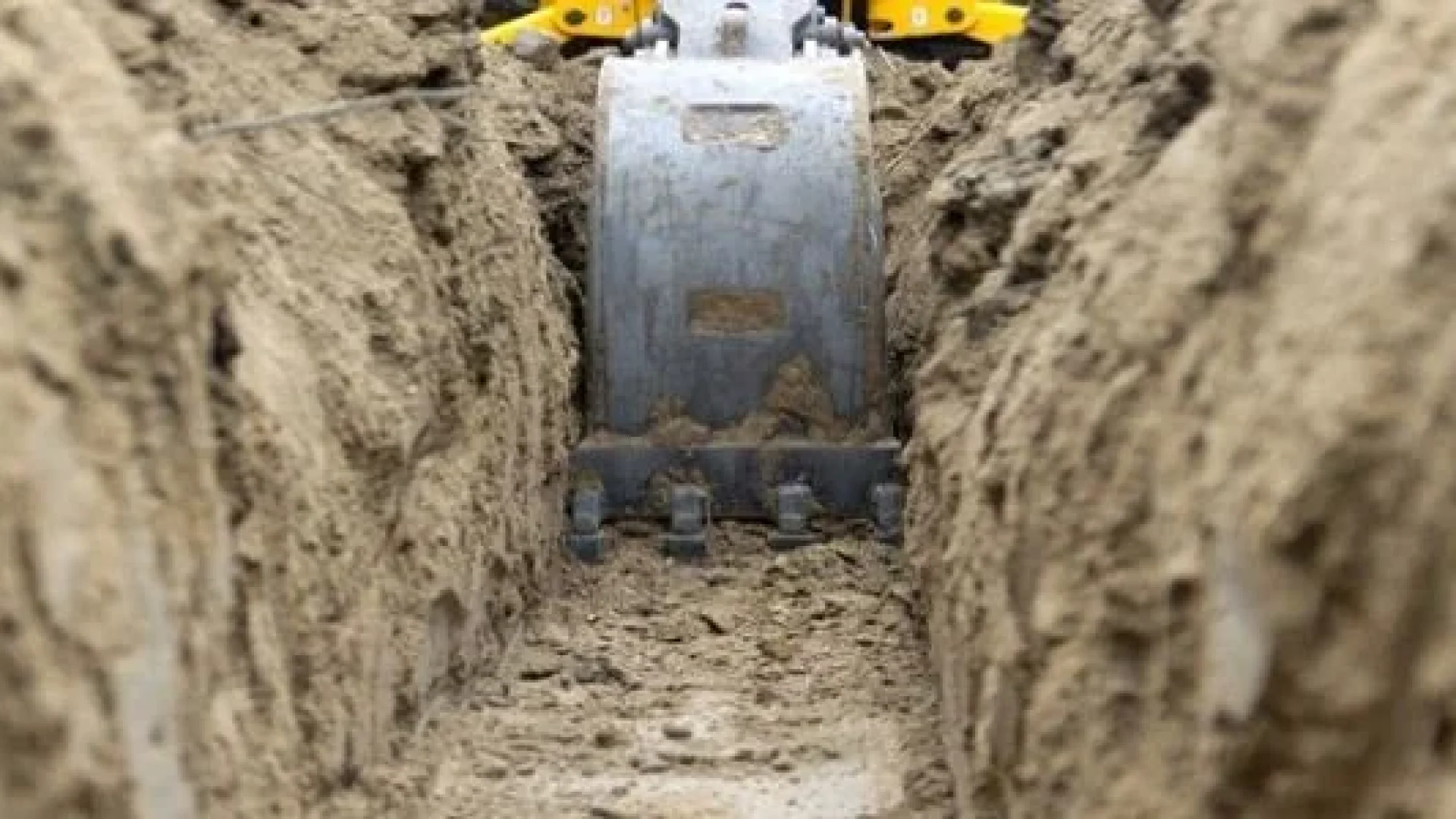
The most expensive thing on a concrete site is rarely the concrete. It is the half-hour when a machine is working next to something nobody marked. A clipped secondary service is a bad afternoon. A clipped gas line is an evacuation, a regulator, and a schedule that belongs to somebody else now.
After 38 years pouring concrete in this city, we have learned that the locate is not paperwork that precedes the real work — it is the first item on the critical path, and it has an expiry date nobody puts in the schedule. What follows is what Alberta’s Occupational Health and Safety Code requires before ground is disturbed, which distances are mandatory rather than advisory, and where the locate calendar sets your pour date.
One point up front, because it catches people on interior work: section 447 covers buried and concrete-embedded facilities. The duty does not switch off because the conduit is in a slab instead of in dirt.
What counts as disturbing the ground, and what the Code leaves out
Almost everything a concrete crew does counts. Part 32 of the OHS Code governs excavating and tunnelling, and section 441 defines “disturbing the ground” along with a short list of what it does not include. Three exclusions matter in practice:
- Routine, minor road maintenance — the Explanation Guide names “patching, street sweeping and the grading of gravel roads.”
- Agricultural cultivation to a depth of less than 450 mm (18 inches) over a pipeline.
- Hand-digging to no more than 300 mm (12 inches), “so long as it does not permanently remove cover over a buried facility.”
Read that last one carefully. The 300 mm allowance is for hand-digging only, and it evaporates the moment the work permanently reduces cover over a facility. The Guide notes that buried facilities “tend to be more than 300 millimetres below the surface” — a statement about where they usually are, not a promise about where yours is.
The practical test: if a machine is involved, you are disturbing the ground, and sections 447 and 448 apply.
The duty in section 447 starts before the machine arrives
Section 447, Locating buried or concrete-embedded facilities, puts four obligations on the employer, in this order.
Advise the owner of the facility. Before the ground is disturbed, the employer must advise the owner of the buried facility of the proposed activities — the owner or their designate, not the one-call centre in their place.
Do not start until it is located and marked. Where the type and location of facilities is not known, the employer must not begin disturbing the ground until they have been identified and their locations marked.
Tell the workers. Once locating is complete, the crew doing the digging has to be informed of what was marked.
Keep the marks alive. Locate marks must be re-established “as often as necessary to ensure the safety of workers.” Paint and flags do not survive two weeks of weather and scraper traffic, and a faded mark is not a mark.
Alberta’s single point of contact for buried facility information is Utility Safety Partners. It is free, and it is a starting point rather than a complete answer: private tanks, private sewer lines and customer-owned services may need a separate locator. On an infill site, the lines outside the one-call system are the ones that hurt you.
The as-built drawing exception has three conditions, and most slab work fails one
There is a narrow alternative to a locate, and it is worth knowing precisely because it is narrow. Under section 447, an employer may rely on as-built drawings instead of a locate where:
- the work involves no excavation or removal of overlying material,
- it penetrates the ground 1 metre or less, and
- the drawings are certified by the owner as the most current drawings of record.
All three, not two of three. “Certified by the owner as the most current drawings of record” is a signature, not a set of prints someone found in a job box.
This exception gets stretched on renovation work — drilling dowels, setting anchors, coring a slab. If you are removing material, you are outside it. The rest of the pre-cut homework is in our guide to cutting openings in an existing concrete slab.
The hand-expose zone is one metre, until a pipeline makes it five
Section 448 governs exposing buried facilities, and this is where the mandatory numbers live.
| Situation | Zone where machines are prohibited | How the facility must be exposed |
|---|---|---|
| General buried facility | 1 m on each side of the locate marks | Hand digging, or a non-destructive technique acceptable to the owner |
| High-pressure pipeline (700 kPa or more) under the Pipeline Act | 5 m — mandatory | Hand exposed; reducing the zone to 1 m requires the owner’s written approval |
| Within 600 mm of an exposed pipeline | Mechanical work permitted only under direct supervision | Dig parallel to the pipeline where possible |
| Electrical cable or conduit | May be mechanically excavated only if grounded and isolated so the disconnection is visible | — |
| Inactive facility | Hand digging avoidable only with the owner’s written approval to remove it | Hand digging still required where residual gas or chemicals may be present |
Four details decide who is right in the argument:
The alternative to hand digging is defined by the owner, not by you. Hydrovac is the usual answer, but the test in the Code is that the technique is acceptable to the owner of the facility. Ask, and keep the answer.
The Guide’s water-jet limits are guidance, not law. Within 1 metre of any cable it recommends limiting water temperature to 38 °C and pressure to 10.3 MPa (1,500 psi), and inspecting exposed cables for damage before backfilling.
An exposed facility has to be protected and supported. A service left spanning an open trench because the crew ran out of day is a finding waiting to be written.
Backfilling is a notification event. Where a pipeline has been exposed, the operator or licensee must be notified before backfilling, and may examine the line and oversee the backfill. That is a hold point — see our pre-backfill inspection list for the rest of what has to be right before the excavator comes back.
Section 448 carries a narrow option for emergency work at subsection (5.1), not a general shortcut.
Pipelines bring a second rulebook, and the OHS Code is not the whole of it
If a pipeline is anywhere near the work, the Pipeline Act and Pipeline Rules apply alongside the OHS Code. The Alberta Energy Regulator’s excavation guidance sets out the parts that surprise builders:
- The controlled area is the land bordering the pipeline for 30 m along each side, measured from the centre of the pipeline — usually wider than the right-of-way itself.
- You need written approval from the pipeline owner before any dig in that area. The industry calls it an encroachment, proximity or crossing agreement depending on who is drafting it.
- Call the pipeline owner at least two full working days before digging so the line can be located and marked.
- Call at least one full working day before covering any exposed pipeline.
- Within 5 m, locate and hand expose the line and request the attendance of the pipeline owner.
- No machinery digs within 60 cm of the pipeline, or at any distance underneath it, without the licensee supervising.
The two-day call to the pipeline owner and the one-call request are different obligations with different clocks. Satisfying one does not satisfy the other.
Section 449 exempts you from the trench rules, not from the locate
This is the misread we see most often. Section 449 provides that where a professional engineer has analyzed the ground formation and certified that it is stable, the workings safe, and that it will remain so throughout the work period, then sections 450 to 459 and 461 to 464 do not apply.
Sections 447 and 448 are not in that list. An engineer’s certificate can change how you protect the walls of an excavation; it cannot excuse locating and hand-exposing what is in the ground. The wall-protection rules themselves — cut-back angles, spoil setbacks, the 3 m threshold for engineered support — sit in the sections the exemption does cover, and we work through them in excavation shoring requirements in Calgary.
The locate calendar is the part that moves your pour date
The provincial damage-prevention guidelines set the process timelines the Code’s duties run on. These are the numbers to build a schedule around:
- Three full working days’ notice before any intended ground disturbance.
- Five full working days where locating is expected to take more than an hour — a large commercial footprint with multiple utilities qualifies far more often than people expect.
- Emergency locate response within 1 hour in urban areas, 2 hours in rural areas.
- A locate is valid for up to 30 calendar days, subject to what the locate report itself states. If the work has not started or finished inside that window, the request has to be refreshed.
That 30-day validity is where concrete schedules get hurt. Locate on the Monday you win the job, lose three weeks to a development permit or a weather delay, and the locate that cost you nothing has expired — along with the marks and the defence that goes with them. Re-requesting is free; standing a crew and a pump down for three days is not. Where the tear-out comes first, the same clock applies to demolition, which we cost out in concrete removal and disposal in Calgary.
Who owns the duty when four trades are in the same hole
The Code puts the locating and exposing duties on the employer, and on a site with a prime contractor that contractor is also responsible for every worker on it. You cannot subcontract the exposure away: if your excavator digs on a stale locate and your crew is in the hole, it is an incident on your site with your name on the file. That allocation is the point of the designation, which we cover in prime contractor requirements in Alberta.
Where this article stops
This article covers sections 441, 447, 448 and 449 — identifying, locating and exposing facilities, plus the pipeline rules on top. It does not cover wall protection, cut-back angles, spoil piles or temporary protective structures (sections 450 to 459), tunnelling or shafts (sections 461 to 464), or Calgary’s permit requirements for working in a road right-of-way.
Frequently asked questions
What counts as ground disturbance in Alberta? Any work that disturbs the earth. Section 441 excludes routine minor road maintenance, cultivation to less than 450 mm over a pipeline, and hand-digging to no more than 300 mm that does not permanently remove cover over a buried facility.
How far back from a marked line do machines have to stay? One metre each side of the locate marks. For a pipeline of 700 kPa or more under the Pipeline Act the zone is 5 metres, reducible to 1 metre only with the owner’s written approval.
How long is a locate good for in Alberta? Up to 30 calendar days, subject to the validity stated on the locate report. If work has not started or finished in that window, the request must be refreshed.
How much notice does a locate request need? Three full working days, and five where locating is expected to take more than an hour.
Can I use as-built drawings instead of a locate? Only where the work involves no excavation or removal of overlying material, penetrates 1 metre or less, and the drawings are certified by the owner as the most current drawings of record.
Does an engineer’s certificate remove the need to locate? No. The section 449 exemption covers sections 450 to 459 and 461 to 464. The duties under sections 447 and 448 remain.
Do these rules apply to coring a slab? Yes. Section 447 covers concrete-embedded facilities, so conduit and services inside a slab have to be identified before the core barrel goes in.
Talk to us before the locate expires
A locate that is technically obtained and practically useless by the time the machine arrives is the most common version of this problem, and it has cost builders more standby time across 52,000+ projects than any genuine surprise in the ground. The fix is a date in the schedule, not a form in a binder.
If you have slab penetrations, coring or saw-cutting coming up and want the embedded-services question answered before the blade is on site, talk to our team about concrete cutting and coring in Calgary. We will tell you what has to be located, who has to sign, and what it does to your sequence.
Sources
- Government of Alberta, Occupational Health and Safety Code 2009 Explanation Guide, Part 32: Excavating and Tunnelling — open.alberta.ca
- Government of Alberta, Occupational Health and Safety Code, Part 32 — Excavating and Tunnelling (section index) — search-ohs-laws.alberta.ca
- Utility Safety Partners, The Damage Prevention Process in Alberta, version 6.4 — utilitysafety.ca
- Alberta Energy Regulator, Safe Excavation Near Pipelines — static.aer.ca